
Dog breed library
Filters
Breed group
Size of dog
Coat length
Grooming required
Size of home required
Size of garden required
Affenpinscher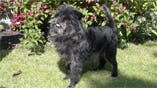 This little terrier type dog has a distinctive look giving rise to the name "Monkey Dog". They are very affectionate but have a mischievous and playful side to their personality too.
Small with a shaggy wiry coat, the hair on the face is longer than on the body and the head is round with a pronounced 'stop'. They can come in a variety of colours but are often black or dark grey. They originate in Germany and are thought to have originally been larger in size and bred for ratting but has been miniaturised to add to its appeal as a pet. They are sharp, lively and stubborn, constantly active and are good guard dogs.
They generally like people but need constant firm guidance. Fearless little dogs, they are inclined to challenge other animals, whatever their size, so that needs to be trained out when they are young.
Although they enjoy a long walk, they are so busy indoors that they give themselves plenty of exercise. However they do need to experience outdoors too for mental stimulation.
The wiry coat doesn't need too much grooming but will need stripping as well as occasional brushing and combing. Their short nose inclines them to breathing problems, especially in hot weather and they can be prone to bone fractures.
This little terrier type dog has a distinctive look giving rise to the name "Monkey Dog". They are very affectionate but have a mischievous and playful side to their personality too.
Small with a shaggy wiry coat, the hair on the face is longer than on the body and the head is round with a pronounced 'stop'. They can come in a variety of colours but are often black or dark grey. They originate in Germany and are thought to have originally been larger in size and bred for ratting but has been miniaturised to add to its appeal as a pet. They are sharp, lively and stubborn, constantly active and are good guard dogs.
They generally like people but need constant firm guidance. Fearless little dogs, they are inclined to challenge other animals, whatever their size, so that needs to be trained out when they are young.
Although they enjoy a long walk, they are so busy indoors that they give themselves plenty of exercise. However they do need to experience outdoors too for mental stimulation.
The wiry coat doesn't need too much grooming but will need stripping as well as occasional brushing and combing. Their short nose inclines them to breathing problems, especially in hot weather and they can be prone to bone fractures.
This little terrier type dog has a distinctive look giving rise to the name "Monkey Dog". They are very affectionate but have a mischievous and playful side to their personality too.
Small with a shaggy wiry coat, the hair on the face is longer than on the body and the head is round with a pronounced 'stop'. They can come in a variety of colours but are often black or dark grey. They originate in Germany and are thought to have originally been larger in size and bred for ratting but has been miniaturised to add to its appeal as a pet. They are sharp, lively and stubborn, constantly active and are good guard dogs.
They generally like people but need constant firm guidance. Fearless little dogs, they are inclined to challenge other animals, whatever their size, so that needs to be trained out when they are young.
Although they enjoy a long walk, they are so busy indoors that they give themselves plenty of exercise. However they do need to experience outdoors too for mental stimulation.
The wiry coat doesn't need too much grooming but will need stripping as well as occasional brushing and combing. Their short nose inclines them to breathing problems, especially in hot weather and they can be prone to bone fractures.Afghan Hound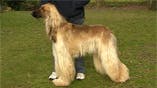 The elegant afghan may have a tendency to look rather aloof, and in fact, the breed standard says that they are meant to look "at one and through one".
Afghans come in many colours with a long nose and an athletic build under a long, silky coat. They also have a saddle area of close coat. The build is similar to that of a Greyhound but they are more angulated.
Originally bred by tribes in Afghanistan for hunting, they are rather independent so not generally known for a high level of obedience. With a generally steady temperament, they don't bark overly but can be known to howl. Afghans can be aloof with strangers at first but can be won over. They tend to get on well with other dogs but their hunting instincts make them inclined to chase wildlife.
Afghans love to run and people often race them. As a result, they need a lot of exercise. Free running is ideal but they're also good escape artists so gardens have to be secure.
Their coat needs a lot of upkeep so thorough, regular grooming is essential. Moulting isn't excessive although the bitches tend to lose a lot of coat during their seasons.
The Afghan has changed little over the years so the breed remains strong and healthy. They're not prone to any particular health problems so are not routinely screened for anything.
The elegant afghan may have a tendency to look rather aloof, and in fact, the breed standard says that they are meant to look "at one and through one".
Afghans come in many colours with a long nose and an athletic build under a long, silky coat. They also have a saddle area of close coat. The build is similar to that of a Greyhound but they are more angulated.
Originally bred by tribes in Afghanistan for hunting, they are rather independent so not generally known for a high level of obedience. With a generally steady temperament, they don't bark overly but can be known to howl. Afghans can be aloof with strangers at first but can be won over. They tend to get on well with other dogs but their hunting instincts make them inclined to chase wildlife.
Afghans love to run and people often race them. As a result, they need a lot of exercise. Free running is ideal but they're also good escape artists so gardens have to be secure.
Their coat needs a lot of upkeep so thorough, regular grooming is essential. Moulting isn't excessive although the bitches tend to lose a lot of coat during their seasons.
The Afghan has changed little over the years so the breed remains strong and healthy. They're not prone to any particular health problems so are not routinely screened for anything.
The elegant afghan may have a tendency to look rather aloof, and in fact, the breed standard says that they are meant to look "at one and through one".
Afghans come in many colours with a long nose and an athletic build under a long, silky coat. They also have a saddle area of close coat. The build is similar to that of a Greyhound but they are more angulated.
Originally bred by tribes in Afghanistan for hunting, they are rather independent so not generally known for a high level of obedience. With a generally steady temperament, they don't bark overly but can be known to howl. Afghans can be aloof with strangers at first but can be won over. They tend to get on well with other dogs but their hunting instincts make them inclined to chase wildlife.
Afghans love to run and people often race them. As a result, they need a lot of exercise. Free running is ideal but they're also good escape artists so gardens have to be secure.
Their coat needs a lot of upkeep so thorough, regular grooming is essential. Moulting isn't excessive although the bitches tend to lose a lot of coat during their seasons.
The Afghan has changed little over the years so the breed remains strong and healthy. They're not prone to any particular health problems so are not routinely screened for anything.Airedale Terrier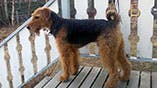 The Airedale is known as the King of Terriers and is the largest of the Terrier breeds. They're very loyal and protective without being aggressive.
The Airedale is very rectangular in shape. The long head is rectangular too with small triangular ears that flop forward. Their wiry coat is very hard and dense. In colour, they are generally black, tan and grizzle.
The Airedale comes from Yorkshire in England and was bred from a mixture of other terriers, primarily as a small game hunter. They have an excellent sense of smell and are often used for tracking so have also worked with the army and police.
They are an intelligent dog and can be trained to high levels of obedience but are inclined to bore easily and need firm, reward-based training.
They are very loyal and are generally good with strangers and children although they need firm training to not jump up. They can be trained to get on well with household pets but their natural tendency is to chase small wildlife.
They need a good amount of exercise and often enjoy playing with toys and swimming. The double coat helps with this as it is waterproof. The wiry coat is very hard and dense and will need plucking at least twice a year, more if being shown.
They are generally very healthy although can suffer from eye and hip problems and dry skin.
The Airedale is known as the King of Terriers and is the largest of the Terrier breeds. They're very loyal and protective without being aggressive.
The Airedale is very rectangular in shape. The long head is rectangular too with small triangular ears that flop forward. Their wiry coat is very hard and dense. In colour, they are generally black, tan and grizzle.
The Airedale comes from Yorkshire in England and was bred from a mixture of other terriers, primarily as a small game hunter. They have an excellent sense of smell and are often used for tracking so have also worked with the army and police.
They are an intelligent dog and can be trained to high levels of obedience but are inclined to bore easily and need firm, reward-based training.
They are very loyal and are generally good with strangers and children although they need firm training to not jump up. They can be trained to get on well with household pets but their natural tendency is to chase small wildlife.
They need a good amount of exercise and often enjoy playing with toys and swimming. The double coat helps with this as it is waterproof. The wiry coat is very hard and dense and will need plucking at least twice a year, more if being shown.
They are generally very healthy although can suffer from eye and hip problems and dry skin.
The Airedale is known as the King of Terriers and is the largest of the Terrier breeds. They're very loyal and protective without being aggressive.
The Airedale is very rectangular in shape. The long head is rectangular too with small triangular ears that flop forward. Their wiry coat is very hard and dense. In colour, they are generally black, tan and grizzle.
The Airedale comes from Yorkshire in England and was bred from a mixture of other terriers, primarily as a small game hunter. They have an excellent sense of smell and are often used for tracking so have also worked with the army and police.
They are an intelligent dog and can be trained to high levels of obedience but are inclined to bore easily and need firm, reward-based training.
They are very loyal and are generally good with strangers and children although they need firm training to not jump up. They can be trained to get on well with household pets but their natural tendency is to chase small wildlife.
They need a good amount of exercise and often enjoy playing with toys and swimming. The double coat helps with this as it is waterproof. The wiry coat is very hard and dense and will need plucking at least twice a year, more if being shown.
They are generally very healthy although can suffer from eye and hip problems and dry skin.Akita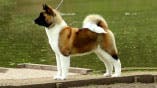 Akitas seldom bark but can make a range of other unusual noises. These are a large, broad and powerful dog but with a well balanced body. The head is triangular when seen from above and the upright ears seem a little too small for it. Their fluffy tail curls up and over their body. They have a very thick but quite short double coat and can come in any colour.
The Akita was originally bred in Japan for fighting but has since been steered towards guarding and hunting. After the second world war, some larger versions of the Japanese Akita, favoured by the US troops, were taken back to America and these are what are known as Akitas today. The slightly smaller Akitas, more typical of the original Japanese ones are known as Japanese Akita Inus.
They are an excellent guard dog, affectionate, very brave and loyal to their owners. They have a tendency to be aggressive to people outside the family so need firm training. They tend to be intolerant to other animals and other dogs. They need regular mental and physical exercise but not excessive amounts of physical activity.
They need a good deal of brushing and will shed heavily at certain times of the year. They should only be bathed when necessary as this removes the coat's natural waterproofing. They can be prone to a number of problems, with hips, thyroid, skin, eyes, immune diseases and knee problems.
Akitas seldom bark but can make a range of other unusual noises. These are a large, broad and powerful dog but with a well balanced body. The head is triangular when seen from above and the upright ears seem a little too small for it. Their fluffy tail curls up and over their body. They have a very thick but quite short double coat and can come in any colour.
The Akita was originally bred in Japan for fighting but has since been steered towards guarding and hunting. After the second world war, some larger versions of the Japanese Akita, favoured by the US troops, were taken back to America and these are what are known as Akitas today. The slightly smaller Akitas, more typical of the original Japanese ones are known as Japanese Akita Inus.
They are an excellent guard dog, affectionate, very brave and loyal to their owners. They have a tendency to be aggressive to people outside the family so need firm training. They tend to be intolerant to other animals and other dogs. They need regular mental and physical exercise but not excessive amounts of physical activity.
They need a good deal of brushing and will shed heavily at certain times of the year. They should only be bathed when necessary as this removes the coat's natural waterproofing. They can be prone to a number of problems, with hips, thyroid, skin, eyes, immune diseases and knee problems.
Akitas seldom bark but can make a range of other unusual noises. These are a large, broad and powerful dog but with a well balanced body. The head is triangular when seen from above and the upright ears seem a little too small for it. Their fluffy tail curls up and over their body. They have a very thick but quite short double coat and can come in any colour.
The Akita was originally bred in Japan for fighting but has since been steered towards guarding and hunting. After the second world war, some larger versions of the Japanese Akita, favoured by the US troops, were taken back to America and these are what are known as Akitas today. The slightly smaller Akitas, more typical of the original Japanese ones are known as Japanese Akita Inus.
They are an excellent guard dog, affectionate, very brave and loyal to their owners. They have a tendency to be aggressive to people outside the family so need firm training. They tend to be intolerant to other animals and other dogs. They need regular mental and physical exercise but not excessive amounts of physical activity.
They need a good deal of brushing and will shed heavily at certain times of the year. They should only be bathed when necessary as this removes the coat's natural waterproofing. They can be prone to a number of problems, with hips, thyroid, skin, eyes, immune diseases and knee problems.Alaskan Malamute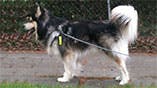 The loving and loyal Malamute, with its wolf-like howl, is happiest outdoors with his human family.
The substantial but wolf-like Malamute is the largest of the Arctic dogs. They come in a variety of colours and have a double coat: a thick, coarse outer coat and woolly undercoat. They also have large feet with tough pads to cope with harsh snowy conditions.
They were bred by the Malhemut tribe in Alaska to pull sleds. As a result, Malamutes are strong and have a keen sense of smell and direction. They need plenty of mental stimulation as they have a tendency to be quite destructive if bored. They much prefer to be outside but need a secure garden as they love to dig.
They get on very well with people and can be trained to get on with household pets but do have a strong prey instinct.
They need plenty of exercise but have to be careful in hot conditions because of their thick coat which needs regular brushing and they moult heavily at certain times. They are prone to bloat, hip dysplasia and dwarfism.
The loving and loyal Malamute, with its wolf-like howl, is happiest outdoors with his human family.
The substantial but wolf-like Malamute is the largest of the Arctic dogs. They come in a variety of colours and have a double coat: a thick, coarse outer coat and woolly undercoat. They also have large feet with tough pads to cope with harsh snowy conditions.
They were bred by the Malhemut tribe in Alaska to pull sleds. As a result, Malamutes are strong and have a keen sense of smell and direction. They need plenty of mental stimulation as they have a tendency to be quite destructive if bored. They much prefer to be outside but need a secure garden as they love to dig.
They get on very well with people and can be trained to get on with household pets but do have a strong prey instinct.
They need plenty of exercise but have to be careful in hot conditions because of their thick coat which needs regular brushing and they moult heavily at certain times. They are prone to bloat, hip dysplasia and dwarfism.
The loving and loyal Malamute, with its wolf-like howl, is happiest outdoors with his human family.
The substantial but wolf-like Malamute is the largest of the Arctic dogs. They come in a variety of colours and have a double coat: a thick, coarse outer coat and woolly undercoat. They also have large feet with tough pads to cope with harsh snowy conditions.
They were bred by the Malhemut tribe in Alaska to pull sleds. As a result, Malamutes are strong and have a keen sense of smell and direction. They need plenty of mental stimulation as they have a tendency to be quite destructive if bored. They much prefer to be outside but need a secure garden as they love to dig.
They get on very well with people and can be trained to get on with household pets but do have a strong prey instinct.
They need plenty of exercise but have to be careful in hot conditions because of their thick coat which needs regular brushing and they moult heavily at certain times. They are prone to bloat, hip dysplasia and dwarfism.Anatolian Shepherd Dog This powerful guard dog, with its acute hearing and sight, remains alert at all times ready to warn you of any danger.
The Anatolian Shepherd Dog is large, Mastiff-type, muscular and powerful with a medium coat. They can come in a variety of colours but are usually fawn with a black muzzle.
They hail from Turkey and were bred to guard flocks of sheep. They were even used in combat. They are suited to living outdoors with a coat that can withstand extremes of heat and cold.
They need very firm but fair guidance. They have a strong protective urge towards their family so need to be trained to accept strangers. They need regular outdoor exercise and will remain active for most of their long lives.
The coat needs little grooming but will shed heavily at times.
They are prone to thyroid and eyelid problems. They are also sensitive to anaesthetics. As puppies, their immune system is slow to develop so may need boosters over a longer period.
This powerful guard dog, with its acute hearing and sight, remains alert at all times ready to warn you of any danger.
The Anatolian Shepherd Dog is large, Mastiff-type, muscular and powerful with a medium coat. They can come in a variety of colours but are usually fawn with a black muzzle.
They hail from Turkey and were bred to guard flocks of sheep. They were even used in combat. They are suited to living outdoors with a coat that can withstand extremes of heat and cold.
They need very firm but fair guidance. They have a strong protective urge towards their family so need to be trained to accept strangers. They need regular outdoor exercise and will remain active for most of their long lives.
The coat needs little grooming but will shed heavily at times.
They are prone to thyroid and eyelid problems. They are also sensitive to anaesthetics. As puppies, their immune system is slow to develop so may need boosters over a longer period.
This powerful guard dog, with its acute hearing and sight, remains alert at all times ready to warn you of any danger.
The Anatolian Shepherd Dog is large, Mastiff-type, muscular and powerful with a medium coat. They can come in a variety of colours but are usually fawn with a black muzzle.
They hail from Turkey and were bred to guard flocks of sheep. They were even used in combat. They are suited to living outdoors with a coat that can withstand extremes of heat and cold.
They need very firm but fair guidance. They have a strong protective urge towards their family so need to be trained to accept strangers. They need regular outdoor exercise and will remain active for most of their long lives.
The coat needs little grooming but will shed heavily at times.
They are prone to thyroid and eyelid problems. They are also sensitive to anaesthetics. As puppies, their immune system is slow to develop so may need boosters over a longer period.Australian Cattle Dog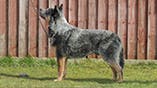 The Australian Cattle Dog, also known as the Australian Heeler, is very intelligent and has bags of energy so is good not only at herding cattle but at keeping people on their toes.
This medium dog is compact and muscular but agile too. They are smooth coated but have a short, dense undercoat. They can come in a variety of colours.
The Australian Cattle Dog comes from a mixture of other dogs with a strong herding and protecting instinct and the ability to withstand the harsh weather conditions and long distances of Australia. They can perform to high levels of agility and obedience but bore easily if not challenged. They are not only naturally hard-working but love to work. They are naturally protective so automatically suspicious of people and animals they don't know.
They have great stamina and energy and need plenty of exercise. The coat can withstand weather well, needs little care and is easy to groom.
They are prone to hip dysplasia and PRA and the merle colours are prone to deafness.
The Australian Cattle Dog, also known as the Australian Heeler, is very intelligent and has bags of energy so is good not only at herding cattle but at keeping people on their toes.
This medium dog is compact and muscular but agile too. They are smooth coated but have a short, dense undercoat. They can come in a variety of colours.
The Australian Cattle Dog comes from a mixture of other dogs with a strong herding and protecting instinct and the ability to withstand the harsh weather conditions and long distances of Australia. They can perform to high levels of agility and obedience but bore easily if not challenged. They are not only naturally hard-working but love to work. They are naturally protective so automatically suspicious of people and animals they don't know.
They have great stamina and energy and need plenty of exercise. The coat can withstand weather well, needs little care and is easy to groom.
They are prone to hip dysplasia and PRA and the merle colours are prone to deafness.
The Australian Cattle Dog, also known as the Australian Heeler, is very intelligent and has bags of energy so is good not only at herding cattle but at keeping people on their toes.
This medium dog is compact and muscular but agile too. They are smooth coated but have a short, dense undercoat. They can come in a variety of colours.
The Australian Cattle Dog comes from a mixture of other dogs with a strong herding and protecting instinct and the ability to withstand the harsh weather conditions and long distances of Australia. They can perform to high levels of agility and obedience but bore easily if not challenged. They are not only naturally hard-working but love to work. They are naturally protective so automatically suspicious of people and animals they don't know.
They have great stamina and energy and need plenty of exercise. The coat can withstand weather well, needs little care and is easy to groom.
They are prone to hip dysplasia and PRA and the merle colours are prone to deafness.Australian Shepherd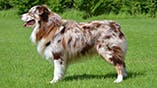 The powerful but playful Australian Shepherd is loving, attentive, smart and eager to please.
The "Aussie" is a well balanced, medium sized dog with a tail that is often naturally bobbed. They have a straight to wavy medium-length coat that comes in a variety of colours. The coat is resistant to the weather and varies with the climate.
Although the name suggests its origins are in Australia, it actually originates from the Pyrenees and was refined in the US to herd on ranches.
They are highly intelligent and easy to train and are capable of high performances in obedience, agility and in a working environment.
They are normally good with adults and children, they are usually good with other dogs but won't take nonsense from the animals they herd. They need a lot of exercise for both body and mind.
Their coat is easy to maintain with occasional brushing and they don't moult very much.
The merle coloured dogs might have sight/hearing problems and interbreeding natural bob tails sometimes leads to spinal problems. Other major concerns are cataracts and CEA.
The powerful but playful Australian Shepherd is loving, attentive, smart and eager to please.
The "Aussie" is a well balanced, medium sized dog with a tail that is often naturally bobbed. They have a straight to wavy medium-length coat that comes in a variety of colours. The coat is resistant to the weather and varies with the climate.
Although the name suggests its origins are in Australia, it actually originates from the Pyrenees and was refined in the US to herd on ranches.
They are highly intelligent and easy to train and are capable of high performances in obedience, agility and in a working environment.
They are normally good with adults and children, they are usually good with other dogs but won't take nonsense from the animals they herd. They need a lot of exercise for both body and mind.
Their coat is easy to maintain with occasional brushing and they don't moult very much.
The merle coloured dogs might have sight/hearing problems and interbreeding natural bob tails sometimes leads to spinal problems. Other major concerns are cataracts and CEA.
The powerful but playful Australian Shepherd is loving, attentive, smart and eager to please.
The "Aussie" is a well balanced, medium sized dog with a tail that is often naturally bobbed. They have a straight to wavy medium-length coat that comes in a variety of colours. The coat is resistant to the weather and varies with the climate.
Although the name suggests its origins are in Australia, it actually originates from the Pyrenees and was refined in the US to herd on ranches.
They are highly intelligent and easy to train and are capable of high performances in obedience, agility and in a working environment.
They are normally good with adults and children, they are usually good with other dogs but won't take nonsense from the animals they herd. They need a lot of exercise for both body and mind.
Their coat is easy to maintain with occasional brushing and they don't moult very much.
The merle coloured dogs might have sight/hearing problems and interbreeding natural bob tails sometimes leads to spinal problems. Other major concerns are cataracts and CEA.Australian Silky TerrierThis courageous little terrier is intelligent and sociable.
The little Silky Terrier is slightly longer than it is tall, with a long silky coat, parted down the middle of the back in shades of tan, black and blue.
They were bred from combining the Yorkshire and Australian Terriers largely as companion dogs but are naturally good at catching small rodents.
Although he is friendly, he is also self-sufficient and full of curiosity. Generally good with people, they have a tendency to chase small wildlife. They have great stamina and are full of energy and will need to go for regular walks as well as the exercise they give themselves by running around at home.
The silky coat is fine to maintain if it is combed daily. If left, it will tangle and matt easily.
They are a generally healthy little dog.
This courageous little terrier is intelligent and sociable.
The little Silky Terrier is slightly longer than it is tall, with a long silky coat, parted down the middle of the back in shades of tan, black and blue.
They were bred from combining the Yorkshire and Australian Terriers largely as companion dogs but are naturally good at catching small rodents.
Although he is friendly, he is also self-sufficient and full of curiosity. Generally good with people, they have a tendency to chase small wildlife. They have great stamina and are full of energy and will need to go for regular walks as well as the exercise they give themselves by running around at home.
The silky coat is fine to maintain if it is combed daily. If left, it will tangle and matt easily.
They are a generally healthy little dog.Australian Terrier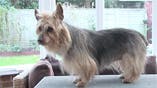 "Aussies" are people oriented little dogs, loyal to every member of the family. They are busy, nosey and active.
A low slung dog, they are quite long but in proportion with a long neck, erect ears, 'top knot', rough, cat-like paws and a tail that goes up and over. Colours include blue and tan or red. The reds can be either sandy or a deeper red.
Bred for guarding in coal mines in Australia, ratting and catching snakes and trained to warn of danger, they are inclined to be noisy and they tend to attack hoses. They are very food oriented and known to be good at obedience. Usually good with children and generally good with other dogs, but they will chase wildlife. Although lively, agile and excellent at jumping, Australian Terriers can take a little or a lot of exercise.
They don't moult but do need grooming and the coat needs stripping. They are a generally strong and healthy dog and are not routinely screened for any health problems.
"Aussies" are people oriented little dogs, loyal to every member of the family. They are busy, nosey and active.
A low slung dog, they are quite long but in proportion with a long neck, erect ears, 'top knot', rough, cat-like paws and a tail that goes up and over. Colours include blue and tan or red. The reds can be either sandy or a deeper red.
Bred for guarding in coal mines in Australia, ratting and catching snakes and trained to warn of danger, they are inclined to be noisy and they tend to attack hoses. They are very food oriented and known to be good at obedience. Usually good with children and generally good with other dogs, but they will chase wildlife. Although lively, agile and excellent at jumping, Australian Terriers can take a little or a lot of exercise.
They don't moult but do need grooming and the coat needs stripping. They are a generally strong and healthy dog and are not routinely screened for any health problems.
"Aussies" are people oriented little dogs, loyal to every member of the family. They are busy, nosey and active.
A low slung dog, they are quite long but in proportion with a long neck, erect ears, 'top knot', rough, cat-like paws and a tail that goes up and over. Colours include blue and tan or red. The reds can be either sandy or a deeper red.
Bred for guarding in coal mines in Australia, ratting and catching snakes and trained to warn of danger, they are inclined to be noisy and they tend to attack hoses. They are very food oriented and known to be good at obedience. Usually good with children and generally good with other dogs, but they will chase wildlife. Although lively, agile and excellent at jumping, Australian Terriers can take a little or a lot of exercise.
They don't moult but do need grooming and the coat needs stripping. They are a generally strong and healthy dog and are not routinely screened for any health problems.AzawakhElegant Azawakhs are not just an alert and loyal hunter and protector but something to show off with pride.
The Azawakh is a sighthound, rather Saluki-like in build although with a small head and an impression of fineness with very taught skin. The hair is very short and non-existent on the belly. Their coat is fawn with a white chest, white feet and a white-tipped tail.
Originally bred in the Sahel region of Africa to guard, hunt and act as companions, they take their name from the Azawakh Valley. They tend to hunt and guard in packs.
Naturally attuned to anything that may mean danger, they are ultra sensitive. Attentive, alert but gentle with his owner, Azawakhs are wary of those they don't know. They are used to working as a team with other dogs but will guard against other animals.
They need plenty of outdoor exercise as they tend to lounge indoors. As their build suggests, they are capable of great speeds.
The short coat is easy to maintain with the occasional brush and they don't moult excessively. Their thin skin and short hair makes them prone to cold so they need a coat in winter.
Elegant Azawakhs are not just an alert and loyal hunter and protector but something to show off with pride.
The Azawakh is a sighthound, rather Saluki-like in build although with a small head and an impression of fineness with very taught skin. The hair is very short and non-existent on the belly. Their coat is fawn with a white chest, white feet and a white-tipped tail.
Originally bred in the Sahel region of Africa to guard, hunt and act as companions, they take their name from the Azawakh Valley. They tend to hunt and guard in packs.
Naturally attuned to anything that may mean danger, they are ultra sensitive. Attentive, alert but gentle with his owner, Azawakhs are wary of those they don't know. They are used to working as a team with other dogs but will guard against other animals.
They need plenty of outdoor exercise as they tend to lounge indoors. As their build suggests, they are capable of great speeds.
The short coat is easy to maintain with the occasional brush and they don't moult excessively. Their thin skin and short hair makes them prone to cold so they need a coat in winter.BarbetThe Barbet is a very versatile French water dog, able to turn it's paw to gundog work, agility, therapy work, truffling, showing and more.
The name is pronounced 'bar bay' with an ending similar to 'ballet'. It is a medium / large dog with a thick curly coat with a distinctive 'beard' (barbe is the french word for beard). They come in black, solid brown or either colour mixed with white.
Barbet's intelligence and their attachment to their owners mean they dislike being left alone for too long, but they are even tempered and generally not aggressive or shy with either people or dogs.
They have a non moulting coat so are good for allergy sufferers, although they do tend to have a love of water so still need time to keep the coat clean!
They are generally very healthy and do not suffer any prevalent inherited conditions.
The Barbet is a very versatile French water dog, able to turn it's paw to gundog work, agility, therapy work, truffling, showing and more.
The name is pronounced 'bar bay' with an ending similar to 'ballet'. It is a medium / large dog with a thick curly coat with a distinctive 'beard' (barbe is the french word for beard). They come in black, solid brown or either colour mixed with white.
Barbet's intelligence and their attachment to their owners mean they dislike being left alone for too long, but they are even tempered and generally not aggressive or shy with either people or dogs.
They have a non moulting coat so are good for allergy sufferers, although they do tend to have a love of water so still need time to keep the coat clean!
They are generally very healthy and do not suffer any prevalent inherited conditions.BasenjiThe Basenji, famously, does not bark but does make a variety of other sounds including a kind of dog-yodel. They also clean themselves like a cat.
The Basenji is a small, muscular dog with a short, shiny coat that comes in a variety of colours. There are white markings on the feet, chest and tip of the tail too. They also have a long tail that curls over to one side of the back. Their foreheads are wrinkled giving them a slightly puzzled expression.
In Africa, Basenjis were used to warn of danger and to help with hunting but images of Basenji-like dogs have been found in Egyptian tombs.
Basenjis are alert, playful and respond well to training. They also love to chew so giving them their own chew toys is wise. They form a bond with their owner but are wary of strangers. They may respond well to other dogs and often enjoy living with other Basenjis but they might not be trustworthy around non-canines.
They have plenty of energy and will be active around the house as well as enjoying exercise outdoors. Because the breed washes itself like a cat, little grooming is needed, they tend to be odourless and they shed very little hair.
They are prone to kidney problems.
The Basenji, famously, does not bark but does make a variety of other sounds including a kind of dog-yodel. They also clean themselves like a cat.
The Basenji is a small, muscular dog with a short, shiny coat that comes in a variety of colours. There are white markings on the feet, chest and tip of the tail too. They also have a long tail that curls over to one side of the back. Their foreheads are wrinkled giving them a slightly puzzled expression.
In Africa, Basenjis were used to warn of danger and to help with hunting but images of Basenji-like dogs have been found in Egyptian tombs.
Basenjis are alert, playful and respond well to training. They also love to chew so giving them their own chew toys is wise. They form a bond with their owner but are wary of strangers. They may respond well to other dogs and often enjoy living with other Basenjis but they might not be trustworthy around non-canines.
They have plenty of energy and will be active around the house as well as enjoying exercise outdoors. Because the breed washes itself like a cat, little grooming is needed, they tend to be odourless and they shed very little hair.
They are prone to kidney problems.Basset Bleu De GascogneThese interesting little dogs nearly became extinct in the 19th Century but were rescued due to the interest of a French enthusiast named Alain Bourbon.
The Basset Bleu De Gascogne is a short-legged ("Basset" means "short-legged"), long-backed hound. It has long, floppy ears and a smooth coat which is white with "ticking" to give the blue appearance.
Their origin is a little unclear but it is known that they were used in France at the time of the French Revolution for hunting on foot - their shape prevents them from moving too quickly.
They are trainable, but like all hounds, may become selectively 'deaf' when they catch an interesting scent. They are stable and friendly around people but their natural tendency is to chase wildlife. They enjoy regular exercise and have good stamina for long walks.
Their short coat is easy to maintain with the occasional brush. They are a generally healthy dog although food allergies have been reported and occasional gastric problems.
These interesting little dogs nearly became extinct in the 19th Century but were rescued due to the interest of a French enthusiast named Alain Bourbon.
The Basset Bleu De Gascogne is a short-legged ("Basset" means "short-legged"), long-backed hound. It has long, floppy ears and a smooth coat which is white with "ticking" to give the blue appearance.
Their origin is a little unclear but it is known that they were used in France at the time of the French Revolution for hunting on foot - their shape prevents them from moving too quickly.
They are trainable, but like all hounds, may become selectively 'deaf' when they catch an interesting scent. They are stable and friendly around people but their natural tendency is to chase wildlife. They enjoy regular exercise and have good stamina for long walks.
Their short coat is easy to maintain with the occasional brush. They are a generally healthy dog although food allergies have been reported and occasional gastric problems.Basset Fauve De BretagneThe Basset Fauve De Bretagne is a sound, busy, happy little dog that makes a good family pet.
They are small and neat, and as the name implies, short legged, but their legs are slightly longer than other similar types. In addition they have a very wiry, harsh coat, red or wheaten in colour, with darker shaded ears.
They were bred in France for hunting and are naturally good at scent work. In 2004, a Kennel Club survey found that one of the most common causes of death was road traffic accidents, possibly due to the fact that once they get a scent for an animal it will often override training.
They are loving towards people and good with children. They are good at co-operating with other dogs, they enjoy regular exercise, have good stamina for long walks and can give rabbits a run for their money.
The wiry coat needs stripping two or three times a year to keep it in condition appropriate to the breed but occasional brushing the rest of the time is sufficient. No hereditary problems have been found in the UK but there have been some instances of epilepsy in Europe.
The Basset Fauve De Bretagne is a sound, busy, happy little dog that makes a good family pet.
They are small and neat, and as the name implies, short legged, but their legs are slightly longer than other similar types. In addition they have a very wiry, harsh coat, red or wheaten in colour, with darker shaded ears.
They were bred in France for hunting and are naturally good at scent work. In 2004, a Kennel Club survey found that one of the most common causes of death was road traffic accidents, possibly due to the fact that once they get a scent for an animal it will often override training.
They are loving towards people and good with children. They are good at co-operating with other dogs, they enjoy regular exercise, have good stamina for long walks and can give rabbits a run for their money.
The wiry coat needs stripping two or three times a year to keep it in condition appropriate to the breed but occasional brushing the rest of the time is sufficient. No hereditary problems have been found in the UK but there have been some instances of epilepsy in Europe.Basset Griffon Vendeen (Grand)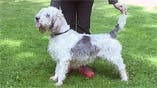 The Basset Griffon Vendeen (Grand) loves human company and is fun to have around. The name is sometimes shortened to GBGV.
The name describes the dog perfectly: Basset (shortened leg), Griffon (wiry-coated), Vendeen (from the Vendee region in France), Grand (larger of the two breeds, standing about two inches taller at the shoulder than the Petit). They come in any hound colour and white.
Originating from the Vendee region of France, they were bred to hunt rabbit, hare and deer. With a strong hunting drive, they love to dig and can be good at escaping so need a secure garden. They also have a strong bark and healthy appetite, if they are in a secure environment, finding and feeding them isn't normally a problem. This breed is a hound and loves company they should never be left for long periods of time as they will howl and become withdrawn.
They get along well with people and other dogs but are less trustworthy with non-canine pets, GBGV's are an active breed that enjoys walking and has plenty of stamina.
They must be groomed regularly with a metal comb to rake out the top coat which would normally be ripped out whilst hunting in heavy undergrowth. Their undercoat does not shed and they are a generally healthy breed.
The Basset Griffon Vendeen (Grand) loves human company and is fun to have around. The name is sometimes shortened to GBGV.
The name describes the dog perfectly: Basset (shortened leg), Griffon (wiry-coated), Vendeen (from the Vendee region in France), Grand (larger of the two breeds, standing about two inches taller at the shoulder than the Petit). They come in any hound colour and white.
Originating from the Vendee region of France, they were bred to hunt rabbit, hare and deer. With a strong hunting drive, they love to dig and can be good at escaping so need a secure garden. They also have a strong bark and healthy appetite, if they are in a secure environment, finding and feeding them isn't normally a problem. This breed is a hound and loves company they should never be left for long periods of time as they will howl and become withdrawn.
They get along well with people and other dogs but are less trustworthy with non-canine pets, GBGV's are an active breed that enjoys walking and has plenty of stamina.
They must be groomed regularly with a metal comb to rake out the top coat which would normally be ripped out whilst hunting in heavy undergrowth. Their undercoat does not shed and they are a generally healthy breed.
The Basset Griffon Vendeen (Grand) loves human company and is fun to have around. The name is sometimes shortened to GBGV.
The name describes the dog perfectly: Basset (shortened leg), Griffon (wiry-coated), Vendeen (from the Vendee region in France), Grand (larger of the two breeds, standing about two inches taller at the shoulder than the Petit). They come in any hound colour and white.
Originating from the Vendee region of France, they were bred to hunt rabbit, hare and deer. With a strong hunting drive, they love to dig and can be good at escaping so need a secure garden. They also have a strong bark and healthy appetite, if they are in a secure environment, finding and feeding them isn't normally a problem. This breed is a hound and loves company they should never be left for long periods of time as they will howl and become withdrawn.
They get along well with people and other dogs but are less trustworthy with non-canine pets, GBGV's are an active breed that enjoys walking and has plenty of stamina.
They must be groomed regularly with a metal comb to rake out the top coat which would normally be ripped out whilst hunting in heavy undergrowth. Their undercoat does not shed and they are a generally healthy breed.Basset Griffon Vendeen (Petit)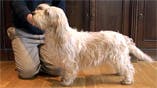 This friendly, confident, little dog is into everything and fun to have around.
Petit Basset Griffon Vendeen (sometimes shortened to PBGV) are small, low to the ground and the length of body (measured from point of shoulder to point of buttock) exceeds the height at withers at a ratio of approximately 7:5. They have quite a long, harsh outer coat and a thick, short undercoat which is generally white with any hound colour.
Both the Grand and Petit Basset Griffon Vendeen came from the Vendee region of France to hunt rabbit and hare and were bred down from the Grand Griffon Vendeen, hence the name 'Basset' meaning shortened legs. Initially, if the puppies were small they were named 'Petit' and if they were large (over 38cm at the shoulder) they were named 'Grand'. They are now recognised by the UK Kennel Club as two separate breeds.
They have a strong hunting drive so a lot of care and preparation is needed if they're going to be let off lead. They are active indoors but enjoy physical exercise outdoors too, so a large garden is ideal. They also like to dig so gardens must be safely fenced. Generally sociable with people and other dogs, they can be less trustworthy with non-canine pets.
Regular brushing should be enough to keep shedding fairly minimal. They are a generally healthy breed although eye problems have been reported.
This friendly, confident, little dog is into everything and fun to have around.
Petit Basset Griffon Vendeen (sometimes shortened to PBGV) are small, low to the ground and the length of body (measured from point of shoulder to point of buttock) exceeds the height at withers at a ratio of approximately 7:5. They have quite a long, harsh outer coat and a thick, short undercoat which is generally white with any hound colour.
Both the Grand and Petit Basset Griffon Vendeen came from the Vendee region of France to hunt rabbit and hare and were bred down from the Grand Griffon Vendeen, hence the name 'Basset' meaning shortened legs. Initially, if the puppies were small they were named 'Petit' and if they were large (over 38cm at the shoulder) they were named 'Grand'. They are now recognised by the UK Kennel Club as two separate breeds.
They have a strong hunting drive so a lot of care and preparation is needed if they're going to be let off lead. They are active indoors but enjoy physical exercise outdoors too, so a large garden is ideal. They also like to dig so gardens must be safely fenced. Generally sociable with people and other dogs, they can be less trustworthy with non-canine pets.
Regular brushing should be enough to keep shedding fairly minimal. They are a generally healthy breed although eye problems have been reported.
This friendly, confident, little dog is into everything and fun to have around.
Petit Basset Griffon Vendeen (sometimes shortened to PBGV) are small, low to the ground and the length of body (measured from point of shoulder to point of buttock) exceeds the height at withers at a ratio of approximately 7:5. They have quite a long, harsh outer coat and a thick, short undercoat which is generally white with any hound colour.
Both the Grand and Petit Basset Griffon Vendeen came from the Vendee region of France to hunt rabbit and hare and were bred down from the Grand Griffon Vendeen, hence the name 'Basset' meaning shortened legs. Initially, if the puppies were small they were named 'Petit' and if they were large (over 38cm at the shoulder) they were named 'Grand'. They are now recognised by the UK Kennel Club as two separate breeds.
They have a strong hunting drive so a lot of care and preparation is needed if they're going to be let off lead. They are active indoors but enjoy physical exercise outdoors too, so a large garden is ideal. They also like to dig so gardens must be safely fenced. Generally sociable with people and other dogs, they can be less trustworthy with non-canine pets.
Regular brushing should be enough to keep shedding fairly minimal. They are a generally healthy breed although eye problems have been reported.Basset Hound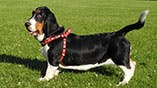 A popular cartoon image is that of the Basset Hound with a deerstalker and his magnifying glass to signify his skills as a detective.
This short legged dog is quite heavily built with a sad expression, loose folds in the mouth and skin and long hanging ears. The coat is short and shiny and they come in a variety of colours. They also have a deep and ringing bark.
The breed is a direct descendent of the Bloodhound and has excellent scenting ability, helped by the fact that his shape makes it easy for him to keep his nose to the ground. They are reported to have been bred by monks to hunt hare and pheasant.
The Basset Hound is devoted and naturally well behaved, but like all hounds, they're inclined towards selective deafness when they catch an interesting scent.
They have a sweet and gentle nature and are good with children and generally get along well with other animals too. They tend to be sedentary indoors but outdoors they are capable of long distances and it's important to give them plenty of opportunity for outdoor walks to keep them fit.
The short coat is easy to maintain but it's important to monitor the health of the ears too. Because they have short legs and a long heavy body, they can suffer lameness so it's important to be careful not to overfeed them.
A popular cartoon image is that of the Basset Hound with a deerstalker and his magnifying glass to signify his skills as a detective.
This short legged dog is quite heavily built with a sad expression, loose folds in the mouth and skin and long hanging ears. The coat is short and shiny and they come in a variety of colours. They also have a deep and ringing bark.
The breed is a direct descendent of the Bloodhound and has excellent scenting ability, helped by the fact that his shape makes it easy for him to keep his nose to the ground. They are reported to have been bred by monks to hunt hare and pheasant.
The Basset Hound is devoted and naturally well behaved, but like all hounds, they're inclined towards selective deafness when they catch an interesting scent.
They have a sweet and gentle nature and are good with children and generally get along well with other animals too. They tend to be sedentary indoors but outdoors they are capable of long distances and it's important to give them plenty of opportunity for outdoor walks to keep them fit.
The short coat is easy to maintain but it's important to monitor the health of the ears too. Because they have short legs and a long heavy body, they can suffer lameness so it's important to be careful not to overfeed them.
A popular cartoon image is that of the Basset Hound with a deerstalker and his magnifying glass to signify his skills as a detective.
This short legged dog is quite heavily built with a sad expression, loose folds in the mouth and skin and long hanging ears. The coat is short and shiny and they come in a variety of colours. They also have a deep and ringing bark.
The breed is a direct descendent of the Bloodhound and has excellent scenting ability, helped by the fact that his shape makes it easy for him to keep his nose to the ground. They are reported to have been bred by monks to hunt hare and pheasant.
The Basset Hound is devoted and naturally well behaved, but like all hounds, they're inclined towards selective deafness when they catch an interesting scent.
They have a sweet and gentle nature and are good with children and generally get along well with other animals too. They tend to be sedentary indoors but outdoors they are capable of long distances and it's important to give them plenty of opportunity for outdoor walks to keep them fit.
The short coat is easy to maintain but it's important to monitor the health of the ears too. Because they have short legs and a long heavy body, they can suffer lameness so it's important to be careful not to overfeed them.Bavarian Mountain Hound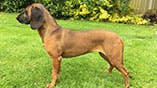 This handsome hound is known as the Bayerische Gebirgsschweisshund in his native Germany.
They are medium sized dogs with quite a long body with a slightly raised rump. The coat is short, thick and shiny and quite harsh. They are black-faced with a fawn or brindle body.
The breed is a cross between the Bavarian Hound and the Hanover Hound and was bred to trail wounded game in the mountains so they are very agile.
They're calm, loyal and brave. Their excellent sense of smell and persistence make them an excellent hunting dog. Loyal to his family and good with children, they can be wary of strangers. Like all hounds, they will go after wildlife, they need plenty of space and a lot of exercise so are well suited to being a working dog.
They need little grooming to maintain their short coats. They have few health problems.
This handsome hound is known as the Bayerische Gebirgsschweisshund in his native Germany.
They are medium sized dogs with quite a long body with a slightly raised rump. The coat is short, thick and shiny and quite harsh. They are black-faced with a fawn or brindle body.
The breed is a cross between the Bavarian Hound and the Hanover Hound and was bred to trail wounded game in the mountains so they are very agile.
They're calm, loyal and brave. Their excellent sense of smell and persistence make them an excellent hunting dog. Loyal to his family and good with children, they can be wary of strangers. Like all hounds, they will go after wildlife, they need plenty of space and a lot of exercise so are well suited to being a working dog.
They need little grooming to maintain their short coats. They have few health problems.
This handsome hound is known as the Bayerische Gebirgsschweisshund in his native Germany.
They are medium sized dogs with quite a long body with a slightly raised rump. The coat is short, thick and shiny and quite harsh. They are black-faced with a fawn or brindle body.
The breed is a cross between the Bavarian Hound and the Hanover Hound and was bred to trail wounded game in the mountains so they are very agile.
They're calm, loyal and brave. Their excellent sense of smell and persistence make them an excellent hunting dog. Loyal to his family and good with children, they can be wary of strangers. Like all hounds, they will go after wildlife, they need plenty of space and a lot of exercise so are well suited to being a working dog.
They need little grooming to maintain their short coats. They have few health problems.BeagleThe Beagle is a sociable, cheerful dog, eager to please and game for anything.
They are a sturdy little hound that looks like a miniature Foxhound. Their coat is short and sleek and any hound-type colouring is acceptable. When out hunting, they have a recognisable baying call.
The first Beagles date back to the 1500s bred by the British to track and hunt small game. They are brave and intelligent with a strong tracking instinct so will respond well to scent-based games.
They are a good family dog, liking people and children. They are bred to co-operate with other dogs but might not be trustworthy around other animals. They need plenty of exercise as they have lots of energy and stamina but are a very active dog indoors as well as out. Like all hounds, once they pick up a scent, they have a tendency towards selective deafness.
The short coat is easy to care for with regular brushing and the occasional shampoo. Some lines can be prone to epilepsy, heart disease, eye and back problems.
The Beagle is a sociable, cheerful dog, eager to please and game for anything.
They are a sturdy little hound that looks like a miniature Foxhound. Their coat is short and sleek and any hound-type colouring is acceptable. When out hunting, they have a recognisable baying call.
The first Beagles date back to the 1500s bred by the British to track and hunt small game. They are brave and intelligent with a strong tracking instinct so will respond well to scent-based games.
They are a good family dog, liking people and children. They are bred to co-operate with other dogs but might not be trustworthy around other animals. They need plenty of exercise as they have lots of energy and stamina but are a very active dog indoors as well as out. Like all hounds, once they pick up a scent, they have a tendency towards selective deafness.
The short coat is easy to care for with regular brushing and the occasional shampoo. Some lines can be prone to epilepsy, heart disease, eye and back problems.Bearded Collie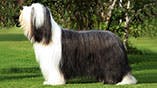 The Bearded Collie's lovable, cheerful, carefree appearance belies their sharp intelligence and boundless energy.
They are a strong dog, leaner than they look because of their long coat. The double coat is shaggy and waterproof and it hangs over the whole body, even the chin, hence the name "Beardie". They can come in a variety of colours with white but the coat changes colour often as they mature.
They are one of Britain's oldest breeds and originate from the 1500s from a cross between Polish sheepdogs and Scottish herding dogs but the breed type as we know it today was set in the 1940s.
Beardies are never happier than with people and their intelligence makes them very trainable. As a result, they are very good working dogs but if kept as family pets it's good to give them plenty to do. They are great with people and children. They will generally get on well with other dogs but have a natural tendency to herd everyone and everything. They are happiest outdoors and active with lots to exercise their body and brain.
Their thick coat needs quite a lot of brushing to keep it looking good. They can be prone to hip dysplasia.
The Bearded Collie's lovable, cheerful, carefree appearance belies their sharp intelligence and boundless energy.
They are a strong dog, leaner than they look because of their long coat. The double coat is shaggy and waterproof and it hangs over the whole body, even the chin, hence the name "Beardie". They can come in a variety of colours with white but the coat changes colour often as they mature.
They are one of Britain's oldest breeds and originate from the 1500s from a cross between Polish sheepdogs and Scottish herding dogs but the breed type as we know it today was set in the 1940s.
Beardies are never happier than with people and their intelligence makes them very trainable. As a result, they are very good working dogs but if kept as family pets it's good to give them plenty to do. They are great with people and children. They will generally get on well with other dogs but have a natural tendency to herd everyone and everything. They are happiest outdoors and active with lots to exercise their body and brain.
Their thick coat needs quite a lot of brushing to keep it looking good. They can be prone to hip dysplasia.
The Bearded Collie's lovable, cheerful, carefree appearance belies their sharp intelligence and boundless energy.
They are a strong dog, leaner than they look because of their long coat. The double coat is shaggy and waterproof and it hangs over the whole body, even the chin, hence the name "Beardie". They can come in a variety of colours with white but the coat changes colour often as they mature.
They are one of Britain's oldest breeds and originate from the 1500s from a cross between Polish sheepdogs and Scottish herding dogs but the breed type as we know it today was set in the 1940s.
Beardies are never happier than with people and their intelligence makes them very trainable. As a result, they are very good working dogs but if kept as family pets it's good to give them plenty to do. They are great with people and children. They will generally get on well with other dogs but have a natural tendency to herd everyone and everything. They are happiest outdoors and active with lots to exercise their body and brain.
Their thick coat needs quite a lot of brushing to keep it looking good. They can be prone to hip dysplasia.Beauceron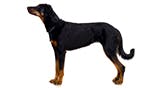 This large dog has a natural tendency to maintain order. Whether it's in guarding or rounding up.
The Beauceron is a large, strong, naturally active and agile, working dog. They are usually black with distinctive tan markings. Their coat is smooth and short with longer hair on the tail and back legs.
They originate from France in the 1500s where they were used to guard and herd sheep. Since then they have also proved themselves in the armed forces and in police work. They are brave and intelligent and will automatically keep a watchful eye out for danger. In the wrong hands, the urge to protect could be a problem but it is in the Beaucerons's nature to be tolerant and keen to obey.
They tend to be good with children but wary of strangers. With the right training, they will get along with other animals. They need a lot of mental and physical exercise.
Their short coat is easy to maintain with the occasional brush. They are generally healthy and hardy but can be prone to hip dysplasia.
This large dog has a natural tendency to maintain order. Whether it's in guarding or rounding up.
The Beauceron is a large, strong, naturally active and agile, working dog. They are usually black with distinctive tan markings. Their coat is smooth and short with longer hair on the tail and back legs.
They originate from France in the 1500s where they were used to guard and herd sheep. Since then they have also proved themselves in the armed forces and in police work. They are brave and intelligent and will automatically keep a watchful eye out for danger. In the wrong hands, the urge to protect could be a problem but it is in the Beaucerons's nature to be tolerant and keen to obey.
They tend to be good with children but wary of strangers. With the right training, they will get along with other animals. They need a lot of mental and physical exercise.
Their short coat is easy to maintain with the occasional brush. They are generally healthy and hardy but can be prone to hip dysplasia.
This large dog has a natural tendency to maintain order. Whether it's in guarding or rounding up.
The Beauceron is a large, strong, naturally active and agile, working dog. They are usually black with distinctive tan markings. Their coat is smooth and short with longer hair on the tail and back legs.
They originate from France in the 1500s where they were used to guard and herd sheep. Since then they have also proved themselves in the armed forces and in police work. They are brave and intelligent and will automatically keep a watchful eye out for danger. In the wrong hands, the urge to protect could be a problem but it is in the Beaucerons's nature to be tolerant and keen to obey.
They tend to be good with children but wary of strangers. With the right training, they will get along with other animals. They need a lot of mental and physical exercise.
Their short coat is easy to maintain with the occasional brush. They are generally healthy and hardy but can be prone to hip dysplasia.Bedlington TerrierThe Bedlington Terrier's lamb-like appearance might give the impression that they are timid but they're actually playful, brave and full of energy.
The Bedlington Terrier is immediately recognisable as a dog that looks like a small lamb. They have a pear shaped head, straight front legs and longer back legs. They have a curly lamb-like coat, described as linty, and little tail and can come in a variety of colours although are often a silvery grey.
They were originally bred as hunting dogs but were renamed Bedlington after being used by miners in the shire of Bedlington to work in the pits keeping them free of vermin.
They are a friendly little dog but need plenty of opportunities to burn off their excess energy and they tend to like the sound of their own bark. They get along well with family and other people. They tend to get along well with dogs but need to be taught to tolerate cats and other wildlife. They will be busy indoors but need plenty of outdoor exercise too.
They shed very little hair but need specialised clipping to keep their coat the correct shape. Bedlingtons have a serious inherited liver problem called Copper Storage Disease and are also prone to kidney disease, PRA, thyroid and eye problems.
The Bedlington Terrier's lamb-like appearance might give the impression that they are timid but they're actually playful, brave and full of energy.
The Bedlington Terrier is immediately recognisable as a dog that looks like a small lamb. They have a pear shaped head, straight front legs and longer back legs. They have a curly lamb-like coat, described as linty, and little tail and can come in a variety of colours although are often a silvery grey.
They were originally bred as hunting dogs but were renamed Bedlington after being used by miners in the shire of Bedlington to work in the pits keeping them free of vermin.
They are a friendly little dog but need plenty of opportunities to burn off their excess energy and they tend to like the sound of their own bark. They get along well with family and other people. They tend to get along well with dogs but need to be taught to tolerate cats and other wildlife. They will be busy indoors but need plenty of outdoor exercise too.
They shed very little hair but need specialised clipping to keep their coat the correct shape. Bedlingtons have a serious inherited liver problem called Copper Storage Disease and are also prone to kidney disease, PRA, thyroid and eye problems.Belgian Shepherd Dog (Groenendael)The Belgian Shepherd is a highly intelligent dog with a strong protective instinct.
They are a medium-sized, strong and well proportioned dog. There are four types, each distinguished by their type of coat. There is the Groenendael which has a long, black, harsh coat; the Laekenois which has a short, wiry, reddish coat; the Malinois with a short red, fawn or black coat with black over the top; and the Tervueren, similar to the Malinois but with a fuller top coat.
Although originally a sheep dog, they have proved themselves in the armed forces and police work in a variety of different roles. They will naturally herd and guard so make excellent working and obedience dogs but with the right training can be family dogs too.
They can be trained to be good with children and strangers and even other animals. They are accustomed to an active outdoor working life, and as such, it is essential that they get a lot of physical and mental exercise.
All the different coat types need careful grooming but the longer haireds more so. They are a hardy breed with no major health problems.
The Belgian Shepherd is a highly intelligent dog with a strong protective instinct.
They are a medium-sized, strong and well proportioned dog. There are four types, each distinguished by their type of coat. There is the Groenendael which has a long, black, harsh coat; the Laekenois which has a short, wiry, reddish coat; the Malinois with a short red, fawn or black coat with black over the top; and the Tervueren, similar to the Malinois but with a fuller top coat.
Although originally a sheep dog, they have proved themselves in the armed forces and police work in a variety of different roles. They will naturally herd and guard so make excellent working and obedience dogs but with the right training can be family dogs too.
They can be trained to be good with children and strangers and even other animals. They are accustomed to an active outdoor working life, and as such, it is essential that they get a lot of physical and mental exercise.
All the different coat types need careful grooming but the longer haireds more so. They are a hardy breed with no major health problems.Belgian Shepherd Dog (Laekenois)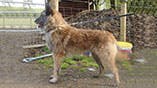 The Belgian Shepherd is a highly intelligent dog with a strong protective instinct.
They are a medium-sized, strong and well proportioned dog. There are four types, each distinguished by their type of coat. There is the Groenendael which has a long, black, harsh coat; the Laekenois which has a short, wiry, reddish coat; the Malinois with a short red, fawn or black coat with black over the top; and the Tervueren, similar to the Malinois but with a fuller top coat.
Although originally a sheep dog, they have proved themselves in the armed forces and police work in a variety of different roles. They will naturally herd and guard so make excellent working and obedience dogs but with the right training can be family dogs too.
They can be trained to be good with children and strangers and even other animals. They are accustomed to an active outdoor working life, and as such, it is essential that they get a lot of physical and mental exercise.
All the different coat types need careful grooming but the longer haireds more so. They are a hardy breed with no major health problems.
The Belgian Shepherd is a highly intelligent dog with a strong protective instinct.
They are a medium-sized, strong and well proportioned dog. There are four types, each distinguished by their type of coat. There is the Groenendael which has a long, black, harsh coat; the Laekenois which has a short, wiry, reddish coat; the Malinois with a short red, fawn or black coat with black over the top; and the Tervueren, similar to the Malinois but with a fuller top coat.
Although originally a sheep dog, they have proved themselves in the armed forces and police work in a variety of different roles. They will naturally herd and guard so make excellent working and obedience dogs but with the right training can be family dogs too.
They can be trained to be good with children and strangers and even other animals. They are accustomed to an active outdoor working life, and as such, it is essential that they get a lot of physical and mental exercise.
All the different coat types need careful grooming but the longer haireds more so. They are a hardy breed with no major health problems.
The Belgian Shepherd is a highly intelligent dog with a strong protective instinct.
They are a medium-sized, strong and well proportioned dog. There are four types, each distinguished by their type of coat. There is the Groenendael which has a long, black, harsh coat; the Laekenois which has a short, wiry, reddish coat; the Malinois with a short red, fawn or black coat with black over the top; and the Tervueren, similar to the Malinois but with a fuller top coat.
Although originally a sheep dog, they have proved themselves in the armed forces and police work in a variety of different roles. They will naturally herd and guard so make excellent working and obedience dogs but with the right training can be family dogs too.
They can be trained to be good with children and strangers and even other animals. They are accustomed to an active outdoor working life, and as such, it is essential that they get a lot of physical and mental exercise.
All the different coat types need careful grooming but the longer haireds more so. They are a hardy breed with no major health problems.Belgian Shepherd Dog (Malinois)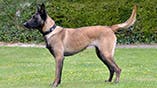 The Belgian Shepherd is a highly intelligent dog with a strong protective instinct.
They are a medium-sized, strong and well proportioned dog. There are four types, each distinguished by their type of coat. There is the Groenendael which has a long, black, harsh coat; the Laekenois which has a short, wiry, reddish coat; the Malinois with a short red, fawn or black coat with black over the top; and the Tervueren, similar to the Malinois but with a fuller top coat.
Although originally a sheep dog, they have proved themselves in the armed forces and police work in a variety of different roles. They will naturally herd and guard so make excellent working and obedience dogs but with the right training can be family dogs too.
They can be trained to be good with children and strangers and even other animals. They are accustomed to an active outdoor working life, and as such, it is essential that they get a lot of physical and mental exercise.
All the different coat types need careful grooming but the longer haireds more so. They are a hardy breed with no major health problems.
The Belgian Shepherd is a highly intelligent dog with a strong protective instinct.
They are a medium-sized, strong and well proportioned dog. There are four types, each distinguished by their type of coat. There is the Groenendael which has a long, black, harsh coat; the Laekenois which has a short, wiry, reddish coat; the Malinois with a short red, fawn or black coat with black over the top; and the Tervueren, similar to the Malinois but with a fuller top coat.
Although originally a sheep dog, they have proved themselves in the armed forces and police work in a variety of different roles. They will naturally herd and guard so make excellent working and obedience dogs but with the right training can be family dogs too.
They can be trained to be good with children and strangers and even other animals. They are accustomed to an active outdoor working life, and as such, it is essential that they get a lot of physical and mental exercise.
All the different coat types need careful grooming but the longer haireds more so. They are a hardy breed with no major health problems.
The Belgian Shepherd is a highly intelligent dog with a strong protective instinct.
They are a medium-sized, strong and well proportioned dog. There are four types, each distinguished by their type of coat. There is the Groenendael which has a long, black, harsh coat; the Laekenois which has a short, wiry, reddish coat; the Malinois with a short red, fawn or black coat with black over the top; and the Tervueren, similar to the Malinois but with a fuller top coat.
Although originally a sheep dog, they have proved themselves in the armed forces and police work in a variety of different roles. They will naturally herd and guard so make excellent working and obedience dogs but with the right training can be family dogs too.
They can be trained to be good with children and strangers and even other animals. They are accustomed to an active outdoor working life, and as such, it is essential that they get a lot of physical and mental exercise.
All the different coat types need careful grooming but the longer haireds more so. They are a hardy breed with no major health problems.Belgian Shepherd Dog (Tervueren)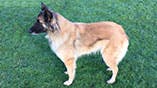 The Belgian Shepherd is a highly intelligent dog with a strong protective instinct.
They are a medium-sized, strong and well proportioned dog. There are four types, each distinguished by their type of coat. There is the Groenendael which has a long, black, harsh coat; the Laekenois which has a short, wiry, reddish coat; the Malinois with a short red, fawn or black coat with black over the top; and the Tervueren, similar to the Malinois but with a fuller top coat.
Although originally a sheep dog, they have proved themselves in the armed forces and police work in a variety of different roles. They will naturally herd and guard so make excellent working and obedience dogs but with the right training can be family dogs too.
They can be trained to be good with children and strangers and even other animals. They are accustomed to an active outdoor working life, and as such, it is essential that they get a lot of physical and mental exercise.
All the different coat types need careful grooming but the longer haireds more so. They are a hardy breed with no major health problems.
The Belgian Shepherd is a highly intelligent dog with a strong protective instinct.
They are a medium-sized, strong and well proportioned dog. There are four types, each distinguished by their type of coat. There is the Groenendael which has a long, black, harsh coat; the Laekenois which has a short, wiry, reddish coat; the Malinois with a short red, fawn or black coat with black over the top; and the Tervueren, similar to the Malinois but with a fuller top coat.
Although originally a sheep dog, they have proved themselves in the armed forces and police work in a variety of different roles. They will naturally herd and guard so make excellent working and obedience dogs but with the right training can be family dogs too.
They can be trained to be good with children and strangers and even other animals. They are accustomed to an active outdoor working life, and as such, it is essential that they get a lot of physical and mental exercise.
All the different coat types need careful grooming but the longer haireds more so. They are a hardy breed with no major health problems.
The Belgian Shepherd is a highly intelligent dog with a strong protective instinct.
They are a medium-sized, strong and well proportioned dog. There are four types, each distinguished by their type of coat. There is the Groenendael which has a long, black, harsh coat; the Laekenois which has a short, wiry, reddish coat; the Malinois with a short red, fawn or black coat with black over the top; and the Tervueren, similar to the Malinois but with a fuller top coat.
Although originally a sheep dog, they have proved themselves in the armed forces and police work in a variety of different roles. They will naturally herd and guard so make excellent working and obedience dogs but with the right training can be family dogs too.
They can be trained to be good with children and strangers and even other animals. They are accustomed to an active outdoor working life, and as such, it is essential that they get a lot of physical and mental exercise.
All the different coat types need careful grooming but the longer haireds more so. They are a hardy breed with no major health problems.BergamascoThe Bergamasco is one of the oldest breeds; thought to have been in existence for 2000 years.
They are a medium-sized, well-proportioned and strong breed. The most distinguishable feature about them is their coat. It is made up of three types of hair which grow very long and hang together in "flocks" which gives them the appearance of having "dreadlocks". Long hair covers their eyes too. The coat comes in varying shades of very light to very dark grey.
They originate from the Alps where they were used to guard and herd sheep. They are intelligent and balanced, attentive and watchful. Although not naturally aggressive, their first instinct is to guard so the right training is essential.
They will tend to use their own judgement about people so may need to be taught to accept all types. They are generally excellent with children. They tend to like other dogs and can be trained to accept other animals. They are usually more comfortable outdoors, especially colder climates, due to their massive coat. They need plenty of exercise.
The flocking coat needs careful management to maintain it. They are generally very healthy.
The Bergamasco is one of the oldest breeds; thought to have been in existence for 2000 years.
They are a medium-sized, well-proportioned and strong breed. The most distinguishable feature about them is their coat. It is made up of three types of hair which grow very long and hang together in "flocks" which gives them the appearance of having "dreadlocks". Long hair covers their eyes too. The coat comes in varying shades of very light to very dark grey.
They originate from the Alps where they were used to guard and herd sheep. They are intelligent and balanced, attentive and watchful. Although not naturally aggressive, their first instinct is to guard so the right training is essential.
They will tend to use their own judgement about people so may need to be taught to accept all types. They are generally excellent with children. They tend to like other dogs and can be trained to accept other animals. They are usually more comfortable outdoors, especially colder climates, due to their massive coat. They need plenty of exercise.
The flocking coat needs careful management to maintain it. They are generally very healthy.Bernese Mountain Dog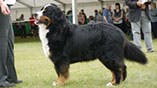 Bernese Mountain Dogs are loving and loyal and excellent with children. They make a good family pet.
The Bernese Mountain Dog is a large, strong and agile dog. Their thick coat is slightly wavy and largely black with distinctive tan and white markings.
They originate from the Swiss mountains and were used to pull carts and help with herding and guarding of cattle.
They are intelligent, trainable, quiet and good natured. Good with strangers, they are generally good natured with other animals too. They need plenty of exercise outdoors as they tend to be sedentary inside.
They need regular grooming and bathing to keep the coat in good condition and will shed heavily at certain times of the year. They are prone to bloat, cancer, eyelid problems and hip and elbow dysplasia. They are inclined to put on weight which puts added strain on their frame so is something to guard against.
Bernese Mountain Dogs are loving and loyal and excellent with children. They make a good family pet.
The Bernese Mountain Dog is a large, strong and agile dog. Their thick coat is slightly wavy and largely black with distinctive tan and white markings.
They originate from the Swiss mountains and were used to pull carts and help with herding and guarding of cattle.
They are intelligent, trainable, quiet and good natured. Good with strangers, they are generally good natured with other animals too. They need plenty of exercise outdoors as they tend to be sedentary inside.
They need regular grooming and bathing to keep the coat in good condition and will shed heavily at certain times of the year. They are prone to bloat, cancer, eyelid problems and hip and elbow dysplasia. They are inclined to put on weight which puts added strain on their frame so is something to guard against.
Bernese Mountain Dogs are loving and loyal and excellent with children. They make a good family pet.
The Bernese Mountain Dog is a large, strong and agile dog. Their thick coat is slightly wavy and largely black with distinctive tan and white markings.
They originate from the Swiss mountains and were used to pull carts and help with herding and guarding of cattle.
They are intelligent, trainable, quiet and good natured. Good with strangers, they are generally good natured with other animals too. They need plenty of exercise outdoors as they tend to be sedentary inside.
They need regular grooming and bathing to keep the coat in good condition and will shed heavily at certain times of the year. They are prone to bloat, cancer, eyelid problems and hip and elbow dysplasia. They are inclined to put on weight which puts added strain on their frame so is something to guard against.Bichon FriseThe Bichon Frise is a natural performer who enjoys taking centre stage.
They are a small, sturdy dog with a (usually) white, soft, curly coat and a tail that curls up and over the back. Overall, they give the impression of a ball of fluff.
The breed dates back to the 13th Century but was popular in the courts of 16th Century France where they provided entertainment by performing tricks.
They are intelligent, charming, affectionate, lively, quick to learn and surprisingly quiet. They love human company and are good natured with other animals. They enjoy a good walk but are an active little dog indoors too.
They should be groomed and bathed regularly and professionally trimmed too but they shed very little. They can be prone to eye, skin and ear problems, epilepsy and dislocated kneecaps. They can also be very sensitive to flea bites.
The Bichon Frise is a natural performer who enjoys taking centre stage.
They are a small, sturdy dog with a (usually) white, soft, curly coat and a tail that curls up and over the back. Overall, they give the impression of a ball of fluff.
The breed dates back to the 13th Century but was popular in the courts of 16th Century France where they provided entertainment by performing tricks.
They are intelligent, charming, affectionate, lively, quick to learn and surprisingly quiet. They love human company and are good natured with other animals. They enjoy a good walk but are an active little dog indoors too.
They should be groomed and bathed regularly and professionally trimmed too but they shed very little. They can be prone to eye, skin and ear problems, epilepsy and dislocated kneecaps. They can also be very sensitive to flea bites.Bloodhound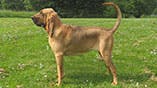 When it comes to tracking, the Bloodhound cannot be beaten.
The Bloodhound is a very large hound. They have very long drooping ears and excess skin that hangs in folds particularly around the head and neck. The coat is short and generally a mixture of black and tan or red. They also tend to drool.
Bloodhounds originated in Belgium, have been around for about 1,000 years and have always been used for tracking. When tracking game their job is to track but not kill.
Although they can be sensitive, they are generally good natured and tolerant, a gentle giant, but once they get a scent of something, they will tend to single-mindedly follow it. Bloodhounds tend to get on well with people and other animals particularly when out on a trail. Full grown Bloodhounds enjoy plenty of exercise and have incredible stamina.
They need little grooming to maintain their coats but their ears need to be checked regularly. They are prone to bloat and need a padded bed to prevent callouses on their joints.
When it comes to tracking, the Bloodhound cannot be beaten.
The Bloodhound is a very large hound. They have very long drooping ears and excess skin that hangs in folds particularly around the head and neck. The coat is short and generally a mixture of black and tan or red. They also tend to drool.
Bloodhounds originated in Belgium, have been around for about 1,000 years and have always been used for tracking. When tracking game their job is to track but not kill.
Although they can be sensitive, they are generally good natured and tolerant, a gentle giant, but once they get a scent of something, they will tend to single-mindedly follow it. Bloodhounds tend to get on well with people and other animals particularly when out on a trail. Full grown Bloodhounds enjoy plenty of exercise and have incredible stamina.
They need little grooming to maintain their coats but their ears need to be checked regularly. They are prone to bloat and need a padded bed to prevent callouses on their joints.
When it comes to tracking, the Bloodhound cannot be beaten.
The Bloodhound is a very large hound. They have very long drooping ears and excess skin that hangs in folds particularly around the head and neck. The coat is short and generally a mixture of black and tan or red. They also tend to drool.
Bloodhounds originated in Belgium, have been around for about 1,000 years and have always been used for tracking. When tracking game their job is to track but not kill.
Although they can be sensitive, they are generally good natured and tolerant, a gentle giant, but once they get a scent of something, they will tend to single-mindedly follow it. Bloodhounds tend to get on well with people and other animals particularly when out on a trail. Full grown Bloodhounds enjoy plenty of exercise and have incredible stamina.
They need little grooming to maintain their coats but their ears need to be checked regularly. They are prone to bloat and need a padded bed to prevent callouses on their joints.Bolognese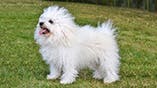 The Bolognese (pronounced Bol-o-neese) is very fond of human company and a generally intelligent little breed.
They are a small, stocky dog with a mass of long, white, fluff. In fact the only feature you can really make out is its little black nose. The coat, however, is more like flocking than a regular coat.
They come from Northern Italy and hail from the same line as the Maltese. They were bred as companion pets. They are fairly docile, particularly indoors, but are willing to please and quite good at obedience. They love human company and are good natured with other animals. They enjoy the opportunity for a daily walk.
The long coat requires regular grooming but does not need trimming. They are a generally healthy breed with few problems.
The Bolognese (pronounced Bol-o-neese) is very fond of human company and a generally intelligent little breed.
They are a small, stocky dog with a mass of long, white, fluff. In fact the only feature you can really make out is its little black nose. The coat, however, is more like flocking than a regular coat.
They come from Northern Italy and hail from the same line as the Maltese. They were bred as companion pets. They are fairly docile, particularly indoors, but are willing to please and quite good at obedience. They love human company and are good natured with other animals. They enjoy the opportunity for a daily walk.
The long coat requires regular grooming but does not need trimming. They are a generally healthy breed with few problems.
The Bolognese (pronounced Bol-o-neese) is very fond of human company and a generally intelligent little breed.
They are a small, stocky dog with a mass of long, white, fluff. In fact the only feature you can really make out is its little black nose. The coat, however, is more like flocking than a regular coat.
They come from Northern Italy and hail from the same line as the Maltese. They were bred as companion pets. They are fairly docile, particularly indoors, but are willing to please and quite good at obedience. They love human company and are good natured with other animals. They enjoy the opportunity for a daily walk.
The long coat requires regular grooming but does not need trimming. They are a generally healthy breed with few problems.Border Collie For anyone who wants a highly intelligent working dog or dog for competitive sports, a Border Collie is hard to beat.
The Border Collie is a medium size energetic working dog with a body slightly longer than it is tall. They come in a variety of colours with a double coat that is either short and sleek or rough.
They originate from the England / Scotland border and were bred to herd sheep.
They make excellent working dogs and are supremely good at agility, obedience, flyball and pretty much any other canine sport. They are hard working and thrive on praise but are also capable of independent thought. However, they will bore easily if not challenged. They will get on well with people and other animals with the right training. They have a lot of energy and tremendous stamina but must have plenty to exercise body and brain every day.
They need regular grooming although professional grooming is generally not needed. They can be prone to hip dysplasia, epilepsy and deafness and are often allergic to fleas.
For anyone who wants a highly intelligent working dog or dog for competitive sports, a Border Collie is hard to beat.
The Border Collie is a medium size energetic working dog with a body slightly longer than it is tall. They come in a variety of colours with a double coat that is either short and sleek or rough.
They originate from the England / Scotland border and were bred to herd sheep.
They make excellent working dogs and are supremely good at agility, obedience, flyball and pretty much any other canine sport. They are hard working and thrive on praise but are also capable of independent thought. However, they will bore easily if not challenged. They will get on well with people and other animals with the right training. They have a lot of energy and tremendous stamina but must have plenty to exercise body and brain every day.
They need regular grooming although professional grooming is generally not needed. They can be prone to hip dysplasia, epilepsy and deafness and are often allergic to fleas.
For anyone who wants a highly intelligent working dog or dog for competitive sports, a Border Collie is hard to beat.
The Border Collie is a medium size energetic working dog with a body slightly longer than it is tall. They come in a variety of colours with a double coat that is either short and sleek or rough.
They originate from the England / Scotland border and were bred to herd sheep.
They make excellent working dogs and are supremely good at agility, obedience, flyball and pretty much any other canine sport. They are hard working and thrive on praise but are also capable of independent thought. However, they will bore easily if not challenged. They will get on well with people and other animals with the right training. They have a lot of energy and tremendous stamina but must have plenty to exercise body and brain every day.
They need regular grooming although professional grooming is generally not needed. They can be prone to hip dysplasia, epilepsy and deafness and are often allergic to fleas.Border Terrier Border Terriers are an intelligent, busy, hard-working, little dog that loves human company.
Colours include tan, dark red, blue/tan and wheaten and they often have a grizzle, a kind of flecking, over the top of the coat. The coat is very harsh with a large pelt. They are strongly built but quite slim-bodied with large teeth for their size and a short, straight tail. This look has been shaped by the job these terriers were bred for.
Borders are a mixture of other terrier breeds, bred by Masters of the Border Hunt to flush out foxes. This resulted in a dog that was supple and brave with good teeth to defend itself and a tail the length of a man's hand to enable him to be pulled out of a hole. Owners need a secure garden and when out off the lead care should be taken as their instinct is to "go to ground" to flush out anything there.
Quick to learn but slow to obey, they often have a love of small spaces which can get them into trouble. Like many terrier breeds, they can be wilful but their keen interest in food can help with training.
Very happy with people and children, they have been bred to get on well with other dogs, too, as they would have worked alongside each other. Although their instinct can make them a danger to other small furry creatures, Border Terriers can be trained to accept small animal companions if introduced early. These terriers had to be fit and have good stamina to be able to keep up with horses and are a naturally active breed that require a good amount of exercise.
Their coat was designed to protect them in harsh weather conditions and is very good at doing just that. The soft undercoat and harsh top coat needs stripping but moults very little. With very few health problems, they tend to be very long living. Occasionally pups are born with undershot or overshot jaws which doesn't affect their quality of life but looks a little odd.
Border Terriers are an intelligent, busy, hard-working, little dog that loves human company.
Colours include tan, dark red, blue/tan and wheaten and they often have a grizzle, a kind of flecking, over the top of the coat. The coat is very harsh with a large pelt. They are strongly built but quite slim-bodied with large teeth for their size and a short, straight tail. This look has been shaped by the job these terriers were bred for.
Borders are a mixture of other terrier breeds, bred by Masters of the Border Hunt to flush out foxes. This resulted in a dog that was supple and brave with good teeth to defend itself and a tail the length of a man's hand to enable him to be pulled out of a hole. Owners need a secure garden and when out off the lead care should be taken as their instinct is to "go to ground" to flush out anything there.
Quick to learn but slow to obey, they often have a love of small spaces which can get them into trouble. Like many terrier breeds, they can be wilful but their keen interest in food can help with training.
Very happy with people and children, they have been bred to get on well with other dogs, too, as they would have worked alongside each other. Although their instinct can make them a danger to other small furry creatures, Border Terriers can be trained to accept small animal companions if introduced early. These terriers had to be fit and have good stamina to be able to keep up with horses and are a naturally active breed that require a good amount of exercise.
Their coat was designed to protect them in harsh weather conditions and is very good at doing just that. The soft undercoat and harsh top coat needs stripping but moults very little. With very few health problems, they tend to be very long living. Occasionally pups are born with undershot or overshot jaws which doesn't affect their quality of life but looks a little odd.
Border Terriers are an intelligent, busy, hard-working, little dog that loves human company.
Colours include tan, dark red, blue/tan and wheaten and they often have a grizzle, a kind of flecking, over the top of the coat. The coat is very harsh with a large pelt. They are strongly built but quite slim-bodied with large teeth for their size and a short, straight tail. This look has been shaped by the job these terriers were bred for.
Borders are a mixture of other terrier breeds, bred by Masters of the Border Hunt to flush out foxes. This resulted in a dog that was supple and brave with good teeth to defend itself and a tail the length of a man's hand to enable him to be pulled out of a hole. Owners need a secure garden and when out off the lead care should be taken as their instinct is to "go to ground" to flush out anything there.
Quick to learn but slow to obey, they often have a love of small spaces which can get them into trouble. Like many terrier breeds, they can be wilful but their keen interest in food can help with training.
Very happy with people and children, they have been bred to get on well with other dogs, too, as they would have worked alongside each other. Although their instinct can make them a danger to other small furry creatures, Border Terriers can be trained to accept small animal companions if introduced early. These terriers had to be fit and have good stamina to be able to keep up with horses and are a naturally active breed that require a good amount of exercise.
Their coat was designed to protect them in harsh weather conditions and is very good at doing just that. The soft undercoat and harsh top coat needs stripping but moults very little. With very few health problems, they tend to be very long living. Occasionally pups are born with undershot or overshot jaws which doesn't affect their quality of life but looks a little odd.BorzoiThe regal looking Borzoi is a noble dog who makes a loyal companion to his owner.
The Borzoi, or Russian Wolfhound, is similar in shape to a Greyhound, very slender but with a deep chest, but their coat is long and comes in a variety of colours.
They were bred in Russia for hunting across the open planes and are very fast. Their name comes from a Russian word meaning "swift". They are quite quiet and clean and can be trained but like all hounds may give priority to a scent over a command.
Although they do not naturally take to strangers, they can be trained to accept them but would not enjoy rough play with children. Like all hounds, they will chase after wildlife. They will tend to be sedentary indoors so need plenty of outdoor exercise and will move very quickly given the opportunity.
The silky coat needs careful attention to keep it at its best and Borzois will moult quite heavily at certain times of the year. They are prone to bloat and sensitive to drugs.
The regal looking Borzoi is a noble dog who makes a loyal companion to his owner.
The Borzoi, or Russian Wolfhound, is similar in shape to a Greyhound, very slender but with a deep chest, but their coat is long and comes in a variety of colours.
They were bred in Russia for hunting across the open planes and are very fast. Their name comes from a Russian word meaning "swift". They are quite quiet and clean and can be trained but like all hounds may give priority to a scent over a command.
Although they do not naturally take to strangers, they can be trained to accept them but would not enjoy rough play with children. Like all hounds, they will chase after wildlife. They will tend to be sedentary indoors so need plenty of outdoor exercise and will move very quickly given the opportunity.
The silky coat needs careful attention to keep it at its best and Borzois will moult quite heavily at certain times of the year. They are prone to bloat and sensitive to drugs.Boston Terrier The Boston Terrier may look as if it is ready for a scrap but is actually a well-mannered and trainable little dog.
Boston Terriers are small and muscular with very round heads and pricked up ears. Their eyes bulge slightly and their muzzle is short and square. Their short and shiny coat is often black and white but can come in other colours too.
They were bred from pit fighting dogs in America which were much larger but they have come a long way from there.
They are sociable, intelligent, keen to learn and surprisingly quiet. They are reliable with children, the elderly and strangers. They generally get on well with non-canine pets and can be trained to tolerate other dogs. They are happy with moderate exercise.
The short coat is easy to maintain. Their prominent eyes can be prone to injury and other problems. The shape of their muzzle can result in breathing problems and the largeness of the heads means that puppies often have to be born via cesarean section.
The Boston Terrier may look as if it is ready for a scrap but is actually a well-mannered and trainable little dog.
Boston Terriers are small and muscular with very round heads and pricked up ears. Their eyes bulge slightly and their muzzle is short and square. Their short and shiny coat is often black and white but can come in other colours too.
They were bred from pit fighting dogs in America which were much larger but they have come a long way from there.
They are sociable, intelligent, keen to learn and surprisingly quiet. They are reliable with children, the elderly and strangers. They generally get on well with non-canine pets and can be trained to tolerate other dogs. They are happy with moderate exercise.
The short coat is easy to maintain. Their prominent eyes can be prone to injury and other problems. The shape of their muzzle can result in breathing problems and the largeness of the heads means that puppies often have to be born via cesarean section.
The Boston Terrier may look as if it is ready for a scrap but is actually a well-mannered and trainable little dog.
Boston Terriers are small and muscular with very round heads and pricked up ears. Their eyes bulge slightly and their muzzle is short and square. Their short and shiny coat is often black and white but can come in other colours too.
They were bred from pit fighting dogs in America which were much larger but they have come a long way from there.
They are sociable, intelligent, keen to learn and surprisingly quiet. They are reliable with children, the elderly and strangers. They generally get on well with non-canine pets and can be trained to tolerate other dogs. They are happy with moderate exercise.
The short coat is easy to maintain. Their prominent eyes can be prone to injury and other problems. The shape of their muzzle can result in breathing problems and the largeness of the heads means that puppies often have to be born via cesarean section.Bouvier Des FlandresThe Bouvier may look a little intimidating but his loyalty is second-to-none.
The Bouvier is a large, muscular dog with a coarse, shaggy coat that comes in a variety of colours. The long coat covers the face too, giving the impression of a beard and moustache.
They were originally bred in Belgium to guard and herd cattle but also helped ambulances in World War 1.
Willing and able to learn, this dog does well with obedience training at an early age. They are a stable breed but their natural instinct is to guard. They are usually good with the family but can be suspicious of strangers. They can be taught to get along with other dogs but care needs to be taken around other animals. They tend to be sedentary indoors so it is necessary to give them enough opportunities for exercise outside.
The long, shaggy coat, needs regular grooming but perhaps not as much as might be imagined. Prone to hip dysplasia and eye problems, it is not always easy to tell if there is something wrong with this breed as they have a high tolerance for pain.
The Bouvier may look a little intimidating but his loyalty is second-to-none.
The Bouvier is a large, muscular dog with a coarse, shaggy coat that comes in a variety of colours. The long coat covers the face too, giving the impression of a beard and moustache.
They were originally bred in Belgium to guard and herd cattle but also helped ambulances in World War 1.
Willing and able to learn, this dog does well with obedience training at an early age. They are a stable breed but their natural instinct is to guard. They are usually good with the family but can be suspicious of strangers. They can be taught to get along with other dogs but care needs to be taken around other animals. They tend to be sedentary indoors so it is necessary to give them enough opportunities for exercise outside.
The long, shaggy coat, needs regular grooming but perhaps not as much as might be imagined. Prone to hip dysplasia and eye problems, it is not always easy to tell if there is something wrong with this breed as they have a high tolerance for pain.Boxer The name "Boxer" is said to come from the way the breed use their front paws so much, especially when they jump up and paw which looks like boxing.
Everything about the Boxer's medium sized body is muscular and powerful. Their short, smooth coat, accentuates the muscular look and usually comes in shades of brown with white.
They were developed in Germany and used for a number of jobs including herding and hunting but also fighting. They have proved themselves very useful in the armed services and police.
They are intelligent, extrovert and playful, excellent at competitive obedience. They naturally guard too. They make a good family pet and are well known for getting on well with children and they can be taught to get along with other dogs but care needs to be taken around other animals.
They have plenty of energy and stamina and will be active around the house as well as enjoying exercise outdoors.
Their short coat is fairly easy to maintain. They have been known to suffer from heart problems and various cancers. Some white boxers are more prone to deafness.
The name "Boxer" is said to come from the way the breed use their front paws so much, especially when they jump up and paw which looks like boxing.
Everything about the Boxer's medium sized body is muscular and powerful. Their short, smooth coat, accentuates the muscular look and usually comes in shades of brown with white.
They were developed in Germany and used for a number of jobs including herding and hunting but also fighting. They have proved themselves very useful in the armed services and police.
They are intelligent, extrovert and playful, excellent at competitive obedience. They naturally guard too. They make a good family pet and are well known for getting on well with children and they can be taught to get along with other dogs but care needs to be taken around other animals.
They have plenty of energy and stamina and will be active around the house as well as enjoying exercise outdoors.
Their short coat is fairly easy to maintain. They have been known to suffer from heart problems and various cancers. Some white boxers are more prone to deafness.
The name "Boxer" is said to come from the way the breed use their front paws so much, especially when they jump up and paw which looks like boxing.
Everything about the Boxer's medium sized body is muscular and powerful. Their short, smooth coat, accentuates the muscular look and usually comes in shades of brown with white.
They were developed in Germany and used for a number of jobs including herding and hunting but also fighting. They have proved themselves very useful in the armed services and police.
They are intelligent, extrovert and playful, excellent at competitive obedience. They naturally guard too. They make a good family pet and are well known for getting on well with children and they can be taught to get along with other dogs but care needs to be taken around other animals.
They have plenty of energy and stamina and will be active around the house as well as enjoying exercise outdoors.
Their short coat is fairly easy to maintain. They have been known to suffer from heart problems and various cancers. Some white boxers are more prone to deafness.Bracco ItalianoAlthough a gentle family dog, the Bracco Italiano loves to hunt.
The Bracco Italiano is the Italian Pointer with a sleek and powerful body similar in shape to that of German Pointers. However, the head is totally different, much larger with long, dangling ears and floppy jowls that are more like the head of a Bloodhound. Their short coat comes in brown and white and orange and white.
They originate from Italy where they were bred from a combination of hounds and gundogs to produce a dog with extra stamina. They will mark out game in the typical "pointing" pose. They are intelligent and eager to please but obedience training is a must; they can be stubborn.
They are naturally a people-friendly dog and often bond closely with children. They can be taught to get along well with other animals but have a strong hunting instinct. Relaxed at home, they enjoy exercise and especially hunting. Ideally they should be given the opportunity to practise their hunting skills to exercise body and brain.
Their short, sleek coat is easy to maintain. They are prone to hip dysplasia, kidney disease and bloat.
Although a gentle family dog, the Bracco Italiano loves to hunt.
The Bracco Italiano is the Italian Pointer with a sleek and powerful body similar in shape to that of German Pointers. However, the head is totally different, much larger with long, dangling ears and floppy jowls that are more like the head of a Bloodhound. Their short coat comes in brown and white and orange and white.
They originate from Italy where they were bred from a combination of hounds and gundogs to produce a dog with extra stamina. They will mark out game in the typical "pointing" pose. They are intelligent and eager to please but obedience training is a must; they can be stubborn.
They are naturally a people-friendly dog and often bond closely with children. They can be taught to get along well with other animals but have a strong hunting instinct. Relaxed at home, they enjoy exercise and especially hunting. Ideally they should be given the opportunity to practise their hunting skills to exercise body and brain.
Their short, sleek coat is easy to maintain. They are prone to hip dysplasia, kidney disease and bloat.Braque dAuvergneThe Braque d'Auvergne is a gentle dog. They are affectionate, intelligent and obedient and they adapt well to family life.
Their body shape predisposes them to be able to cover long distances with ease, allowing them to maintain their activity the whole day, even on difficult terrain.
The short, glossy coat is white with black mottling and this creates a blue impression. The head and ears are mainly black.
They are an excellent all round gundog.
The Braque d'Auvergne is a gentle dog. They are affectionate, intelligent and obedient and they adapt well to family life.
Their body shape predisposes them to be able to cover long distances with ease, allowing them to maintain their activity the whole day, even on difficult terrain.
The short, glossy coat is white with black mottling and this creates a blue impression. The head and ears are mainly black.
They are an excellent all round gundog.Briard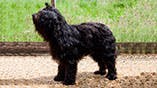 Briards need a firm hand and lots of love, but with the right training, are said to return the love ten-fold.
They are a large and powerful dog with a double coat, the outer being shaggy and coarse and they come in various shades of fawn and black. They also have a distinctive square nose, shaggy beard and double dew claws on their back legs.
Originally the Briard was a herding dog but has also proved its value in the armed forces and police.
The Briard loves to herd and has exceptional hearing. They are good-natured, fearless, loyal, and very trainable but with a strong protective instinct. They are normally good with strangers and children and with the right training, they will get along with other animals. They need plenty of exercise outdoors even though they tend to be fairly active indoors too, they often particularly enjoy swimming.
They need plenty of grooming to maintain the shaggy coat. They are generally healthy but can be prone to PRA, hip dysplasia and bloat.
Briards need a firm hand and lots of love, but with the right training, are said to return the love ten-fold.
They are a large and powerful dog with a double coat, the outer being shaggy and coarse and they come in various shades of fawn and black. They also have a distinctive square nose, shaggy beard and double dew claws on their back legs.
Originally the Briard was a herding dog but has also proved its value in the armed forces and police.
The Briard loves to herd and has exceptional hearing. They are good-natured, fearless, loyal, and very trainable but with a strong protective instinct. They are normally good with strangers and children and with the right training, they will get along with other animals. They need plenty of exercise outdoors even though they tend to be fairly active indoors too, they often particularly enjoy swimming.
They need plenty of grooming to maintain the shaggy coat. They are generally healthy but can be prone to PRA, hip dysplasia and bloat.
Briards need a firm hand and lots of love, but with the right training, are said to return the love ten-fold.
They are a large and powerful dog with a double coat, the outer being shaggy and coarse and they come in various shades of fawn and black. They also have a distinctive square nose, shaggy beard and double dew claws on their back legs.
Originally the Briard was a herding dog but has also proved its value in the armed forces and police.
The Briard loves to herd and has exceptional hearing. They are good-natured, fearless, loyal, and very trainable but with a strong protective instinct. They are normally good with strangers and children and with the right training, they will get along with other animals. They need plenty of exercise outdoors even though they tend to be fairly active indoors too, they often particularly enjoy swimming.
They need plenty of grooming to maintain the shaggy coat. They are generally healthy but can be prone to PRA, hip dysplasia and bloat.BrittanyThe Brittany is a lovable and trainable breed with plenty of energy.
They are a medium-sized dog, quite square in shape. They have flat or wavy silky fur that comes in various colours with white or tricolour. Their coat is very weather resistant. They come from France and were bred to accompany a hunter out shooting birds.
They are happy, enthusiastic and eager to please but capable of independent thought. They are normally good with strangers and children and generally get on well with other animals. They need lots of exercise and have plenty of stamina.
Regular normal grooming is needed to keep the coat looking good and the dangling ears need checking regularly too. They are prone to hip dysplasia, seizures and chest cancer.
The Brittany is a lovable and trainable breed with plenty of energy.
They are a medium-sized dog, quite square in shape. They have flat or wavy silky fur that comes in various colours with white or tricolour. Their coat is very weather resistant. They come from France and were bred to accompany a hunter out shooting birds.
They are happy, enthusiastic and eager to please but capable of independent thought. They are normally good with strangers and children and generally get on well with other animals. They need lots of exercise and have plenty of stamina.
Regular normal grooming is needed to keep the coat looking good and the dangling ears need checking regularly too. They are prone to hip dysplasia, seizures and chest cancer.Bull Terrier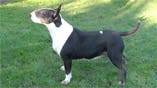 This easily recognisable, powerfully-built dog can be very entertaining, loving and loyal but they can be a bit of a handful.
There is no specific height for the standard Bull Terrier although mini Bull Terriers should not exceed 14 inches. Their heads are very distinctive, designed not to have a stop but to be half the shape of an egg. They are a muscular dog with 75% of their body weight on the front. Colours include white, brindle, black brindle/white, tricolour, solid red, red/white, fawn, solid brindle and even silver brindle.
They were bred from fighting dogs, a mix of the Bulldog and English White Terrier, with a little Dalmatian to give added height.
Positive and consistent training is needed with these dogs with plenty of mental stimulation as they have a tendency to be quite destructive if bored. They do respond well to clicker training and food rewards, however.
Generally excellent with people and children, some have a natural tendency to want to fight other dogs and occasionally other animals. They enjoy moderate exercise and are happy to play with a ball but make sure it is a sturdy one as their powerful jaws can destroy many toys.
They don't need a lot of grooming but they do moult with the seasons. Health tests are highly recommended for heart, kidney, hearing and patella.
This easily recognisable, powerfully-built dog can be very entertaining, loving and loyal but they can be a bit of a handful.
There is no specific height for the standard Bull Terrier although mini Bull Terriers should not exceed 14 inches. Their heads are very distinctive, designed not to have a stop but to be half the shape of an egg. They are a muscular dog with 75% of their body weight on the front. Colours include white, brindle, black brindle/white, tricolour, solid red, red/white, fawn, solid brindle and even silver brindle.
They were bred from fighting dogs, a mix of the Bulldog and English White Terrier, with a little Dalmatian to give added height.
Positive and consistent training is needed with these dogs with plenty of mental stimulation as they have a tendency to be quite destructive if bored. They do respond well to clicker training and food rewards, however.
Generally excellent with people and children, some have a natural tendency to want to fight other dogs and occasionally other animals. They enjoy moderate exercise and are happy to play with a ball but make sure it is a sturdy one as their powerful jaws can destroy many toys.
They don't need a lot of grooming but they do moult with the seasons. Health tests are highly recommended for heart, kidney, hearing and patella.
This easily recognisable, powerfully-built dog can be very entertaining, loving and loyal but they can be a bit of a handful.
There is no specific height for the standard Bull Terrier although mini Bull Terriers should not exceed 14 inches. Their heads are very distinctive, designed not to have a stop but to be half the shape of an egg. They are a muscular dog with 75% of their body weight on the front. Colours include white, brindle, black brindle/white, tricolour, solid red, red/white, fawn, solid brindle and even silver brindle.
They were bred from fighting dogs, a mix of the Bulldog and English White Terrier, with a little Dalmatian to give added height.
Positive and consistent training is needed with these dogs with plenty of mental stimulation as they have a tendency to be quite destructive if bored. They do respond well to clicker training and food rewards, however.
Generally excellent with people and children, some have a natural tendency to want to fight other dogs and occasionally other animals. They enjoy moderate exercise and are happy to play with a ball but make sure it is a sturdy one as their powerful jaws can destroy many toys.
They don't need a lot of grooming but they do moult with the seasons. Health tests are highly recommended for heart, kidney, hearing and patella.BulldogThe distinctive British Bulldog, the National Dog of Great Britain, is a lot less scary than it looks.
They are a medium-sized, short-legged, muscular dog. Folds hang either side of his massive head with its huge jaw. Their short, glossy coat comes in a range of colours.
The original Bulldog was used for bull baiting but has come a long way since then.
Bulldogs love human attention, are brave and have a strong guarding instinct and sense of loyalty. They are also very determined. They tend to snore and slobber due to the shape of their muzzles. With the right training they are good with people and excellent with children. They have to be trained not to be combative with animals they don't know. They need regular exercise and tend to be inactive indoors but a fit Bulldog is capable of moving surprisingly quickly in short bursts.
Little grooming is needed. They are prone to a number of health problems especially with breathing but also eye, skin, hip and knee problems. They are sensitive to hot and cold and the bitches are prone to difficulties with labour.
The distinctive British Bulldog, the National Dog of Great Britain, is a lot less scary than it looks.
They are a medium-sized, short-legged, muscular dog. Folds hang either side of his massive head with its huge jaw. Their short, glossy coat comes in a range of colours.
The original Bulldog was used for bull baiting but has come a long way since then.
Bulldogs love human attention, are brave and have a strong guarding instinct and sense of loyalty. They are also very determined. They tend to snore and slobber due to the shape of their muzzles. With the right training they are good with people and excellent with children. They have to be trained not to be combative with animals they don't know. They need regular exercise and tend to be inactive indoors but a fit Bulldog is capable of moving surprisingly quickly in short bursts.
Little grooming is needed. They are prone to a number of health problems especially with breathing but also eye, skin, hip and knee problems. They are sensitive to hot and cold and the bitches are prone to difficulties with labour.BullmastiffThe Bullmastiff is a gentle giant. The perfect guard dog.
They are a large and powerfully built dog with a square, wrinkled head and short coat that comes in brindle, fawn or red.
They were bred to help gamekeepers deal with poachers. The dogs were taught to track and hold but not attack them. Since then Bullmastiffs have proved valuable in the armed forces and police.
Although Bullmastiffs need firm leadership, they are easy to train and naturally calm, good natured and affectionate. Their instinct is to guard. They are people friendly but would pin down, though not attack, an intruder and they are good with children. They need to be taught to tolerate other animals. They need regular exercise outdoors as they are relatively inactive indoors.
Their short coat is easy to maintain but their feet need checking regularly because of the weight they carry. They are prone to cancer, hip dysplasia, bloat, tumours and eyelid and lip problems. They also have a tendency to gain weight.
The Bullmastiff is a gentle giant. The perfect guard dog.
They are a large and powerfully built dog with a square, wrinkled head and short coat that comes in brindle, fawn or red.
They were bred to help gamekeepers deal with poachers. The dogs were taught to track and hold but not attack them. Since then Bullmastiffs have proved valuable in the armed forces and police.
Although Bullmastiffs need firm leadership, they are easy to train and naturally calm, good natured and affectionate. Their instinct is to guard. They are people friendly but would pin down, though not attack, an intruder and they are good with children. They need to be taught to tolerate other animals. They need regular exercise outdoors as they are relatively inactive indoors.
Their short coat is easy to maintain but their feet need checking regularly because of the weight they carry. They are prone to cancer, hip dysplasia, bloat, tumours and eyelid and lip problems. They also have a tendency to gain weight.Cairn Terrier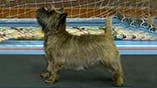 This energetic little dog is playful and into everything. It was a Cairn Terrier that famously played Toto in The Wizard of Oz.
The Cairn Terrier is a hardy little dog with pricked up ears and a harsh, shaggy coat over a soft undercoat. The coat comes in every colour except white.
The Cairn Terrier hails from Scotland and derives it's name from the way it used to bark at Cairns (small mounds of stones) to alert a farmer that a fox or badger was hiding under them.
They are intelligent and good at learning tricks. Although sociable, they can be willful. They also like digging and the sound of their own voice. They normally like strangers and children but have a tendency to chase small wildlife. They are an active little dog that will enjoy a walk outdoors and even a swim but will keep busy indoors too.
The shaggy coat needs a fair amount of grooming. They are often allergic to fleas and have a tendency to gain weight.
This energetic little dog is playful and into everything. It was a Cairn Terrier that famously played Toto in The Wizard of Oz.
The Cairn Terrier is a hardy little dog with pricked up ears and a harsh, shaggy coat over a soft undercoat. The coat comes in every colour except white.
The Cairn Terrier hails from Scotland and derives it's name from the way it used to bark at Cairns (small mounds of stones) to alert a farmer that a fox or badger was hiding under them.
They are intelligent and good at learning tricks. Although sociable, they can be willful. They also like digging and the sound of their own voice. They normally like strangers and children but have a tendency to chase small wildlife. They are an active little dog that will enjoy a walk outdoors and even a swim but will keep busy indoors too.
The shaggy coat needs a fair amount of grooming. They are often allergic to fleas and have a tendency to gain weight.
This energetic little dog is playful and into everything. It was a Cairn Terrier that famously played Toto in The Wizard of Oz.
The Cairn Terrier is a hardy little dog with pricked up ears and a harsh, shaggy coat over a soft undercoat. The coat comes in every colour except white.
The Cairn Terrier hails from Scotland and derives it's name from the way it used to bark at Cairns (small mounds of stones) to alert a farmer that a fox or badger was hiding under them.
They are intelligent and good at learning tricks. Although sociable, they can be willful. They also like digging and the sound of their own voice. They normally like strangers and children but have a tendency to chase small wildlife. They are an active little dog that will enjoy a walk outdoors and even a swim but will keep busy indoors too.
The shaggy coat needs a fair amount of grooming. They are often allergic to fleas and have a tendency to gain weight.Canaan DogThe Canaan Dog is the national breed of Israel.
They are medium-sized and well-proportioned with a wedge-shaped head and alert, pointed ears. The coat is short but double with the outer coat being harsh. They come in various colours.
They were originally bred in Israel to herd and protect sheep but have proved very useful in mine detection with the army since then too.
This highly intelligent dog likes to be kept active in body and brain and can excel at obedience and agility. Their natural instinct is to defend and protect, they are naturally wary of strangers although loyal to their families. They often have to be trained to not be aggressive towards other dogs and other animals. They need a lot of physical and mental exercise and can withstand extreme weather conditions.
The Canaan Dog's coat is easy to maintain although they shed heavily at certain times of the year. They have little odour and are generally very healthy.
The Canaan Dog is the national breed of Israel.
They are medium-sized and well-proportioned with a wedge-shaped head and alert, pointed ears. The coat is short but double with the outer coat being harsh. They come in various colours.
They were originally bred in Israel to herd and protect sheep but have proved very useful in mine detection with the army since then too.
This highly intelligent dog likes to be kept active in body and brain and can excel at obedience and agility. Their natural instinct is to defend and protect, they are naturally wary of strangers although loyal to their families. They often have to be trained to not be aggressive towards other dogs and other animals. They need a lot of physical and mental exercise and can withstand extreme weather conditions.
The Canaan Dog's coat is easy to maintain although they shed heavily at certain times of the year. They have little odour and are generally very healthy.Canadian Eskimo DogThe Canadian Eskimo Dog is one of North America's oldest pure dog breeds. They were thought to have died out but the breed was rescued in the 1970s.
They are a large and powerful dog with a wolf-like appearance. Their coat is very thick and dense and they have a mane of fur around their neck. They come in various colours with white.
They were bred to hunt and to haul supplies and people in the cold of the Arctic. They are brave, loyal and intelligent. They are not really a family dog but will tend to form a strong bond with their owner.
They are generally people friendly and can work well with other dogs but they do have a strong prey drive. They need a lot of exercise and especially enjoy dog sports that involve pulling such as carting, although they are built for stamina rather than speed.
Their thick coat means that they can suffer from heat stroke in hot climates. They need regular brushing and will shed heavily at certain times of the year. The small numbers that were used to rescue the breed mean that there are some health problems associated with inbreeding.
The Canadian Eskimo Dog is one of North America's oldest pure dog breeds. They were thought to have died out but the breed was rescued in the 1970s.
They are a large and powerful dog with a wolf-like appearance. Their coat is very thick and dense and they have a mane of fur around their neck. They come in various colours with white.
They were bred to hunt and to haul supplies and people in the cold of the Arctic. They are brave, loyal and intelligent. They are not really a family dog but will tend to form a strong bond with their owner.
They are generally people friendly and can work well with other dogs but they do have a strong prey drive. They need a lot of exercise and especially enjoy dog sports that involve pulling such as carting, although they are built for stamina rather than speed.
Their thick coat means that they can suffer from heat stroke in hot climates. They need regular brushing and will shed heavily at certain times of the year. The small numbers that were used to rescue the breed mean that there are some health problems associated with inbreeding.Catalan SheepdogThe Catalan Sheepdog will serve his family well as a loyal and intelligent companion.
They are a medium-sized dog with a long, dark, shaggy coat. Because the long hair covers the face too, it gives the impression of a beard and moustache. They tend to moult in two stages, first the front half and then the back.
They were bred to guard and herd sheep in their native Spain. They are very trainable and excel at dog sports like agility, obedience and doggy dancing. They naturally guard and tend to become attached to their family but they can be taught to get on well with other people and other animals.
They need plenty of physical and mental exercise and their long coat needs regular grooming. They are prone to hip dysplasia.
The Catalan Sheepdog will serve his family well as a loyal and intelligent companion.
They are a medium-sized dog with a long, dark, shaggy coat. Because the long hair covers the face too, it gives the impression of a beard and moustache. They tend to moult in two stages, first the front half and then the back.
They were bred to guard and herd sheep in their native Spain. They are very trainable and excel at dog sports like agility, obedience and doggy dancing. They naturally guard and tend to become attached to their family but they can be taught to get on well with other people and other animals.
They need plenty of physical and mental exercise and their long coat needs regular grooming. They are prone to hip dysplasia.Cavalier King Charles Spaniel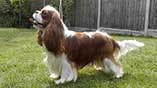 The Cavalier King Charles Spaniel is a sweet dog with an ever wagging tail who is eager to please.
They are a small, balanced, silky-coated little dog with a domed head and large, dark eyes. Their coats are usually two colours but they can be tricolour too.
The Cavalier King Charles Spaniel was bred as a companion dog. Trainable, affectionate and happy, they love human company and are good natured with other animals.
They are quite active indoors but will enjoy a daily walk too. They don't require a lot of grooming but it is necessary to trim the hair between their pads and to check their ears.
Unfortunately, this adorable little dog is prone to some serious health problems: syringomyelia (a brain disease), eye problems, kneecap problems, back problems, ear infections, deafness and hip dysplasia. If considering getting a puppy, it is advisable to check the health of the sire and dam over a few generations.
The Cavalier King Charles Spaniel is a sweet dog with an ever wagging tail who is eager to please.
They are a small, balanced, silky-coated little dog with a domed head and large, dark eyes. Their coats are usually two colours but they can be tricolour too.
The Cavalier King Charles Spaniel was bred as a companion dog. Trainable, affectionate and happy, they love human company and are good natured with other animals.
They are quite active indoors but will enjoy a daily walk too. They don't require a lot of grooming but it is necessary to trim the hair between their pads and to check their ears.
Unfortunately, this adorable little dog is prone to some serious health problems: syringomyelia (a brain disease), eye problems, kneecap problems, back problems, ear infections, deafness and hip dysplasia. If considering getting a puppy, it is advisable to check the health of the sire and dam over a few generations.
The Cavalier King Charles Spaniel is a sweet dog with an ever wagging tail who is eager to please.
They are a small, balanced, silky-coated little dog with a domed head and large, dark eyes. Their coats are usually two colours but they can be tricolour too.
The Cavalier King Charles Spaniel was bred as a companion dog. Trainable, affectionate and happy, they love human company and are good natured with other animals.
They are quite active indoors but will enjoy a daily walk too. They don't require a lot of grooming but it is necessary to trim the hair between their pads and to check their ears.
Unfortunately, this adorable little dog is prone to some serious health problems: syringomyelia (a brain disease), eye problems, kneecap problems, back problems, ear infections, deafness and hip dysplasia. If considering getting a puppy, it is advisable to check the health of the sire and dam over a few generations.Cesky TerrierCesky Terriers are a happy little dog that enjoys the company of children.
The Cesky Terrier has something of the look of the Airedale about him with his distinctive wedge-shaped head and beard; but they have a long, silky coat and much shorter legs. The coat generally comes in various shades of grey.
They were originally bred in Czechoslovakia for hunting rats and foxes. They are sweet-natured, brave and loyal, yet playful. They are intelligent and trainable but, like all terriers, can have a stubborn streak. Their natural tendency is to guard.
Although a little shy, they generally get on well with all people and animals and especially well with children. They enjoy exploring outdoors but are quite active indoors too.
They need regular grooming and trimming to keep the coat at the correct length. They are generally healthy but can be prone to Scotty Cramp Syndrome which causes an awkward walking movement.
Cesky Terriers are a happy little dog that enjoys the company of children.
The Cesky Terrier has something of the look of the Airedale about him with his distinctive wedge-shaped head and beard; but they have a long, silky coat and much shorter legs. The coat generally comes in various shades of grey.
They were originally bred in Czechoslovakia for hunting rats and foxes. They are sweet-natured, brave and loyal, yet playful. They are intelligent and trainable but, like all terriers, can have a stubborn streak. Their natural tendency is to guard.
Although a little shy, they generally get on well with all people and animals and especially well with children. They enjoy exploring outdoors but are quite active indoors too.
They need regular grooming and trimming to keep the coat at the correct length. They are generally healthy but can be prone to Scotty Cramp Syndrome which causes an awkward walking movement.ChihuahuaThe famously tiny Chihuahua is the epitome of cuteness.
Their tiny body is slightly longer than it is tall. Their head is very round with large round eyes and large erect ears. There are two types - Long Coated and Smooth Coated, they come in all colours.
They come from Mexico and were bred to be a pet that was prized for its size. They are full of energy and cheerful. They are willful but intelligent so perfectly trainable but their size inclines people to let them get away with things they would not allow a larger dog to do.
Loyal to their owner, they need to be trained to accept strangers and children in particular. They need to be taught to tolerate other animals. Although very active indoors, they need the opportunity for outdoors exercise too but the smooth coated types will need a coat in cold weather. Neither coat type needs undue brushing.
They are prone to rheumatism, gum and eye problems. They are born with a molera, an unclosed section of the skull which usually closes but remains open in some dogs making them more susceptible to injury.
The famously tiny Chihuahua is the epitome of cuteness.
Their tiny body is slightly longer than it is tall. Their head is very round with large round eyes and large erect ears. There are two types - Long Coated and Smooth Coated, they come in all colours.
They come from Mexico and were bred to be a pet that was prized for its size. They are full of energy and cheerful. They are willful but intelligent so perfectly trainable but their size inclines people to let them get away with things they would not allow a larger dog to do.
Loyal to their owner, they need to be trained to accept strangers and children in particular. They need to be taught to tolerate other animals. Although very active indoors, they need the opportunity for outdoors exercise too but the smooth coated types will need a coat in cold weather. Neither coat type needs undue brushing.
They are prone to rheumatism, gum and eye problems. They are born with a molera, an unclosed section of the skull which usually closes but remains open in some dogs making them more susceptible to injury.Chinese CrestedThe Chinese Crested is the most popular of all the hairless breeds but they actually come in two varieties, the hairless and the powderpuff.
They are a small, slender dog. The hairless has hair only on their head, feet and tail whereas the powderpuff has a soft coat all over. They have large, erect ears and come in all colours.
They actually originate in Africa but were brought on board Chinese trading ships to hunt vermin.
They crave human companionship, are alert and affectionate. They are trainable and can be remarkably good at agility. They are very people friendly but children may need to be careful not to damage the skin of the hairless. They are generally good natured with other animals. Although active indoors, they need a good daily walk too.
The hairless type do not need a lot of brushing but will need bathing frequently. The powderpuffs have a very fine coat that matts together easily so regular brushing is essential.
The hairless need sun cream to protect them against sun and coats for the cold and tend to have more problems with their teeth than the powderpuffs. Both varieties can be allergic to wool.
The Chinese Crested is the most popular of all the hairless breeds but they actually come in two varieties, the hairless and the powderpuff.
They are a small, slender dog. The hairless has hair only on their head, feet and tail whereas the powderpuff has a soft coat all over. They have large, erect ears and come in all colours.
They actually originate in Africa but were brought on board Chinese trading ships to hunt vermin.
They crave human companionship, are alert and affectionate. They are trainable and can be remarkably good at agility. They are very people friendly but children may need to be careful not to damage the skin of the hairless. They are generally good natured with other animals. Although active indoors, they need a good daily walk too.
The hairless type do not need a lot of brushing but will need bathing frequently. The powderpuffs have a very fine coat that matts together easily so regular brushing is essential.
The hairless need sun cream to protect them against sun and coats for the cold and tend to have more problems with their teeth than the powderpuffs. Both varieties can be allergic to wool.Chow ChowThe large, stocky Chow Chow may look like a big teddy bear but is no pushover.
They have quite a stiff, short gait because their hind legs are nearly straight. They also have a large head with a ruff behind and a famously blueish-black tongue. Their coat is thick and furry and often red although can come in shades of black and blue. There is a soft smooth-coated variety and a coarser rough-coat.
They are one of the oldest of the breeds from China and were used for herding, guarding and pulling carts. They are naturally protective and can be willful so close attention needs to be paid to their training.
Loyal to their owner, they need to be trained to accept other people, they may have a tendency to want to be pushy around other animals. They tend to be sedentary indoors so need a good walk outdoors every day. The thick coat needs regular brushing and they moult heavily at certain times.
They are prone to an eyelid abnormality called entropion where the eyelid turns inwards. This can usually be corrected with surgery. They can also suffer from hip dysplasia, stomach cancer and ear infections.
The large, stocky Chow Chow may look like a big teddy bear but is no pushover.
They have quite a stiff, short gait because their hind legs are nearly straight. They also have a large head with a ruff behind and a famously blueish-black tongue. Their coat is thick and furry and often red although can come in shades of black and blue. There is a soft smooth-coated variety and a coarser rough-coat.
They are one of the oldest of the breeds from China and were used for herding, guarding and pulling carts. They are naturally protective and can be willful so close attention needs to be paid to their training.
Loyal to their owner, they need to be trained to accept other people, they may have a tendency to want to be pushy around other animals. They tend to be sedentary indoors so need a good walk outdoors every day. The thick coat needs regular brushing and they moult heavily at certain times.
They are prone to an eyelid abnormality called entropion where the eyelid turns inwards. This can usually be corrected with surgery. They can also suffer from hip dysplasia, stomach cancer and ear infections.Cirneco Dell'EtnaThis nimble hound can move over the difficult terrain formed by lava flows and go for hours in the heat without food or water.
They are a slender but muscular, medium-sized hound with a short, glossy coat and upright ears. They come in shades of brown with white patches, particularly on the chest.
They come from the Island of Etna and were bred to hunt rabbit. They are lively, intelligent and independent but also affectionate. They are particularly good at hunting, using sight and hearing as well as their sense of smell, and they enjoy physical sports like agility.
They generally get on well with people and other animals but their natural instinct is to chase, they need plenty of physical and mental exercise.
Their short coat is easy to maintain. They are a very hardy breed and not prone to any particular health problem.
This nimble hound can move over the difficult terrain formed by lava flows and go for hours in the heat without food or water.
They are a slender but muscular, medium-sized hound with a short, glossy coat and upright ears. They come in shades of brown with white patches, particularly on the chest.
They come from the Island of Etna and were bred to hunt rabbit. They are lively, intelligent and independent but also affectionate. They are particularly good at hunting, using sight and hearing as well as their sense of smell, and they enjoy physical sports like agility.
They generally get on well with people and other animals but their natural instinct is to chase, they need plenty of physical and mental exercise.
Their short coat is easy to maintain. They are a very hardy breed and not prone to any particular health problem.Collie (Rough)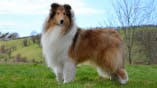 This highly intelligent dog has many talents as showcased by the famous Lassie.
The Collie is large and strong but lean. The ears are distinctive: they are partly upright but the ends fold forward. There are two coat types, the rough and the smooth. Rough Collies have long, straight hair all over their bodies with a magnificent mane down their neck and chest. They both can come in a large variety of colours including the blue merle.
They were originally bred to herd and protect sheep in Scotland but have also been successfully used in search and rescue and acting as guide dogs for the blind.
They are very intelligent and highly trainable. Although loyal and naturally protective of their family, they are good natured and normally get on well with people and other animals. They need plenty of opportunities to exercise their body and brain.
Both coat types need grooming but the rough coat needs substantially more. They are generally healthy but can be prone to PRA, eye defects and hip problems. Some of them also carry the MDR1 gene which makes them sensitive to some drugs.
This highly intelligent dog has many talents as showcased by the famous Lassie.
The Collie is large and strong but lean. The ears are distinctive: they are partly upright but the ends fold forward. There are two coat types, the rough and the smooth. Rough Collies have long, straight hair all over their bodies with a magnificent mane down their neck and chest. They both can come in a large variety of colours including the blue merle.
They were originally bred to herd and protect sheep in Scotland but have also been successfully used in search and rescue and acting as guide dogs for the blind.
They are very intelligent and highly trainable. Although loyal and naturally protective of their family, they are good natured and normally get on well with people and other animals. They need plenty of opportunities to exercise their body and brain.
Both coat types need grooming but the rough coat needs substantially more. They are generally healthy but can be prone to PRA, eye defects and hip problems. Some of them also carry the MDR1 gene which makes them sensitive to some drugs.
This highly intelligent dog has many talents as showcased by the famous Lassie.
The Collie is large and strong but lean. The ears are distinctive: they are partly upright but the ends fold forward. There are two coat types, the rough and the smooth. Rough Collies have long, straight hair all over their bodies with a magnificent mane down their neck and chest. They both can come in a large variety of colours including the blue merle.
They were originally bred to herd and protect sheep in Scotland but have also been successfully used in search and rescue and acting as guide dogs for the blind.
They are very intelligent and highly trainable. Although loyal and naturally protective of their family, they are good natured and normally get on well with people and other animals. They need plenty of opportunities to exercise their body and brain.
Both coat types need grooming but the rough coat needs substantially more. They are generally healthy but can be prone to PRA, eye defects and hip problems. Some of them also carry the MDR1 gene which makes them sensitive to some drugs.Collie (Smooth)This highly intelligent dog has many talents as showcased by the famous Lassie (of the Rough Coated type).
The Collie is large and strong but lean. The ears are distinctive: they are partly upright but the ends fold forward. There are two coat types, the rough and the smooth. Smooth-coated Collies have a shorter, harsher coat with a soft undercoat. They both can come in a large variety of colours including the blue merle.
They were originally bred to herd and protect sheep in Scotland but have also been successfully used in search and rescue and acting as guide dogs for the blind.
They are very intelligent and highly trainable. Although loyal and naturally protective of their family, they are good natured and normally get on well with people and other animals. They need plenty of opportunities to exercise their body and brain.
They are generally healthy but can be prone to PRA, eye defects and hip problems. Some of them also carry the MDR1 gene which makes them sensitive to some drugs.
This highly intelligent dog has many talents as showcased by the famous Lassie (of the Rough Coated type).
The Collie is large and strong but lean. The ears are distinctive: they are partly upright but the ends fold forward. There are two coat types, the rough and the smooth. Smooth-coated Collies have a shorter, harsher coat with a soft undercoat. They both can come in a large variety of colours including the blue merle.
They were originally bred to herd and protect sheep in Scotland but have also been successfully used in search and rescue and acting as guide dogs for the blind.
They are very intelligent and highly trainable. Although loyal and naturally protective of their family, they are good natured and normally get on well with people and other animals. They need plenty of opportunities to exercise their body and brain.
They are generally healthy but can be prone to PRA, eye defects and hip problems. Some of them also carry the MDR1 gene which makes them sensitive to some drugs.Coton De TulearThe little Coton De Tulear is always eager to please.
The French word "coton" means cotton and these dogs look like a little ball of fluffy cotton. They do come in a variety of colours but the preferred one for show dogs is white.
The Coton De Tulear is the official dog of Madagascar and was originally bred as a companion. They are friendly, lively and sociable and very people-centred and they naturally tend to get on well with people and other animals.
They are active indoors but enjoy physical exercise outdoors too, including swimming, and do well at agility.
Their long hair needs a good deal of grooming. There are no known health problems.
The little Coton De Tulear is always eager to please.
The French word "coton" means cotton and these dogs look like a little ball of fluffy cotton. They do come in a variety of colours but the preferred one for show dogs is white.
The Coton De Tulear is the official dog of Madagascar and was originally bred as a companion. They are friendly, lively and sociable and very people-centred and they naturally tend to get on well with people and other animals.
They are active indoors but enjoy physical exercise outdoors too, including swimming, and do well at agility.
Their long hair needs a good deal of grooming. There are no known health problems.Dachshund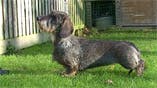 Intelligent and lively, dachshunds are generally very sociable and affectionate, although they can be quite vocal if not trained properly.
Their shape is easily identifiable, but they don't so much have long bodies as short legs. They come in 6 different varieties:
- There are 3 different coat types: smooth, long and wire;
- Two different sizes: standard and miniature.
each coat type can be in either size.
The standards should be up to 26lbs in weight, whereas the minis are 10 - 11 lbs. There are three main colours: black / tan, red and chocolate / tan although there can also be dapples and brindles too.
Originally bred for hunting, the standards went to ground for badger and fox and the miniatures for rabbit and vermin. They have an excellent sense of smell so are also used for tracking wounded game. Like all hounds, they can get distracted by scents when off lead so training for a good recall is important. They need plenty of mental stimulation and exercise otherwise they can be noisy and destructive. Not naturally obedient, with persistence they are trainable and tend to respond well to food rewards. Minis can often take longer to house-train.
They are very good with people and children, but are likely to chase and harm small furries, although they will generally tolerate animals they've been brought up with. It's important not to over-exercise puppies because of the strain this would put on their joints and developing bones, but once adult, they are surprisingly active for their shape and they enjoy exercise.
A wire coat needs the most attention as it needs hand-stripping. The other coat types need brushing too; the long-haired varieties also requiring regular attention.
They can suffer from back problems, but there is currently no preventative health test for this. It is advisable to not encourage them to run up and down stairs, or jump on or off furniture because of the stress this can put on their spine. There is an eye condition in the minis called cord1 PRA which breeders should use a DNA test for. Mini Wires should be DNA tested for Lafora Disease, a form of epilepsy.
For the most up-to-date health information and advice for buyers and owners, please visit <a href="http://www.dachshundbreedcouncil.org.uk" title="Visit the Dachshund club website">www.dachshundbreedcouncil.org.uk</a>
Intelligent and lively, dachshunds are generally very sociable and affectionate, although they can be quite vocal if not trained properly.
Their shape is easily identifiable, but they don't so much have long bodies as short legs. They come in 6 different varieties:
- There are 3 different coat types: smooth, long and wire;
- Two different sizes: standard and miniature.
each coat type can be in either size.
The standards should be up to 26lbs in weight, whereas the minis are 10 - 11 lbs. There are three main colours: black / tan, red and chocolate / tan although there can also be dapples and brindles too.
Originally bred for hunting, the standards went to ground for badger and fox and the miniatures for rabbit and vermin. They have an excellent sense of smell so are also used for tracking wounded game. Like all hounds, they can get distracted by scents when off lead so training for a good recall is important. They need plenty of mental stimulation and exercise otherwise they can be noisy and destructive. Not naturally obedient, with persistence they are trainable and tend to respond well to food rewards. Minis can often take longer to house-train.
They are very good with people and children, but are likely to chase and harm small furries, although they will generally tolerate animals they've been brought up with. It's important not to over-exercise puppies because of the strain this would put on their joints and developing bones, but once adult, they are surprisingly active for their shape and they enjoy exercise.
A wire coat needs the most attention as it needs hand-stripping. The other coat types need brushing too; the long-haired varieties also requiring regular attention.
They can suffer from back problems, but there is currently no preventative health test for this. It is advisable to not encourage them to run up and down stairs, or jump on or off furniture because of the stress this can put on their spine. There is an eye condition in the minis called cord1 PRA which breeders should use a DNA test for. Mini Wires should be DNA tested for Lafora Disease, a form of epilepsy.
For the most up-to-date health information and advice for buyers and owners, please visit <a href="http://www.dachshundbreedcouncil.org.uk" title="Visit the Dachshund club website">www.dachshundbreedcouncil.org.uk</a>
Intelligent and lively, dachshunds are generally very sociable and affectionate, although they can be quite vocal if not trained properly.
Their shape is easily identifiable, but they don't so much have long bodies as short legs. They come in 6 different varieties:
- There are 3 different coat types: smooth, long and wire;
- Two different sizes: standard and miniature.
each coat type can be in either size.
The standards should be up to 26lbs in weight, whereas the minis are 10 - 11 lbs. There are three main colours: black / tan, red and chocolate / tan although there can also be dapples and brindles too.
Originally bred for hunting, the standards went to ground for badger and fox and the miniatures for rabbit and vermin. They have an excellent sense of smell so are also used for tracking wounded game. Like all hounds, they can get distracted by scents when off lead so training for a good recall is important. They need plenty of mental stimulation and exercise otherwise they can be noisy and destructive. Not naturally obedient, with persistence they are trainable and tend to respond well to food rewards. Minis can often take longer to house-train.
They are very good with people and children, but are likely to chase and harm small furries, although they will generally tolerate animals they've been brought up with. It's important not to over-exercise puppies because of the strain this would put on their joints and developing bones, but once adult, they are surprisingly active for their shape and they enjoy exercise.
A wire coat needs the most attention as it needs hand-stripping. The other coat types need brushing too; the long-haired varieties also requiring regular attention.
They can suffer from back problems, but there is currently no preventative health test for this. It is advisable to not encourage them to run up and down stairs, or jump on or off furniture because of the stress this can put on their spine. There is an eye condition in the minis called cord1 PRA which breeders should use a DNA test for. Mini Wires should be DNA tested for Lafora Disease, a form of epilepsy.
For the most up-to-date health information and advice for buyers and owners, please visit <a href="http://www.dachshundbreedcouncil.org.uk" title="Visit the Dachshund club website">www.dachshundbreedcouncil.org.uk</a>Dalmatian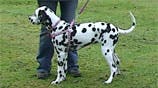 The striking Dalmatian is a playful companion as long as he has an outlet for his enormous energy.
They are large, strong and muscular with a short white coat with distinctive spots. The spots can come in a variety of colours but the preferred colours are black or liver. The puppies are born white and the spots appear later.
There is some disagreement about their country of origin although they were certainly popular in the 1800s as a carriage dog: looking distinctive following the carriage and then guarding it when the master was away unoccupied.
They have a lot of stamina and energy but are not particularly good at independent thought. As a result, they need clear leadership and something to do. With the right training they can be good with strangers, and other pets but may be a little too excitable for small children. Dalmatians need a lot of opportunity to exercise and may become destructive if not allowed to do so.
They shed all year so regular grooming is needed to help to keep that in check. There is quite a high proportion of deafness in this breed. They are also prone to urinary stones and skin allergies.
The striking Dalmatian is a playful companion as long as he has an outlet for his enormous energy.
They are large, strong and muscular with a short white coat with distinctive spots. The spots can come in a variety of colours but the preferred colours are black or liver. The puppies are born white and the spots appear later.
There is some disagreement about their country of origin although they were certainly popular in the 1800s as a carriage dog: looking distinctive following the carriage and then guarding it when the master was away unoccupied.
They have a lot of stamina and energy but are not particularly good at independent thought. As a result, they need clear leadership and something to do. With the right training they can be good with strangers, and other pets but may be a little too excitable for small children. Dalmatians need a lot of opportunity to exercise and may become destructive if not allowed to do so.
They shed all year so regular grooming is needed to help to keep that in check. There is quite a high proportion of deafness in this breed. They are also prone to urinary stones and skin allergies.
The striking Dalmatian is a playful companion as long as he has an outlet for his enormous energy.
They are large, strong and muscular with a short white coat with distinctive spots. The spots can come in a variety of colours but the preferred colours are black or liver. The puppies are born white and the spots appear later.
There is some disagreement about their country of origin although they were certainly popular in the 1800s as a carriage dog: looking distinctive following the carriage and then guarding it when the master was away unoccupied.
They have a lot of stamina and energy but are not particularly good at independent thought. As a result, they need clear leadership and something to do. With the right training they can be good with strangers, and other pets but may be a little too excitable for small children. Dalmatians need a lot of opportunity to exercise and may become destructive if not allowed to do so.
They shed all year so regular grooming is needed to help to keep that in check. There is quite a high proportion of deafness in this breed. They are also prone to urinary stones and skin allergies.Dandie Dinmont Terrier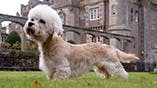 This cheeky little terrier enjoys being the centre of attention.
They are a little dog with a long body and short legs. The head is quite large for the size of the dog with close hanging ears and a distinctive top knot of soft hair. They have a soft undercoat with harsher top coat which comes in shades of pale grey (pepper) or shades of pale brown (mustard).
They actually get their name from a character in a book and come from the border between England and Scotland where they were used to kill vermin.
Essentially, they are playful, intelligent, bold and affectionate but like all terriers, have a stubborn streak. They enjoy human company and are good with children, they can be trained to get on well with other dogs and cats but their terrier nature makes them less trustworthy around small mammals. Although active indoors, they need a good daily walk too.
They need to be brushed regularly, plucked twice a year and taken for professional grooming occasionally too.
Generally healthy, they can be affected by spinal issues due to their elongated body and there are some instances of cancer and hypothyroidism. The breed can also suffer from glaucoma and the breed clubs recommend that Dandies are tested throughout their lives.
This cheeky little terrier enjoys being the centre of attention.
They are a little dog with a long body and short legs. The head is quite large for the size of the dog with close hanging ears and a distinctive top knot of soft hair. They have a soft undercoat with harsher top coat which comes in shades of pale grey (pepper) or shades of pale brown (mustard).
They actually get their name from a character in a book and come from the border between England and Scotland where they were used to kill vermin.
Essentially, they are playful, intelligent, bold and affectionate but like all terriers, have a stubborn streak. They enjoy human company and are good with children, they can be trained to get on well with other dogs and cats but their terrier nature makes them less trustworthy around small mammals. Although active indoors, they need a good daily walk too.
They need to be brushed regularly, plucked twice a year and taken for professional grooming occasionally too.
Generally healthy, they can be affected by spinal issues due to their elongated body and there are some instances of cancer and hypothyroidism. The breed can also suffer from glaucoma and the breed clubs recommend that Dandies are tested throughout their lives.
This cheeky little terrier enjoys being the centre of attention.
They are a little dog with a long body and short legs. The head is quite large for the size of the dog with close hanging ears and a distinctive top knot of soft hair. They have a soft undercoat with harsher top coat which comes in shades of pale grey (pepper) or shades of pale brown (mustard).
They actually get their name from a character in a book and come from the border between England and Scotland where they were used to kill vermin.
Essentially, they are playful, intelligent, bold and affectionate but like all terriers, have a stubborn streak. They enjoy human company and are good with children, they can be trained to get on well with other dogs and cats but their terrier nature makes them less trustworthy around small mammals. Although active indoors, they need a good daily walk too.
They need to be brushed regularly, plucked twice a year and taken for professional grooming occasionally too.
Generally healthy, they can be affected by spinal issues due to their elongated body and there are some instances of cancer and hypothyroidism. The breed can also suffer from glaucoma and the breed clubs recommend that Dandies are tested throughout their lives.DeerhoundThe gentle deerhound makes a dignified and affectionate companion.
At first glance, the Deerhound looks like a rough-coated Greyhound but they are larger and slightly heavier in build. They can come in a variety of colours but mainly black, blue-black or grey. They tend to carry their tail low, almost between their back legs.
They were bred in Scotland to help to track deer so the harsh coat is for protection against the cold. They almost became extinct, their numbers fell because, at one time, only the nobility were allowed to own one.
They are particularly good at tracking and are a well-mannered and loyal dog but can be rather slow to follow commands. They enjoy the company of people and are very good with children, they normally get on well with other dogs but have to be trained to tolerate non-canine animals. They need plenty of outdoor exercise as they tend to be sedentary indoors.
Their harsh coat needs trimming and stripping. They are prone to bloat but are otherwise generally healthy.
The gentle deerhound makes a dignified and affectionate companion.
At first glance, the Deerhound looks like a rough-coated Greyhound but they are larger and slightly heavier in build. They can come in a variety of colours but mainly black, blue-black or grey. They tend to carry their tail low, almost between their back legs.
They were bred in Scotland to help to track deer so the harsh coat is for protection against the cold. They almost became extinct, their numbers fell because, at one time, only the nobility were allowed to own one.
They are particularly good at tracking and are a well-mannered and loyal dog but can be rather slow to follow commands. They enjoy the company of people and are very good with children, they normally get on well with other dogs but have to be trained to tolerate non-canine animals. They need plenty of outdoor exercise as they tend to be sedentary indoors.
Their harsh coat needs trimming and stripping. They are prone to bloat but are otherwise generally healthy.Dobermann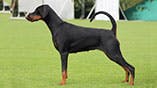 Dobermanns have a bad press, but with the right training these can be good family dogs and even be used as therapy dogs.
The Dobermann is a medium-sized, muscular dog. The short, glossy coat is often black with distinctive tan markings on the head, chest and legs but the base can be other colours too.
They are said to have been bred by German Tax Collector Louis Dobermann to help him with his work. Subsequently they have proved a valuable assistant to the police. Dobermanns are natural guarders and need strong leadership. They are very intelligent and trainable and can do well at obedience.
They can be trained to be good with children and strangers and to tolerate other animals. Dobermanns have great strength and stamina and need plenty of exercise.
Their short coat is easy to care for. They are prone to cervical spondylitis, certain blood disorders, skin problems, bloat, hip dysplasia and heart problems.
Dobermanns have a bad press, but with the right training these can be good family dogs and even be used as therapy dogs.
The Dobermann is a medium-sized, muscular dog. The short, glossy coat is often black with distinctive tan markings on the head, chest and legs but the base can be other colours too.
They are said to have been bred by German Tax Collector Louis Dobermann to help him with his work. Subsequently they have proved a valuable assistant to the police. Dobermanns are natural guarders and need strong leadership. They are very intelligent and trainable and can do well at obedience.
They can be trained to be good with children and strangers and to tolerate other animals. Dobermanns have great strength and stamina and need plenty of exercise.
Their short coat is easy to care for. They are prone to cervical spondylitis, certain blood disorders, skin problems, bloat, hip dysplasia and heart problems.
Dobermanns have a bad press, but with the right training these can be good family dogs and even be used as therapy dogs.
The Dobermann is a medium-sized, muscular dog. The short, glossy coat is often black with distinctive tan markings on the head, chest and legs but the base can be other colours too.
They are said to have been bred by German Tax Collector Louis Dobermann to help him with his work. Subsequently they have proved a valuable assistant to the police. Dobermanns are natural guarders and need strong leadership. They are very intelligent and trainable and can do well at obedience.
They can be trained to be good with children and strangers and to tolerate other animals. Dobermanns have great strength and stamina and need plenty of exercise.
Their short coat is easy to care for. They are prone to cervical spondylitis, certain blood disorders, skin problems, bloat, hip dysplasia and heart problems.Dogue de Bordeaux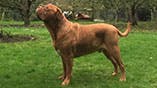 The Dogue de Bordeaux is extremely loyal and a natural guard.
The Dogue de Bordeaux is also called the French Mastiff and has the typical mastiff look of being stocky with a huge wrinkled head. These mastiffs are quite short legged and have loose-fitting skin. Their coats are short and reddish and they occasionally have white markings on the chest and feet.
They were originally bred as a guard dog, both of people and animals such as sheep and cattle but have been used in baiting and hunting too. They are naturally protective of their family and often good with children but they are essentially a guard dog and need firm training to learn tolerance towards others. The Dogue de Bordeaux tends to snore and drool too.
They can be trained to tolerate strangers and other animals. They are inclined to be inactive indoors so need a good daily walk outside. They are also surprisingly agile and can jump quite well.
Little grooming is needed. They are generally healthy but can be prone to hip dysplasia and the dams often have to have cesareans when giving birth.
The Dogue de Bordeaux is extremely loyal and a natural guard.
The Dogue de Bordeaux is also called the French Mastiff and has the typical mastiff look of being stocky with a huge wrinkled head. These mastiffs are quite short legged and have loose-fitting skin. Their coats are short and reddish and they occasionally have white markings on the chest and feet.
They were originally bred as a guard dog, both of people and animals such as sheep and cattle but have been used in baiting and hunting too. They are naturally protective of their family and often good with children but they are essentially a guard dog and need firm training to learn tolerance towards others. The Dogue de Bordeaux tends to snore and drool too.
They can be trained to tolerate strangers and other animals. They are inclined to be inactive indoors so need a good daily walk outside. They are also surprisingly agile and can jump quite well.
Little grooming is needed. They are generally healthy but can be prone to hip dysplasia and the dams often have to have cesareans when giving birth.
The Dogue de Bordeaux is extremely loyal and a natural guard.
The Dogue de Bordeaux is also called the French Mastiff and has the typical mastiff look of being stocky with a huge wrinkled head. These mastiffs are quite short legged and have loose-fitting skin. Their coats are short and reddish and they occasionally have white markings on the chest and feet.
They were originally bred as a guard dog, both of people and animals such as sheep and cattle but have been used in baiting and hunting too. They are naturally protective of their family and often good with children but they are essentially a guard dog and need firm training to learn tolerance towards others. The Dogue de Bordeaux tends to snore and drool too.
They can be trained to tolerate strangers and other animals. They are inclined to be inactive indoors so need a good daily walk outside. They are also surprisingly agile and can jump quite well.
Little grooming is needed. They are generally healthy but can be prone to hip dysplasia and the dams often have to have cesareans when giving birth.English SetterThe English Setter makes a fine looking and affectionate companion.
The English Setter is an impressive looking dog with quite a deep chest, long, silky ears and a silky, white coat with flecking in another colour called "belton". They are a lean but strong gundog with an elegance of movement.
They were bred to help hunters on shooting expeditions. The term "setter" refers to the crouching stance when they find game.
They are calm and quiet and very trainable. They tend to be good with strangers and excellent with children and they generally get on well with other animals. Although quite inactive indoors they have a lot of stamina and will need plenty of outdoor exercise.
It is not too difficult to keep the silky coat in good condition. It just requires regular brushing and occasional trimming. They are prone to hip dysplasia and mast cell tumours and the females are prone to false pregnancies.
The English Setter makes a fine looking and affectionate companion.
The English Setter is an impressive looking dog with quite a deep chest, long, silky ears and a silky, white coat with flecking in another colour called "belton". They are a lean but strong gundog with an elegance of movement.
They were bred to help hunters on shooting expeditions. The term "setter" refers to the crouching stance when they find game.
They are calm and quiet and very trainable. They tend to be good with strangers and excellent with children and they generally get on well with other animals. Although quite inactive indoors they have a lot of stamina and will need plenty of outdoor exercise.
It is not too difficult to keep the silky coat in good condition. It just requires regular brushing and occasional trimming. They are prone to hip dysplasia and mast cell tumours and the females are prone to false pregnancies.English Toy Terrier (Black & Tan) The English Toy Terrier is the oldest of the terrier breeds and is full of energy.
They are a small, slender but muscular dog with a long, narrow head and pointed, erect ears. Their smooth coat is black and tan.
They were bred to kill vermin and are said to be the best terrier for this task. They are highly intelligent, alert, eager to please and powerful. This makes them excellent at sports like agility but their body and brain must be kept exercised.
They generally get along well with people and are usually good natured with other dogs but may not be trustworthy around small mammals. They are very active indoors but need plenty of exercise outside too.
Their short, shiny coat is easy to care for with minimal grooming. They can be prone to problems with their blood.
The English Toy Terrier is the oldest of the terrier breeds and is full of energy.
They are a small, slender but muscular dog with a long, narrow head and pointed, erect ears. Their smooth coat is black and tan.
They were bred to kill vermin and are said to be the best terrier for this task. They are highly intelligent, alert, eager to please and powerful. This makes them excellent at sports like agility but their body and brain must be kept exercised.
They generally get along well with people and are usually good natured with other dogs but may not be trustworthy around small mammals. They are very active indoors but need plenty of exercise outside too.
Their short, shiny coat is easy to care for with minimal grooming. They can be prone to problems with their blood.
The English Toy Terrier is the oldest of the terrier breeds and is full of energy.
They are a small, slender but muscular dog with a long, narrow head and pointed, erect ears. Their smooth coat is black and tan.
They were bred to kill vermin and are said to be the best terrier for this task. They are highly intelligent, alert, eager to please and powerful. This makes them excellent at sports like agility but their body and brain must be kept exercised.
They generally get along well with people and are usually good natured with other dogs but may not be trustworthy around small mammals. They are very active indoors but need plenty of exercise outside too.
Their short, shiny coat is easy to care for with minimal grooming. They can be prone to problems with their blood.Entlebucher Mountain Dog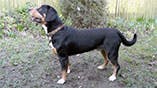 The Entlebucher is a popular family dog in Switzerland.
They are the smallest of the Swiss Mountain Dogs. All four have the same sort of markings: mainly black with tan and white in particular areas. The Entlebucher's coat is close, harsh and shiny with a thick undercoat. They are a squarish, sturdy dog.
Their origins are uncertain but they were used as a cattle herding and general farm dog in Switzerland.
They are faithful, people-friendly, intelligent and eager to please. They tend to get on well with all people and other animals. They are agile and need regular outdoor exercise.
Their coat is quite easy to maintain with regular brushing. There are no known health problems.
The Entlebucher is a popular family dog in Switzerland.
They are the smallest of the Swiss Mountain Dogs. All four have the same sort of markings: mainly black with tan and white in particular areas. The Entlebucher's coat is close, harsh and shiny with a thick undercoat. They are a squarish, sturdy dog.
Their origins are uncertain but they were used as a cattle herding and general farm dog in Switzerland.
They are faithful, people-friendly, intelligent and eager to please. They tend to get on well with all people and other animals. They are agile and need regular outdoor exercise.
Their coat is quite easy to maintain with regular brushing. There are no known health problems.
The Entlebucher is a popular family dog in Switzerland.
They are the smallest of the Swiss Mountain Dogs. All four have the same sort of markings: mainly black with tan and white in particular areas. The Entlebucher's coat is close, harsh and shiny with a thick undercoat. They are a squarish, sturdy dog.
Their origins are uncertain but they were used as a cattle herding and general farm dog in Switzerland.
They are faithful, people-friendly, intelligent and eager to please. They tend to get on well with all people and other animals. They are agile and need regular outdoor exercise.
Their coat is quite easy to maintain with regular brushing. There are no known health problems.Estrela Mountain DogThe Estrela is good if you want a substantial dog with a commanding voice.
This is a large, strong and sturdy dog. They come in two coat types: long and short. The long has a slightly coarse, thick top coat and dense undercoat. The short is similar but the outer coat is shorter. They can come in a variety of colours.
They are Portuguese and were bred to fight wolves and protect sheep. Their urge to guard is strong and they are devoted to their family but can be suspicious of strangers. They are strong-willed but intelligent and trainable. They can be taught to get on well with strangers and other animals.
They need good daily exercise outside and often favour being outside because of their thick coats. They're also agile and capable of jumping substantial heights.
They are relatively easy to groom despite the thick coat. There are no known health problems.
The Estrela is good if you want a substantial dog with a commanding voice.
This is a large, strong and sturdy dog. They come in two coat types: long and short. The long has a slightly coarse, thick top coat and dense undercoat. The short is similar but the outer coat is shorter. They can come in a variety of colours.
They are Portuguese and were bred to fight wolves and protect sheep. Their urge to guard is strong and they are devoted to their family but can be suspicious of strangers. They are strong-willed but intelligent and trainable. They can be taught to get on well with strangers and other animals.
They need good daily exercise outside and often favour being outside because of their thick coats. They're also agile and capable of jumping substantial heights.
They are relatively easy to groom despite the thick coat. There are no known health problems.Eurasier The Eurasier is a calm, even-tempered dog that forms a very close bond with their family.
They are a medium-sized, balanced spitz style dog that comes in a variety of colours. They have a double coat with a thick undercoat and long outer hairs, although the hair is shorter on the head and front legs. Unusually, their tongue may be pink, blue-black or spotted.
The Eurasia is quite a recent breed having been developed in Germany, in the 1960s, to combine the best qualities of the Chow Chow and Wolfspitz and, later, the Samoyed with the intention breeding a companion dog.
They are dignified, affectionate, gentle, intelligent, easy to train and very people-oriented. They are watchful of strangers but never aggressive and are vigilant but friendly to other dogs.
They need a good amount of exercise and the thick coat needs regular brushing. There are no known health problems.
The Eurasier is a calm, even-tempered dog that forms a very close bond with their family.
They are a medium-sized, balanced spitz style dog that comes in a variety of colours. They have a double coat with a thick undercoat and long outer hairs, although the hair is shorter on the head and front legs. Unusually, their tongue may be pink, blue-black or spotted.
The Eurasia is quite a recent breed having been developed in Germany, in the 1960s, to combine the best qualities of the Chow Chow and Wolfspitz and, later, the Samoyed with the intention breeding a companion dog.
They are dignified, affectionate, gentle, intelligent, easy to train and very people-oriented. They are watchful of strangers but never aggressive and are vigilant but friendly to other dogs.
They need a good amount of exercise and the thick coat needs regular brushing. There are no known health problems.
The Eurasier is a calm, even-tempered dog that forms a very close bond with their family.
They are a medium-sized, balanced spitz style dog that comes in a variety of colours. They have a double coat with a thick undercoat and long outer hairs, although the hair is shorter on the head and front legs. Unusually, their tongue may be pink, blue-black or spotted.
The Eurasia is quite a recent breed having been developed in Germany, in the 1960s, to combine the best qualities of the Chow Chow and Wolfspitz and, later, the Samoyed with the intention breeding a companion dog.
They are dignified, affectionate, gentle, intelligent, easy to train and very people-oriented. They are watchful of strangers but never aggressive and are vigilant but friendly to other dogs.
They need a good amount of exercise and the thick coat needs regular brushing. There are no known health problems.Finnish Lapphund The Finnish Lapphund is a friendly, family dog that loves people and is eager to please.
A little less than medium-sized and fairly broad in body and head with a curly tail, they are often tricolour with brown 'eye-brow' markings. Their double coat is long and very thick, consisting of a longer outer coat and a thick, wooly undercoat to enable them to survive in extreme cold conditions in their native Finland.
They were originally used by the Sami people for herding reindeer so they enjoy being outdoors and will often choose to stay outside. Like many other spitz breeds, they can be vocal. They are very good with people and children and generally fine with other dogs but have a tendency to chase wildlife. They are full of energy and need quite a bit of exercise and many breeders will require new owners to have a good sized garden.
Their coat doesn't matt easily but grooming can be quite time consuming as there is so much coat, a good groom once a week should be fine. They can moult periodically quite dramatically and require regular combing during this time to remove loose hair. Health testing is done for PRA (night blindness). There are also problems with hereditary cataracts but the gene has not yet been found for this and they should be hip scored before breeding.
The Finnish Lapphund is a friendly, family dog that loves people and is eager to please.
A little less than medium-sized and fairly broad in body and head with a curly tail, they are often tricolour with brown 'eye-brow' markings. Their double coat is long and very thick, consisting of a longer outer coat and a thick, wooly undercoat to enable them to survive in extreme cold conditions in their native Finland.
They were originally used by the Sami people for herding reindeer so they enjoy being outdoors and will often choose to stay outside. Like many other spitz breeds, they can be vocal. They are very good with people and children and generally fine with other dogs but have a tendency to chase wildlife. They are full of energy and need quite a bit of exercise and many breeders will require new owners to have a good sized garden.
Their coat doesn't matt easily but grooming can be quite time consuming as there is so much coat, a good groom once a week should be fine. They can moult periodically quite dramatically and require regular combing during this time to remove loose hair. Health testing is done for PRA (night blindness). There are also problems with hereditary cataracts but the gene has not yet been found for this and they should be hip scored before breeding.
The Finnish Lapphund is a friendly, family dog that loves people and is eager to please.
A little less than medium-sized and fairly broad in body and head with a curly tail, they are often tricolour with brown 'eye-brow' markings. Their double coat is long and very thick, consisting of a longer outer coat and a thick, wooly undercoat to enable them to survive in extreme cold conditions in their native Finland.
They were originally used by the Sami people for herding reindeer so they enjoy being outdoors and will often choose to stay outside. Like many other spitz breeds, they can be vocal. They are very good with people and children and generally fine with other dogs but have a tendency to chase wildlife. They are full of energy and need quite a bit of exercise and many breeders will require new owners to have a good sized garden.
Their coat doesn't matt easily but grooming can be quite time consuming as there is so much coat, a good groom once a week should be fine. They can moult periodically quite dramatically and require regular combing during this time to remove loose hair. Health testing is done for PRA (night blindness). There are also problems with hereditary cataracts but the gene has not yet been found for this and they should be hip scored before breeding.Finnish SpitzThe Finnish Spitz was not named the "barking bird dog" for nothing. They were bred to bark and even take part in barking contests.
There is something fox-like in their appearance. They have a a foxy face and reddish colouring. Their body is muscular and square and their impressive tail curls up and over the body in typical spitz fashion. The double coat is typically spitz too with a dense undercoat and rather harsh top coat.
They originally came from Russia but are now the national dog of Finland. They were used to hunt small game and would alert the hunter with a yodelling bark.
They are friendly, loyal, lively, intelligent and brave. They tend not to be fully mature until about 3 or 4 years old. They generally get on well with people and children and with the right training, they will get along with other animals. They need plenty of exercise, especially outdoors.
Their coat is fairy easy to maintain but they shed heavily at certain times of the year. There are no known health problems.
The Finnish Spitz was not named the "barking bird dog" for nothing. They were bred to bark and even take part in barking contests.
There is something fox-like in their appearance. They have a a foxy face and reddish colouring. Their body is muscular and square and their impressive tail curls up and over the body in typical spitz fashion. The double coat is typically spitz too with a dense undercoat and rather harsh top coat.
They originally came from Russia but are now the national dog of Finland. They were used to hunt small game and would alert the hunter with a yodelling bark.
They are friendly, loyal, lively, intelligent and brave. They tend not to be fully mature until about 3 or 4 years old. They generally get on well with people and children and with the right training, they will get along with other animals. They need plenty of exercise, especially outdoors.
Their coat is fairy easy to maintain but they shed heavily at certain times of the year. There are no known health problems.Fox Terrier (Wire and Smooth) Fox Terriers make a great little family dog if you can keep up with them.
The Fox Terrier is a medium-sized dog, quite trim but with a rather muscular neck and v-shaped ears that drop forwards. They come in two coat types: smooth and wiry, but both are white with black or brown markings. The smooth coated has a short and flat coat. The wiry coated has a dense undercoat and an outer one that is also dense and twisted, similar to the hair on a coconut.
The Fox Terrier is one of the oldest Terrier breeds in Britain. They were bred to help farmers to get rid of vermin, either by killing rats etc themselves or by harassing them out of hiding for the farmer to kill.
They are fearless, friendly and full of energy. They are also highly intelligent and especially good at learning tricks. They like people and are very good with children but they do have a very strong hunting urge so cannot be trusted around non-canine animals.
Although they are an active dog indoors, they need plenty to exercise their body and brain. Care must be taken outdoors as their natural terrier instinct makes them inclined to run off to chase something.
The short coat of the smooth coated Fox Terrier is easy to maintain but the wire coated will need stripping. On the plus side, the wire haireds shed very little hair. Fox Terriers that are largely white are more prone to deafness and may also be prone to Mast Cell Tumours. Wire haireds are also prone to epilepsy.
Fox Terriers make a great little family dog if you can keep up with them.
The Fox Terrier is a medium-sized dog, quite trim but with a rather muscular neck and v-shaped ears that drop forwards. They come in two coat types: smooth and wiry, but both are white with black or brown markings. The smooth coated has a short and flat coat. The wiry coated has a dense undercoat and an outer one that is also dense and twisted, similar to the hair on a coconut.
The Fox Terrier is one of the oldest Terrier breeds in Britain. They were bred to help farmers to get rid of vermin, either by killing rats etc themselves or by harassing them out of hiding for the farmer to kill.
They are fearless, friendly and full of energy. They are also highly intelligent and especially good at learning tricks. They like people and are very good with children but they do have a very strong hunting urge so cannot be trusted around non-canine animals.
Although they are an active dog indoors, they need plenty to exercise their body and brain. Care must be taken outdoors as their natural terrier instinct makes them inclined to run off to chase something.
The short coat of the smooth coated Fox Terrier is easy to maintain but the wire coated will need stripping. On the plus side, the wire haireds shed very little hair. Fox Terriers that are largely white are more prone to deafness and may also be prone to Mast Cell Tumours. Wire haireds are also prone to epilepsy.
Fox Terriers make a great little family dog if you can keep up with them.
The Fox Terrier is a medium-sized dog, quite trim but with a rather muscular neck and v-shaped ears that drop forwards. They come in two coat types: smooth and wiry, but both are white with black or brown markings. The smooth coated has a short and flat coat. The wiry coated has a dense undercoat and an outer one that is also dense and twisted, similar to the hair on a coconut.
The Fox Terrier is one of the oldest Terrier breeds in Britain. They were bred to help farmers to get rid of vermin, either by killing rats etc themselves or by harassing them out of hiding for the farmer to kill.
They are fearless, friendly and full of energy. They are also highly intelligent and especially good at learning tricks. They like people and are very good with children but they do have a very strong hunting urge so cannot be trusted around non-canine animals.
Although they are an active dog indoors, they need plenty to exercise their body and brain. Care must be taken outdoors as their natural terrier instinct makes them inclined to run off to chase something.
The short coat of the smooth coated Fox Terrier is easy to maintain but the wire coated will need stripping. On the plus side, the wire haireds shed very little hair. Fox Terriers that are largely white are more prone to deafness and may also be prone to Mast Cell Tumours. Wire haireds are also prone to epilepsy.FoxhoundThe Foxhound is a large and very energetic hunting dog.
They have a wide head with large, brown eyes and a long muzzle. Their short and dense but glossy coat is usually a combination of black, tan and white.
They were bred in the UK for tracking and hunting in packs, and with their great stamina, they work well with hunters on horseback. In the UK this breed is still most often found in kennelled packs, and is not widely kept as a pet. The Foxhound loves to run and likes to 'bay' rather than bark, but can be stubborn so patient and continuous training is needed. Excellent with people, particularly children, this breed accepts leadership well but training requires patience. They prefer being with other dogs, and are generally good with other household pets, but are likely to take off if they pick up an interesting scent whilst off the lead. Once they have reached adulthood, until they are around 6 years old, this dog can run at speed for many hours at a time, so they need a lot of daily exercise in the form of long and brisk walks or runs.
They are easy to groom with a comb or firm brush. There are no known health problems.
The Foxhound is a large and very energetic hunting dog.
They have a wide head with large, brown eyes and a long muzzle. Their short and dense but glossy coat is usually a combination of black, tan and white.
They were bred in the UK for tracking and hunting in packs, and with their great stamina, they work well with hunters on horseback. In the UK this breed is still most often found in kennelled packs, and is not widely kept as a pet. The Foxhound loves to run and likes to 'bay' rather than bark, but can be stubborn so patient and continuous training is needed. Excellent with people, particularly children, this breed accepts leadership well but training requires patience. They prefer being with other dogs, and are generally good with other household pets, but are likely to take off if they pick up an interesting scent whilst off the lead. Once they have reached adulthood, until they are around 6 years old, this dog can run at speed for many hours at a time, so they need a lot of daily exercise in the form of long and brisk walks or runs.
They are easy to groom with a comb or firm brush. There are no known health problems.French Bulldog This mini version of the Bulldog loves to play the clown.
They are a sturdy, compact little dog with quite a large head and mouth and slightly rounded 'bat' ears that stand straight up. The eyes are prominent too. Their short, smooth coat comes in a wide range of colours including brindle and spotted.
They actually originate from England when lacemakers wanted a miniature bulldog as a lapdog but the lacemakers moved to France in the industrial revolution and took their dogs with them where they were renamed.
They are easy-going, playful and affectionate. They are game for anything and intelligent but not noisy or demanding. They generally get along well with people and other animals although they do like to catch mice. They are quite active indoors but enjoy a daily walk too. Care needs to be taken in hot weather as they are prone to heatstroke and around water as most of them cannot swim.
Little grooming is needed. They are prone to quite a range of problems so vet bills can be high. Typically affected areas are joints, spine, heart and eyes and they often suffer from respiratory problems. Pups are normally delivered via cesarean section.
This mini version of the Bulldog loves to play the clown.
They are a sturdy, compact little dog with quite a large head and mouth and slightly rounded 'bat' ears that stand straight up. The eyes are prominent too. Their short, smooth coat comes in a wide range of colours including brindle and spotted.
They actually originate from England when lacemakers wanted a miniature bulldog as a lapdog but the lacemakers moved to France in the industrial revolution and took their dogs with them where they were renamed.
They are easy-going, playful and affectionate. They are game for anything and intelligent but not noisy or demanding. They generally get along well with people and other animals although they do like to catch mice. They are quite active indoors but enjoy a daily walk too. Care needs to be taken in hot weather as they are prone to heatstroke and around water as most of them cannot swim.
Little grooming is needed. They are prone to quite a range of problems so vet bills can be high. Typically affected areas are joints, spine, heart and eyes and they often suffer from respiratory problems. Pups are normally delivered via cesarean section.
This mini version of the Bulldog loves to play the clown.
They are a sturdy, compact little dog with quite a large head and mouth and slightly rounded 'bat' ears that stand straight up. The eyes are prominent too. Their short, smooth coat comes in a wide range of colours including brindle and spotted.
They actually originate from England when lacemakers wanted a miniature bulldog as a lapdog but the lacemakers moved to France in the industrial revolution and took their dogs with them where they were renamed.
They are easy-going, playful and affectionate. They are game for anything and intelligent but not noisy or demanding. They generally get along well with people and other animals although they do like to catch mice. They are quite active indoors but enjoy a daily walk too. Care needs to be taken in hot weather as they are prone to heatstroke and around water as most of them cannot swim.
Little grooming is needed. They are prone to quite a range of problems so vet bills can be high. Typically affected areas are joints, spine, heart and eyes and they often suffer from respiratory problems. Pups are normally delivered via cesarean section.German PinscherGerman Pinchers make an excellent watchdog and decent family pet once they know what the rules are.
They are a medium-sized, tall terrier with a head shaped like a blunt wedge. Their smooth, glossy coat is normally black and tan.
They originate from Germany where they were used on farms as an all round worker: herding, guarding, destroying vermin; but also as a family pet. "Pincsher" is the German word for Terrier and the German Pinscher displays many typical terrier characteristics. They are brave, lively, determined and intelligent and respond well to obedience training.
They can be taught to get on well with strangers but they have a strong urge to protect. The same goes for other dogs but they don't back down from a challenge and have a tendency to chase non-canines. This breed needs a lot of exercise, hey have a lot of energy and stamina.
Their coat needs little grooming and there are no known health problems.
German Pinchers make an excellent watchdog and decent family pet once they know what the rules are.
They are a medium-sized, tall terrier with a head shaped like a blunt wedge. Their smooth, glossy coat is normally black and tan.
They originate from Germany where they were used on farms as an all round worker: herding, guarding, destroying vermin; but also as a family pet. "Pincsher" is the German word for Terrier and the German Pinscher displays many typical terrier characteristics. They are brave, lively, determined and intelligent and respond well to obedience training.
They can be taught to get on well with strangers but they have a strong urge to protect. The same goes for other dogs but they don't back down from a challenge and have a tendency to chase non-canines. This breed needs a lot of exercise, hey have a lot of energy and stamina.
Their coat needs little grooming and there are no known health problems.German Pointer (Long and Shorthaired)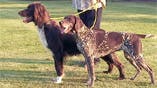 For a country-living family with a healthy outdoor life, especially if they love to go hunting, the German Pointer is hard to beat.
They are a medium-sized, well-proportioned dog. The German Pointer actually comes in three coat types, the shorthaired, the longhaired and the wirehaired (for a description of the Wirehaired Pointer <a href="/breed-library/german-wirehaired-pointer" title="German wirehaired pointer">click here</a>). All coat types come in combinations of liver, white and black. Shorthaireds are the smallest. Their coat is short, thick and slightly rough. The Longhaired is the largest, their coat is a little longer and wavy but is firm rather than silky.
They were bred in Germany for hunting so had to be good at tracking, pointing and retrieving across both land and water, but they were also bred to be a family pet and watchdog. Affectionate, intelligent and eager to learn, they are very trainable and excel at gundog work but also at obedience and in the show ring. They are happiest when they have a job to do and are normally good natured with all people and animals. Both coat types are extremely energetic and need plenty of opportunity to run and swim on a regular basis.
The short coat is easy to groom, the longhaireds need a little more attention especially in the winter and spring months when grass seeds, mud and or snow can ball up between their feet. Teasels and other weeds can collect in the hair around their ears and in their longer coat causing it to matt and tangle. Both breeds are reasonably healthy and that is because breeders are encouraged to have breeding stock hip scored and eye tested. When looking for a puppy the questions about health testing should be asked of the breeder.
For a country-living family with a healthy outdoor life, especially if they love to go hunting, the German Pointer is hard to beat.
They are a medium-sized, well-proportioned dog. The German Pointer actually comes in three coat types, the shorthaired, the longhaired and the wirehaired (for a description of the Wirehaired Pointer <a href="/breed-library/german-wirehaired-pointer" title="German wirehaired pointer">click here</a>). All coat types come in combinations of liver, white and black. Shorthaireds are the smallest. Their coat is short, thick and slightly rough. The Longhaired is the largest, their coat is a little longer and wavy but is firm rather than silky.
They were bred in Germany for hunting so had to be good at tracking, pointing and retrieving across both land and water, but they were also bred to be a family pet and watchdog. Affectionate, intelligent and eager to learn, they are very trainable and excel at gundog work but also at obedience and in the show ring. They are happiest when they have a job to do and are normally good natured with all people and animals. Both coat types are extremely energetic and need plenty of opportunity to run and swim on a regular basis.
The short coat is easy to groom, the longhaireds need a little more attention especially in the winter and spring months when grass seeds, mud and or snow can ball up between their feet. Teasels and other weeds can collect in the hair around their ears and in their longer coat causing it to matt and tangle. Both breeds are reasonably healthy and that is because breeders are encouraged to have breeding stock hip scored and eye tested. When looking for a puppy the questions about health testing should be asked of the breeder.
For a country-living family with a healthy outdoor life, especially if they love to go hunting, the German Pointer is hard to beat.
They are a medium-sized, well-proportioned dog. The German Pointer actually comes in three coat types, the shorthaired, the longhaired and the wirehaired (for a description of the Wirehaired Pointer <a href="/breed-library/german-wirehaired-pointer" title="German wirehaired pointer">click here</a>). All coat types come in combinations of liver, white and black. Shorthaireds are the smallest. Their coat is short, thick and slightly rough. The Longhaired is the largest, their coat is a little longer and wavy but is firm rather than silky.
They were bred in Germany for hunting so had to be good at tracking, pointing and retrieving across both land and water, but they were also bred to be a family pet and watchdog. Affectionate, intelligent and eager to learn, they are very trainable and excel at gundog work but also at obedience and in the show ring. They are happiest when they have a job to do and are normally good natured with all people and animals. Both coat types are extremely energetic and need plenty of opportunity to run and swim on a regular basis.
The short coat is easy to groom, the longhaireds need a little more attention especially in the winter and spring months when grass seeds, mud and or snow can ball up between their feet. Teasels and other weeds can collect in the hair around their ears and in their longer coat causing it to matt and tangle. Both breeds are reasonably healthy and that is because breeders are encouraged to have breeding stock hip scored and eye tested. When looking for a puppy the questions about health testing should be asked of the breeder.German Pointer (Wirehaired)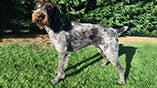 For a country-living family with a healthy outdoor life, especially if they love to go hunting, the German Pointer is hard to beat.
They are a medium-sized, well-proportioned dog. The German Pointer actually comes in three coat types, the shorthaired, the longhaired and the wirehaired (for a description of the Shorthaired and Longhaired Pointers <a href="/breed-library/german-longhaired-shorthaired-pointer" title="German Shorthaired and Longhaired pointers">click here</a>). All coat types come in combinations of liver, white and black. Wirehaireds are between the Short and Longhaireds in terms of size. Their coat is more weather repellent and helps to protect them against prickly undergrowth; it is about 4cms long and gives them a rather bearded look.
They were bred in Germany for hunting so had to be good at tracking, pointing and retrieving across both land and water, but they were also bred to be a family pet and watchdog. Affectionate, intelligent and eager to learn, they are very trainable and excel at gundog work but also at obedience and in the show ring. They are happiest when they have a job to do and are normally good natured with all people and animals. They are extremely energetic and need plenty of opportunity to run and swim on a regular basis.
The coat is fairly easy to groom but does need occasional stripping. They can be prone to eye and ear problems and skin cancers but are usually a healthy breed because breeders are encouraged to have breeding stock hip scored and eye tested. When looking for a puppy the questions about health testing should be asked of the breeder.
For a country-living family with a healthy outdoor life, especially if they love to go hunting, the German Pointer is hard to beat.
They are a medium-sized, well-proportioned dog. The German Pointer actually comes in three coat types, the shorthaired, the longhaired and the wirehaired (for a description of the Shorthaired and Longhaired Pointers <a href="/breed-library/german-longhaired-shorthaired-pointer" title="German Shorthaired and Longhaired pointers">click here</a>). All coat types come in combinations of liver, white and black. Wirehaireds are between the Short and Longhaireds in terms of size. Their coat is more weather repellent and helps to protect them against prickly undergrowth; it is about 4cms long and gives them a rather bearded look.
They were bred in Germany for hunting so had to be good at tracking, pointing and retrieving across both land and water, but they were also bred to be a family pet and watchdog. Affectionate, intelligent and eager to learn, they are very trainable and excel at gundog work but also at obedience and in the show ring. They are happiest when they have a job to do and are normally good natured with all people and animals. They are extremely energetic and need plenty of opportunity to run and swim on a regular basis.
The coat is fairly easy to groom but does need occasional stripping. They can be prone to eye and ear problems and skin cancers but are usually a healthy breed because breeders are encouraged to have breeding stock hip scored and eye tested. When looking for a puppy the questions about health testing should be asked of the breeder.
For a country-living family with a healthy outdoor life, especially if they love to go hunting, the German Pointer is hard to beat.
They are a medium-sized, well-proportioned dog. The German Pointer actually comes in three coat types, the shorthaired, the longhaired and the wirehaired (for a description of the Shorthaired and Longhaired Pointers <a href="/breed-library/german-longhaired-shorthaired-pointer" title="German Shorthaired and Longhaired pointers">click here</a>). All coat types come in combinations of liver, white and black. Wirehaireds are between the Short and Longhaireds in terms of size. Their coat is more weather repellent and helps to protect them against prickly undergrowth; it is about 4cms long and gives them a rather bearded look.
They were bred in Germany for hunting so had to be good at tracking, pointing and retrieving across both land and water, but they were also bred to be a family pet and watchdog. Affectionate, intelligent and eager to learn, they are very trainable and excel at gundog work but also at obedience and in the show ring. They are happiest when they have a job to do and are normally good natured with all people and animals. They are extremely energetic and need plenty of opportunity to run and swim on a regular basis.
The coat is fairly easy to groom but does need occasional stripping. They can be prone to eye and ear problems and skin cancers but are usually a healthy breed because breeders are encouraged to have breeding stock hip scored and eye tested. When looking for a puppy the questions about health testing should be asked of the breeder.German Shepherd Dog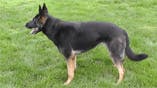 Given consistent, firm training, the German Shepherd Dog, or GSD, can turn his paw to pretty much anything.
They are balanced, muscular and very strong with long, pointed ears and a bushy tail. There are three coat types, the most common double coat, the plush coat, and the longhaired coat. All of these coat types appear fairly frequently, they come in degrees of thickness but all are quite soft and come in shades of black and tan, black, white and sable.
The name tells us everything about this dog's history: originally a working farm dog from Germany, but they have proved invaluable in police work, the armed forces and many other fields.
German Shepherds are fearless, loyal, eager to learn, very intelligent and have a steady temperament. They are highly skilled as a working dog and can be trained for a huge range of jobs as well as activities such as obedience and flyball. They bond closely with a family but can be wary of strangers, they can be trained to get on well with other animals. They need lots of opportunities for physical and mental exercise.
They need regular grooming but are likely to shed constantly despite this. There are some known hereditary diseases such as hip and elbow dysplasia, blood disorders, digestive problems, bloat, epilepsy, eczema, keratitis, dwarfism and flea allergies.
Given consistent, firm training, the German Shepherd Dog, or GSD, can turn his paw to pretty much anything.
They are balanced, muscular and very strong with long, pointed ears and a bushy tail. There are three coat types, the most common double coat, the plush coat, and the longhaired coat. All of these coat types appear fairly frequently, they come in degrees of thickness but all are quite soft and come in shades of black and tan, black, white and sable.
The name tells us everything about this dog's history: originally a working farm dog from Germany, but they have proved invaluable in police work, the armed forces and many other fields.
German Shepherds are fearless, loyal, eager to learn, very intelligent and have a steady temperament. They are highly skilled as a working dog and can be trained for a huge range of jobs as well as activities such as obedience and flyball. They bond closely with a family but can be wary of strangers, they can be trained to get on well with other animals. They need lots of opportunities for physical and mental exercise.
They need regular grooming but are likely to shed constantly despite this. There are some known hereditary diseases such as hip and elbow dysplasia, blood disorders, digestive problems, bloat, epilepsy, eczema, keratitis, dwarfism and flea allergies.
Given consistent, firm training, the German Shepherd Dog, or GSD, can turn his paw to pretty much anything.
They are balanced, muscular and very strong with long, pointed ears and a bushy tail. There are three coat types, the most common double coat, the plush coat, and the longhaired coat. All of these coat types appear fairly frequently, they come in degrees of thickness but all are quite soft and come in shades of black and tan, black, white and sable.
The name tells us everything about this dog's history: originally a working farm dog from Germany, but they have proved invaluable in police work, the armed forces and many other fields.
German Shepherds are fearless, loyal, eager to learn, very intelligent and have a steady temperament. They are highly skilled as a working dog and can be trained for a huge range of jobs as well as activities such as obedience and flyball. They bond closely with a family but can be wary of strangers, they can be trained to get on well with other animals. They need lots of opportunities for physical and mental exercise.
They need regular grooming but are likely to shed constantly despite this. There are some known hereditary diseases such as hip and elbow dysplasia, blood disorders, digestive problems, bloat, epilepsy, eczema, keratitis, dwarfism and flea allergies.German Spitz (Klein)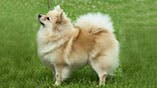 The German Spitz breed loves to be the centre of attention and will "dance" for it, standing on their hind legs.
They have the typical spitz look: thick undercoat with a harsher long top coat, curled tail over their back and a slightly wolf-like face; but their eyes are larger than most spitz breeds and they come in a wider variety of colours. There are two sizes recognised by the kennel club: Klein (small) and Mittel (medium-sized) but they have the same overall shape and character.
The medium-sized German Spitz was used as a herding dog but the small variety is more of a companion breed, similar to the Pomeranian.
They are a busy and inquisitive dog and are happy to please as long they have firm leadership, they make a good companion for an older person. They love human attention and can be trained to get on well with strangers, children and animals. Although quite active indoors, they enjoy regular daily walks.
They need regular brushing to prevent matting but there are no known health problems.
The German Spitz breed loves to be the centre of attention and will "dance" for it, standing on their hind legs.
They have the typical spitz look: thick undercoat with a harsher long top coat, curled tail over their back and a slightly wolf-like face; but their eyes are larger than most spitz breeds and they come in a wider variety of colours. There are two sizes recognised by the kennel club: Klein (small) and Mittel (medium-sized) but they have the same overall shape and character.
The medium-sized German Spitz was used as a herding dog but the small variety is more of a companion breed, similar to the Pomeranian.
They are a busy and inquisitive dog and are happy to please as long they have firm leadership, they make a good companion for an older person. They love human attention and can be trained to get on well with strangers, children and animals. Although quite active indoors, they enjoy regular daily walks.
They need regular brushing to prevent matting but there are no known health problems.
The German Spitz breed loves to be the centre of attention and will "dance" for it, standing on their hind legs.
They have the typical spitz look: thick undercoat with a harsher long top coat, curled tail over their back and a slightly wolf-like face; but their eyes are larger than most spitz breeds and they come in a wider variety of colours. There are two sizes recognised by the kennel club: Klein (small) and Mittel (medium-sized) but they have the same overall shape and character.
The medium-sized German Spitz was used as a herding dog but the small variety is more of a companion breed, similar to the Pomeranian.
They are a busy and inquisitive dog and are happy to please as long they have firm leadership, they make a good companion for an older person. They love human attention and can be trained to get on well with strangers, children and animals. Although quite active indoors, they enjoy regular daily walks.
They need regular brushing to prevent matting but there are no known health problems.German Spitz (Mittel)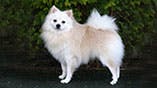 The German Spitz breed loves to be the centre of attention and will "dance" for it, standing on their hind legs.
They have the typical spitz look: thick undercoat with a harsher long top coat, curled tail over their back and a slightly wolf-like face; but their eyes are larger than most spitz breeds and they come in a wider variety of colours. There are two sizes recognised by the kennel club: Klein (small) and Mittel (medium-sized) but they have the same overall shape and character.
The medium-sized German Spitz was used as a herding dog but the small variety is more of a companion breed, similar to the Pomeranian.
They are a busy and inquisitive dog and are happy to please as long they have firm leadership, they make a good companion for an older person. They love human attention and can be trained to get on well with strangers, children and animals. Although quite active indoors, they enjoy regular daily walks.
They need regular brushing to prevent matting but there are no known health problems.
The German Spitz breed loves to be the centre of attention and will "dance" for it, standing on their hind legs.
They have the typical spitz look: thick undercoat with a harsher long top coat, curled tail over their back and a slightly wolf-like face; but their eyes are larger than most spitz breeds and they come in a wider variety of colours. There are two sizes recognised by the kennel club: Klein (small) and Mittel (medium-sized) but they have the same overall shape and character.
The medium-sized German Spitz was used as a herding dog but the small variety is more of a companion breed, similar to the Pomeranian.
They are a busy and inquisitive dog and are happy to please as long they have firm leadership, they make a good companion for an older person. They love human attention and can be trained to get on well with strangers, children and animals. Although quite active indoors, they enjoy regular daily walks.
They need regular brushing to prevent matting but there are no known health problems.
The German Spitz breed loves to be the centre of attention and will "dance" for it, standing on their hind legs.
They have the typical spitz look: thick undercoat with a harsher long top coat, curled tail over their back and a slightly wolf-like face; but their eyes are larger than most spitz breeds and they come in a wider variety of colours. There are two sizes recognised by the kennel club: Klein (small) and Mittel (medium-sized) but they have the same overall shape and character.
The medium-sized German Spitz was used as a herding dog but the small variety is more of a companion breed, similar to the Pomeranian.
They are a busy and inquisitive dog and are happy to please as long they have firm leadership, they make a good companion for an older person. They love human attention and can be trained to get on well with strangers, children and animals. Although quite active indoors, they enjoy regular daily walks.
They need regular brushing to prevent matting but there are no known health problems.Giant SchnauzerThe Giant Schnauzer makes an imposing guard dog but with the right training can be a lovable pet.
They are a large, powerful, square-looking dog with straight front legs, a straight back and a rectangular-shaped head. Their head also has a beard and whiskers. The coat comes in two colours, black and 'salt and pepper' and is hard and wiry with a soft undercoat.
They come from Germany and were originally used to herd cattle but have since proved useful for the police and armed forces.
These dogs are very protective, loyal, intelligent and trainable but they need a firm, consistent approach and plenty of exercise. They can be wary of strangers so need to be socialised with people and animals from a young age. They can be difficult to manage if not given sufficient opportunity to expend their excess energy.
Their dense undercoat needs regular grooming and the top coat needs clipping and stripping. They are prone to cancer, especially toe cancer, bloat, epilepsy and hip dysplasia.
The Giant Schnauzer makes an imposing guard dog but with the right training can be a lovable pet.
They are a large, powerful, square-looking dog with straight front legs, a straight back and a rectangular-shaped head. Their head also has a beard and whiskers. The coat comes in two colours, black and 'salt and pepper' and is hard and wiry with a soft undercoat.
They come from Germany and were originally used to herd cattle but have since proved useful for the police and armed forces.
These dogs are very protective, loyal, intelligent and trainable but they need a firm, consistent approach and plenty of exercise. They can be wary of strangers so need to be socialised with people and animals from a young age. They can be difficult to manage if not given sufficient opportunity to expend their excess energy.
Their dense undercoat needs regular grooming and the top coat needs clipping and stripping. They are prone to cancer, especially toe cancer, bloat, epilepsy and hip dysplasia.Glen Of Imaal Terrier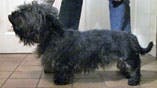 Although calm and gentle with their family indoors, the Glen of Imaal Terrier makes a determined hunter outside.
They are a short-legged, wire-coated terrier that comes in a wheaten (all shades), brindle and blue. Their top size is 14" and they weigh in at 35lbs, but they must give the impression of maximum strength for the dog's size.
The Glen is an earth dog, not a digging dog. Originating from Ireland and used for hunting, they were sent into the sett or burrow to pull out vermin such as foxes and badgers. Their fronts are slightly bowed with the feet turning out slightly at the pasterns, which is needed to brace themselves whilst pulling. There is also some anecdotal descriptions of turnspit dogs that could very well fit the description of a Glen, with the dogs keeping a roasting spit going by walking on a treadmill for hours.
They are good family dogs and in the main travel well. They are not a trouble maker but will they will not back down in a confrontation. They are normally friendly around people and good with children, but must be properly socialised so they mix with other animals. They are fairly active indoors but surprisingly active on walks too.
Glen of Imaal Terriers are easy to groom but will need stripping at least twice a year. They are prone to skin allergies, CRD3 (Cone rod deficiency) which can descent into blindness in old age. There is a gene test for this condition and it is recommended that parents should be tested and that at least one parent should have tested clear.
Although calm and gentle with their family indoors, the Glen of Imaal Terrier makes a determined hunter outside.
They are a short-legged, wire-coated terrier that comes in a wheaten (all shades), brindle and blue. Their top size is 14" and they weigh in at 35lbs, but they must give the impression of maximum strength for the dog's size.
The Glen is an earth dog, not a digging dog. Originating from Ireland and used for hunting, they were sent into the sett or burrow to pull out vermin such as foxes and badgers. Their fronts are slightly bowed with the feet turning out slightly at the pasterns, which is needed to brace themselves whilst pulling. There is also some anecdotal descriptions of turnspit dogs that could very well fit the description of a Glen, with the dogs keeping a roasting spit going by walking on a treadmill for hours.
They are good family dogs and in the main travel well. They are not a trouble maker but will they will not back down in a confrontation. They are normally friendly around people and good with children, but must be properly socialised so they mix with other animals. They are fairly active indoors but surprisingly active on walks too.
Glen of Imaal Terriers are easy to groom but will need stripping at least twice a year. They are prone to skin allergies, CRD3 (Cone rod deficiency) which can descent into blindness in old age. There is a gene test for this condition and it is recommended that parents should be tested and that at least one parent should have tested clear.
Although calm and gentle with their family indoors, the Glen of Imaal Terrier makes a determined hunter outside.
They are a short-legged, wire-coated terrier that comes in a wheaten (all shades), brindle and blue. Their top size is 14" and they weigh in at 35lbs, but they must give the impression of maximum strength for the dog's size.
The Glen is an earth dog, not a digging dog. Originating from Ireland and used for hunting, they were sent into the sett or burrow to pull out vermin such as foxes and badgers. Their fronts are slightly bowed with the feet turning out slightly at the pasterns, which is needed to brace themselves whilst pulling. There is also some anecdotal descriptions of turnspit dogs that could very well fit the description of a Glen, with the dogs keeping a roasting spit going by walking on a treadmill for hours.
They are good family dogs and in the main travel well. They are not a trouble maker but will they will not back down in a confrontation. They are normally friendly around people and good with children, but must be properly socialised so they mix with other animals. They are fairly active indoors but surprisingly active on walks too.
Glen of Imaal Terriers are easy to groom but will need stripping at least twice a year. They are prone to skin allergies, CRD3 (Cone rod deficiency) which can descent into blindness in old age. There is a gene test for this condition and it is recommended that parents should be tested and that at least one parent should have tested clear.Gordon Setter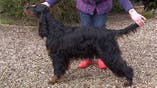 When they're not enjoying family life, the Gordon Setter is the perfect one-to-one hunting companion with excellent scenting skills.
They are slim but quite substantial with a long muzzle and a long, silky coat. They are the only Setter to come in black and tan.
Originating from Scotland, this Setter would accompany hunters when shooting birds: pointing out the location of a fallen bird and retrieving it. The breed fell out of favour because, although they have an excellent sense of smell, they are not as fast as Pointers.
Gordon Setters are steady, loyal, affectionate, intelligent and eager to please. They generally get on well with all people and animals, although some can be a little wary of strangers at first but it is not in their nature to be aggressive. The breed is quite inactive indoors so needs a good daily walk and has the stamina to take as much exercise as you can give.
Their silky coat needs regular grooming. They are generally healthy but some are prone to hip dysplasia, eye diseases and bloat.
When they're not enjoying family life, the Gordon Setter is the perfect one-to-one hunting companion with excellent scenting skills.
They are slim but quite substantial with a long muzzle and a long, silky coat. They are the only Setter to come in black and tan.
Originating from Scotland, this Setter would accompany hunters when shooting birds: pointing out the location of a fallen bird and retrieving it. The breed fell out of favour because, although they have an excellent sense of smell, they are not as fast as Pointers.
Gordon Setters are steady, loyal, affectionate, intelligent and eager to please. They generally get on well with all people and animals, although some can be a little wary of strangers at first but it is not in their nature to be aggressive. The breed is quite inactive indoors so needs a good daily walk and has the stamina to take as much exercise as you can give.
Their silky coat needs regular grooming. They are generally healthy but some are prone to hip dysplasia, eye diseases and bloat.
When they're not enjoying family life, the Gordon Setter is the perfect one-to-one hunting companion with excellent scenting skills.
They are slim but quite substantial with a long muzzle and a long, silky coat. They are the only Setter to come in black and tan.
Originating from Scotland, this Setter would accompany hunters when shooting birds: pointing out the location of a fallen bird and retrieving it. The breed fell out of favour because, although they have an excellent sense of smell, they are not as fast as Pointers.
Gordon Setters are steady, loyal, affectionate, intelligent and eager to please. They generally get on well with all people and animals, although some can be a little wary of strangers at first but it is not in their nature to be aggressive. The breed is quite inactive indoors so needs a good daily walk and has the stamina to take as much exercise as you can give.
Their silky coat needs regular grooming. They are generally healthy but some are prone to hip dysplasia, eye diseases and bloat.Grand Bleu De GascogneThe Grand Bleu De Gascogne loves to hunt, sounding their pleasure with a deep, ringing howl.
They are a large, impressive dog with a lean and muscular frame, slightly domed head, drooping ears and with a droop at the sides of their mouths. The short coat is white with black mottling giving the blue look overall.
They were bred in France to hunt deer, wild boar and even wolves and have excellent scenting skills. They are sociable, intelligent, confident and capable of independent thought but bore easily and can be rather stubborn. They are normally friendly towards adults, children and domestic pets but their hound nature may make them inclined to chase wildlife. They need plenty of opportunities to exercise their body and brain.
The short coat is easy to maintain. They are generally healthy but can suffer from hip dysplasia, a blood clotting disorder eyelid problems, sensitivity to anaesthesia and bloat.
The Grand Bleu De Gascogne loves to hunt, sounding their pleasure with a deep, ringing howl.
They are a large, impressive dog with a lean and muscular frame, slightly domed head, drooping ears and with a droop at the sides of their mouths. The short coat is white with black mottling giving the blue look overall.
They were bred in France to hunt deer, wild boar and even wolves and have excellent scenting skills. They are sociable, intelligent, confident and capable of independent thought but bore easily and can be rather stubborn. They are normally friendly towards adults, children and domestic pets but their hound nature may make them inclined to chase wildlife. They need plenty of opportunities to exercise their body and brain.
The short coat is easy to maintain. They are generally healthy but can suffer from hip dysplasia, a blood clotting disorder eyelid problems, sensitivity to anaesthesia and bloat.Great DaneThe Great Dane is so enormous, their behaviour has to be impeccable. Fortunately, they are naturally a very gentle giant.
They are huge and powerful with a squarish body and a large, rectangular head. Their stance is tall and straight and their coat is short and thick and comes in a variety of colours, including Fawn, Brindle, Blue (greyish), Black, Harlequin (white with irregular black patches) and Mantle (black with white muzzle, neck, chest and parts of legs).
They are the national dog of Germany but dogs like this have been seen in pictures since before Christ. They were used for tracking, as guard dogs and for pulling carts.
Despite their size, they make a surprisingly good house dog. They are brave, loyal and affectionate, they bark little but are a good watchdog. They are tolerant of other animals, fond of people and affectionate to children. Great Danes need plenty of exercise but jogging is not recommended until they are one year old because of the strain it puts on their joints.
The short coat is easy to maintain with regular grooming. They are not a long-living breed and are prone to hip dysplasia, bloat, heart disease and tail injuries.
The Great Dane is so enormous, their behaviour has to be impeccable. Fortunately, they are naturally a very gentle giant.
They are huge and powerful with a squarish body and a large, rectangular head. Their stance is tall and straight and their coat is short and thick and comes in a variety of colours, including Fawn, Brindle, Blue (greyish), Black, Harlequin (white with irregular black patches) and Mantle (black with white muzzle, neck, chest and parts of legs).
They are the national dog of Germany but dogs like this have been seen in pictures since before Christ. They were used for tracking, as guard dogs and for pulling carts.
Despite their size, they make a surprisingly good house dog. They are brave, loyal and affectionate, they bark little but are a good watchdog. They are tolerant of other animals, fond of people and affectionate to children. Great Danes need plenty of exercise but jogging is not recommended until they are one year old because of the strain it puts on their joints.
The short coat is easy to maintain with regular grooming. They are not a long-living breed and are prone to hip dysplasia, bloat, heart disease and tail injuries.Greater Swiss Mountain DogThe Greater Swiss Mountain Dog makes a fine large family dog.
These dogs are large, sturdy and muscular. They have a thick but short double coat and specific tricolour markings of brown, white and black. They are similar to the Bernese Mountain Dog but with a shorter coat.
They originate from Switzerland where they were used to herd cattle and pull milk carts which led to them being nicknamed "the poor man's horse".
They are eager to please, calm and good natured. They make a very good watchdog and will bark if they suspect anything untoward. Although they like to chase, they warm to people. They are great with children, not dog aggressive and generally good with other pets. They need a good long daily walk.
They are easy to groom. They are prone to bloat, epilepsy, hip dysplasia, digestive problems and excess eyelashes.
The Greater Swiss Mountain Dog makes a fine large family dog.
These dogs are large, sturdy and muscular. They have a thick but short double coat and specific tricolour markings of brown, white and black. They are similar to the Bernese Mountain Dog but with a shorter coat.
They originate from Switzerland where they were used to herd cattle and pull milk carts which led to them being nicknamed "the poor man's horse".
They are eager to please, calm and good natured. They make a very good watchdog and will bark if they suspect anything untoward. Although they like to chase, they warm to people. They are great with children, not dog aggressive and generally good with other pets. They need a good long daily walk.
They are easy to groom. They are prone to bloat, epilepsy, hip dysplasia, digestive problems and excess eyelashes.Greenland DogThe Greenland dog can bond with an owner but is predominantly an independent working dog.
They are very much a tough dog for cold conditions: very thick coat, robust head with powerful jaws and a large, bushy tail. They rarely make it out of Greenland and were used as an all-purpose dog but mainly for pulling sleds etc.
They need firm and consistent training. They are good natured and loyal but can also be wilful and boisterous. Greenland Dogs are normally quiet but enjoy a good howl with their pack. They get on well enough with people but are very independent with strong hunting skills. This is a dog that can't sit around indoors all day. They can cope with extremes of cold but not heat and they have the energy and stamina for a lot of exercise.
They need regular grooming of their thick coat. They are normally very healthy.
The Greenland dog can bond with an owner but is predominantly an independent working dog.
They are very much a tough dog for cold conditions: very thick coat, robust head with powerful jaws and a large, bushy tail. They rarely make it out of Greenland and were used as an all-purpose dog but mainly for pulling sleds etc.
They need firm and consistent training. They are good natured and loyal but can also be wilful and boisterous. Greenland Dogs are normally quiet but enjoy a good howl with their pack. They get on well enough with people but are very independent with strong hunting skills. This is a dog that can't sit around indoors all day. They can cope with extremes of cold but not heat and they have the energy and stamina for a lot of exercise.
They need regular grooming of their thick coat. They are normally very healthy.
Greyhound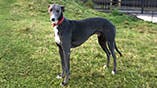 The Greyhound is the fastest dog in the world, capable of reaching speeds of over forty miles per hour. They are sighthounds, hunting by sight scanning for movement rather than following a scent.
Everything about the Greyhound is long and slender. They have slender bodies with deep chests, a long narrow head, long legs and even a long, thin tail. Their coat is short and fine and comes in all colours. There are two types of Greyhound - show dogs and racing dogs. The show dogs are taller, heavier and not as fast.
With greyhound type dogs appearing in hieroglyphics it is believed they may have come originally from Egypt. Greyhounds are the only breed mentioned in the Bible. Hundreds of years ago, they were used in England to hunt wild boar, deer and foxes, but over more recent years have been used for racing.
They are a gentle, quiet, affectionate breed but can be very sensitive. They can be reserved around strangers and would not welcome rough play from children. Many can be taught to live happily with other animals but a strong urge to chase combined with the speed to catch what they are chasing means they must be managed responsibly. Built for speed they are very much couch potatoes indoors and enjoy regular short exercise opportunities (two 20 minute walks each day is usually recommended depending on the needs of individual dogs). Lead walking is great to tone their muscles and a secure area where they can let off short bursts of speed can be particularly enjoyed. They will need a coat in winter.
The short hair is easy to maintain. They have a unique physiology to enable them to reach their high speeds including a proportionately larger heart compared to other breeds, and a greater proportion of red blood cells within their blood. They are prone to bloat and hypothyroidism and can also be sensitive to drugs including insecticides.
The Greyhound is the fastest dog in the world, capable of reaching speeds of over forty miles per hour. They are sighthounds, hunting by sight scanning for movement rather than following a scent.
Everything about the Greyhound is long and slender. They have slender bodies with deep chests, a long narrow head, long legs and even a long, thin tail. Their coat is short and fine and comes in all colours. There are two types of Greyhound - show dogs and racing dogs. The show dogs are taller, heavier and not as fast.
With greyhound type dogs appearing in hieroglyphics it is believed they may have come originally from Egypt. Greyhounds are the only breed mentioned in the Bible. Hundreds of years ago, they were used in England to hunt wild boar, deer and foxes, but over more recent years have been used for racing.
They are a gentle, quiet, affectionate breed but can be very sensitive. They can be reserved around strangers and would not welcome rough play from children. Many can be taught to live happily with other animals but a strong urge to chase combined with the speed to catch what they are chasing means they must be managed responsibly. Built for speed they are very much couch potatoes indoors and enjoy regular short exercise opportunities (two 20 minute walks each day is usually recommended depending on the needs of individual dogs). Lead walking is great to tone their muscles and a secure area where they can let off short bursts of speed can be particularly enjoyed. They will need a coat in winter.
The short hair is easy to maintain. They have a unique physiology to enable them to reach their high speeds including a proportionately larger heart compared to other breeds, and a greater proportion of red blood cells within their blood. They are prone to bloat and hypothyroidism and can also be sensitive to drugs including insecticides.
The Greyhound is the fastest dog in the world, capable of reaching speeds of over forty miles per hour. They are sighthounds, hunting by sight scanning for movement rather than following a scent.
Everything about the Greyhound is long and slender. They have slender bodies with deep chests, a long narrow head, long legs and even a long, thin tail. Their coat is short and fine and comes in all colours. There are two types of Greyhound - show dogs and racing dogs. The show dogs are taller, heavier and not as fast.
With greyhound type dogs appearing in hieroglyphics it is believed they may have come originally from Egypt. Greyhounds are the only breed mentioned in the Bible. Hundreds of years ago, they were used in England to hunt wild boar, deer and foxes, but over more recent years have been used for racing.
They are a gentle, quiet, affectionate breed but can be very sensitive. They can be reserved around strangers and would not welcome rough play from children. Many can be taught to live happily with other animals but a strong urge to chase combined with the speed to catch what they are chasing means they must be managed responsibly. Built for speed they are very much couch potatoes indoors and enjoy regular short exercise opportunities (two 20 minute walks each day is usually recommended depending on the needs of individual dogs). Lead walking is great to tone their muscles and a secure area where they can let off short bursts of speed can be particularly enjoyed. They will need a coat in winter.
The short hair is easy to maintain. They have a unique physiology to enable them to reach their high speeds including a proportionately larger heart compared to other breeds, and a greater proportion of red blood cells within their blood. They are prone to bloat and hypothyroidism and can also be sensitive to drugs including insecticides.Griffon BruxelloisThe Griffon Bruxellois may have been nicknamed "monkey-face" and "street urchin", but he makes a delightful companion.
This little dog's cute face is said to be reminiscent of the Ewok from the Star Wars film with their rounded head, bulging eyes, short nose, beard and shaggy eyebrows. They come in two coat types, smooth and rough. Smooth coats are short and glossy and rough coats are dense and wiry.
They hail from Belgium. Their ancestors were vermin catchers but the Griffon Bruxellois was more popular as a pet.
Intelligent, happy, lively, curious and good at learning tricks, the Griffon Bruxellois is fearless,fun and, unlike some small dogs, not yappy. They make a good companion for people and get on well with animals such as dogs and cats. They are an active little dog indoors but enjoy a walk outdoors too.
The smooth coats are easy to maintain, the rough coats need stripping. They can be prone to eye and respiratory problems and are sensitive to the heat.
The Griffon Bruxellois may have been nicknamed "monkey-face" and "street urchin", but he makes a delightful companion.
This little dog's cute face is said to be reminiscent of the Ewok from the Star Wars film with their rounded head, bulging eyes, short nose, beard and shaggy eyebrows. They come in two coat types, smooth and rough. Smooth coats are short and glossy and rough coats are dense and wiry.
They hail from Belgium. Their ancestors were vermin catchers but the Griffon Bruxellois was more popular as a pet.
Intelligent, happy, lively, curious and good at learning tricks, the Griffon Bruxellois is fearless,fun and, unlike some small dogs, not yappy. They make a good companion for people and get on well with animals such as dogs and cats. They are an active little dog indoors but enjoy a walk outdoors too.
The smooth coats are easy to maintain, the rough coats need stripping. They can be prone to eye and respiratory problems and are sensitive to the heat.Griffon Fauve De BretagneThe Griffon Fauve De Bretagne, or Griffon Fauve for short, is one of the oldest French hunting dogs. They date back to the 13th Century and for many years were used in pairs to hunt wolves. As the wolf started to decline, so did the numbers of Griffon Fauves and when the wolf was wiped out the breed nearly became extinct. Fortunately they were revived in the 1940s.
They are still a popular hunting dog today, for game and wild boar, showing determination and courage for their work and loyalty and affection for their family.
They are a hardy, medium-sized dog with a distinctive shaggy coat in shades of fawn from golden to red, which is easy to maintain.
The Griffon Fauve De Bretagne, or Griffon Fauve for short, is one of the oldest French hunting dogs. They date back to the 13th Century and for many years were used in pairs to hunt wolves. As the wolf started to decline, so did the numbers of Griffon Fauves and when the wolf was wiped out the breed nearly became extinct. Fortunately they were revived in the 1940s.
They are still a popular hunting dog today, for game and wild boar, showing determination and courage for their work and loyalty and affection for their family.
They are a hardy, medium-sized dog with a distinctive shaggy coat in shades of fawn from golden to red, which is easy to maintain.HamiltonstovareThe Hamiltonstovare is a very easy going hound but they love to work.
They are very like a slender version of the English Foxhound, in overall shape, colour and coat and were, in fact, bred from combining the English Foxhound with German hounds. They were bred by Count Hamilton in the late 1800s in Sweden who wanted to produce a hound that would hunt foxes and hares singly rather than in a pack.
They are affectionate and trainable but can be stubborn. They tend to be good with people and children but have a strong prey drive so may not be trustworthy around small animals. They have a lot of energy and stamina so must be given the opportunity for long walks outside but they also have a great urge to run off after a scent.
They need little grooming and shed very little. They are a very healthy breed. There have been cases of hip dysplasia and epilepsy but the instances are very low.
The Hamiltonstovare is a very easy going hound but they love to work.
They are very like a slender version of the English Foxhound, in overall shape, colour and coat and were, in fact, bred from combining the English Foxhound with German hounds. They were bred by Count Hamilton in the late 1800s in Sweden who wanted to produce a hound that would hunt foxes and hares singly rather than in a pack.
They are affectionate and trainable but can be stubborn. They tend to be good with people and children but have a strong prey drive so may not be trustworthy around small animals. They have a lot of energy and stamina so must be given the opportunity for long walks outside but they also have a great urge to run off after a scent.
They need little grooming and shed very little. They are a very healthy breed. There have been cases of hip dysplasia and epilepsy but the instances are very low.HavaneseThe Havanese is the National Dog of Cuba.
They are a little, sturdy dog with a bouncy stride and a lot of hair which covers their entire body. The coat may be wavy or curly but the most striking kind is the corded where the coat hangs in long strands. This can come in many colours.
They are one of the "Bichon" breeds, the French word for bearded, and were popular in Cuba as a lap-dog. They are a natural companion dog: playful, affectionate, intelligent, easy to train for obedience and tricks and generally quiet. They are naturally sociable with other animals and people and are happy with moderate exercise.
If just wanted as a pet, the coats can be clipped to make grooming easier but a corded coat requires special care. They are a healthy, long-lived breed but can suffer from some age-related problems eventually.
The Havanese is the National Dog of Cuba.
They are a little, sturdy dog with a bouncy stride and a lot of hair which covers their entire body. The coat may be wavy or curly but the most striking kind is the corded where the coat hangs in long strands. This can come in many colours.
They are one of the "Bichon" breeds, the French word for bearded, and were popular in Cuba as a lap-dog. They are a natural companion dog: playful, affectionate, intelligent, easy to train for obedience and tricks and generally quiet. They are naturally sociable with other animals and people and are happy with moderate exercise.
If just wanted as a pet, the coats can be clipped to make grooming easier but a corded coat requires special care. They are a healthy, long-lived breed but can suffer from some age-related problems eventually.HovawartAlthough strong-willed, the Hovawart makes a loyal and good tempered companion.
They look like a shaggier-coated version of the Golden Retriever. They are an ancient herding breed from Germany but have also been used as a watchdog and for tracking and search and rescue.
They are an affectionate, calm, intelligent and obedient dog, very trainable; a first class watchdog with an excellent sense of smell. They are wary of strangers at first but will accept people once given the go-ahead and they are excellent with children. They can be trained to get on with other animals. They need a decent amount of outdoor exercise and prefer cooler climates.
Their coat needs regular brushing but is not as difficult to maintain as it might look. This is generally a very healthy breed but they have been known to suffer from hip dysplasia and a under active thyroids.
Although strong-willed, the Hovawart makes a loyal and good tempered companion.
They look like a shaggier-coated version of the Golden Retriever. They are an ancient herding breed from Germany but have also been used as a watchdog and for tracking and search and rescue.
They are an affectionate, calm, intelligent and obedient dog, very trainable; a first class watchdog with an excellent sense of smell. They are wary of strangers at first but will accept people once given the go-ahead and they are excellent with children. They can be trained to get on with other animals. They need a decent amount of outdoor exercise and prefer cooler climates.
Their coat needs regular brushing but is not as difficult to maintain as it might look. This is generally a very healthy breed but they have been known to suffer from hip dysplasia and a under active thyroids.Hungarian KuvaszThe Hungarian Kuvasz has very strong guarding instincts and while this may be an asset for working, they would need careful training to make a suitable family dog.
They are a large, thick-coated dog that comes in white or cream. In the show ring, the head is thought to be the most attractive part of the dog, this is well proportioned with a large mane around the neck and down to the chest.
They originate from Tibet but have been known in Hungary for hundreds of years as sheep guardians. They have a very strong urge to protect, are intelligent and think for themselves, so need well considered training. They can form a close bond with the pets and people of their family but need to be taught to accept those outside. They need plenty of regular exercise and prefer to be outside in cooler weather.
This is a breed that needs to be brushed regularly but not bathed too often as the natural oils in the coat help it to shed dirt. They are generally healthy but may suffer from hip dysplasia and are inclined to drool and slobber.
The Hungarian Kuvasz has very strong guarding instincts and while this may be an asset for working, they would need careful training to make a suitable family dog.
They are a large, thick-coated dog that comes in white or cream. In the show ring, the head is thought to be the most attractive part of the dog, this is well proportioned with a large mane around the neck and down to the chest.
They originate from Tibet but have been known in Hungary for hundreds of years as sheep guardians. They have a very strong urge to protect, are intelligent and think for themselves, so need well considered training. They can form a close bond with the pets and people of their family but need to be taught to accept those outside. They need plenty of regular exercise and prefer to be outside in cooler weather.
This is a breed that needs to be brushed regularly but not bathed too often as the natural oils in the coat help it to shed dirt. They are generally healthy but may suffer from hip dysplasia and are inclined to drool and slobber.Hungarian Puli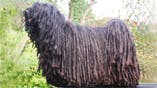 Underneath their striking coat, the Hungarian Puli is a likeable and very capable dog.
The most noticeable thing about this medium-sized, compact dog is the huge, corded coat. Because it completely covers their head and covers a tail that curls up and over the body, it's almost difficult to tell which end is which. The coat can reach the ground and can come in a range of colours.
They have been used for many years in Hungary as a sheep dog. The shepherds preferred the darkest colours, probably because they were easier to spot amongst the sheep. They are lively, cheerful and highly intelligent and make a good family pet as long as children are not rough with them. Their trainability means they do well in sports like obedience and even agility. They may be a little wary of strangers but as long as people adhere to general rule of 'let the puli come to you' they are usually friendly. They will bark enthusiastically but are unlikely to be aggressive.
Pulis are an active dog and need regular daily walks outside. Surprisingly, the coat seems to be able to protect them equally well against hot as well as cold conditions.
Although Pulis are bathed, they are not brushed as this would ruin the coat, instead the coat has to be hand separated into strands of the correct thickness, about the width of a pencil. The coat takes a lot of work to create the cords to begin with, and then weekly maintenance.
Reputable breeders will test for hip dysplasia and eye problems (mainly Retinal Dysplasia), but in general this breed is very hardy.
Underneath their striking coat, the Hungarian Puli is a likeable and very capable dog.
The most noticeable thing about this medium-sized, compact dog is the huge, corded coat. Because it completely covers their head and covers a tail that curls up and over the body, it's almost difficult to tell which end is which. The coat can reach the ground and can come in a range of colours.
They have been used for many years in Hungary as a sheep dog. The shepherds preferred the darkest colours, probably because they were easier to spot amongst the sheep. They are lively, cheerful and highly intelligent and make a good family pet as long as children are not rough with them. Their trainability means they do well in sports like obedience and even agility. They may be a little wary of strangers but as long as people adhere to general rule of 'let the puli come to you' they are usually friendly. They will bark enthusiastically but are unlikely to be aggressive.
Pulis are an active dog and need regular daily walks outside. Surprisingly, the coat seems to be able to protect them equally well against hot as well as cold conditions.
Although Pulis are bathed, they are not brushed as this would ruin the coat, instead the coat has to be hand separated into strands of the correct thickness, about the width of a pencil. The coat takes a lot of work to create the cords to begin with, and then weekly maintenance.
Reputable breeders will test for hip dysplasia and eye problems (mainly Retinal Dysplasia), but in general this breed is very hardy.
Underneath their striking coat, the Hungarian Puli is a likeable and very capable dog.
The most noticeable thing about this medium-sized, compact dog is the huge, corded coat. Because it completely covers their head and covers a tail that curls up and over the body, it's almost difficult to tell which end is which. The coat can reach the ground and can come in a range of colours.
They have been used for many years in Hungary as a sheep dog. The shepherds preferred the darkest colours, probably because they were easier to spot amongst the sheep. They are lively, cheerful and highly intelligent and make a good family pet as long as children are not rough with them. Their trainability means they do well in sports like obedience and even agility. They may be a little wary of strangers but as long as people adhere to general rule of 'let the puli come to you' they are usually friendly. They will bark enthusiastically but are unlikely to be aggressive.
Pulis are an active dog and need regular daily walks outside. Surprisingly, the coat seems to be able to protect them equally well against hot as well as cold conditions.
Although Pulis are bathed, they are not brushed as this would ruin the coat, instead the coat has to be hand separated into strands of the correct thickness, about the width of a pencil. The coat takes a lot of work to create the cords to begin with, and then weekly maintenance.
Reputable breeders will test for hip dysplasia and eye problems (mainly Retinal Dysplasia), but in general this breed is very hardy.Hungarian PumiThe distinctive appearance of the Hungarian Pumi is likely the result of his origins as a cross between the Hungarian Puli and German and French prick-eared sheepdogs. However, there is probably a good deal of terrier in the breed too, as they have a very terrier-like personality.
They are quite a small dog with an elongated muzzle and a medium-length, curled coat that has to be trimmed regularly like that of the Poodle to avoid it matting. However, also like the Poodle, they have little to no shedding. Their colouring is normally anything from black to light grey but always one solid colour.
They were bred as a farm dog to guard and drive cattle and to clear vermin. As a result, they are energetic, spirited and intelligent so need plenty of mental and physical exercise. The Pumi is loyal and very trainable, if a little noisy, but needs to be well socialised to strangers and other animals from an early age.
Pumis are generally a very healthy breed with a life expectancy of 12-14 years.
The distinctive appearance of the Hungarian Pumi is likely the result of his origins as a cross between the Hungarian Puli and German and French prick-eared sheepdogs. However, there is probably a good deal of terrier in the breed too, as they have a very terrier-like personality.
They are quite a small dog with an elongated muzzle and a medium-length, curled coat that has to be trimmed regularly like that of the Poodle to avoid it matting. However, also like the Poodle, they have little to no shedding. Their colouring is normally anything from black to light grey but always one solid colour.
They were bred as a farm dog to guard and drive cattle and to clear vermin. As a result, they are energetic, spirited and intelligent so need plenty of mental and physical exercise. The Pumi is loyal and very trainable, if a little noisy, but needs to be well socialised to strangers and other animals from an early age.
Pumis are generally a very healthy breed with a life expectancy of 12-14 years.Hungarian VizslaThe Hungarian Vizsla makes an outstanding gun dog and a good family pet as long as their body and brain are given plenty to do.
They are a long-legged, medium sized hunting dog, lean and muscular with a short, smooth, rust-coloured coat. There are two main coat types, the Hungarian Vizsla has a short, smooth coat whereas the Hungarian Wire Haired Vizsla has a longer harsh coat. There is also a long-haired version but they are extremely rare and not registered anywhere in the world. The wire-haireds, with their tough coat and bushy eyebrows, are making something of a comeback.
They originate from Hungary where they have been used as a hunting dog for many years, for prey like game-birds and rabbits. The word "Vizsla" means "pointer". They are affectionate, highly trainable and highly intelligent. They have great scenting ability, too, and are happy to work in all weather but they need to be kept occupied and have a tendency to chew. They are people friendly and would be good for older children with lots of energy but may be too much for small children. They get along well with other dogs and can be trained to accept family cats but may not be trustworthy around wildlife and small mammals. They are a breed with enormous mental and physical energy and stamina and need plenty of opportunity to expend this.
The short coat is easy to maintain, the wire-haireds would need stripping. They are generally healthy but are prone to hip dysplasia.
The Hungarian Vizsla makes an outstanding gun dog and a good family pet as long as their body and brain are given plenty to do.
They are a long-legged, medium sized hunting dog, lean and muscular with a short, smooth, rust-coloured coat. There are two main coat types, the Hungarian Vizsla has a short, smooth coat whereas the Hungarian Wire Haired Vizsla has a longer harsh coat. There is also a long-haired version but they are extremely rare and not registered anywhere in the world. The wire-haireds, with their tough coat and bushy eyebrows, are making something of a comeback.
They originate from Hungary where they have been used as a hunting dog for many years, for prey like game-birds and rabbits. The word "Vizsla" means "pointer". They are affectionate, highly trainable and highly intelligent. They have great scenting ability, too, and are happy to work in all weather but they need to be kept occupied and have a tendency to chew. They are people friendly and would be good for older children with lots of energy but may be too much for small children. They get along well with other dogs and can be trained to accept family cats but may not be trustworthy around wildlife and small mammals. They are a breed with enormous mental and physical energy and stamina and need plenty of opportunity to expend this.
The short coat is easy to maintain, the wire-haireds would need stripping. They are generally healthy but are prone to hip dysplasia.Ibizan HoundThe Ibizan Hound is an extremely energetic hunting dog.
They are slim and athletic, with large upright ears and amber coloured eyes. Their coats, a combination of whites, reds and tans are most commonly smooth-haired, but can be wire-haired, or, less often, long-haired.
They were bred in the Spanish islands for hunting rabbits, either alone or in packs. Most garden fences would not present much of a challenge to such a breed that so loves to run, and, especially, chase. They can be a little cautious with strangers, but once they get to know them, the Ibizan Hounds are very good with adults and children. They are generally good with other pets that are raised in the household, but cats, rabbits, rodents and other small animals outside the home are likely to be hunted, and if caught, might be killed. This breed needs a great deal of very energetic exercise. If the Ibizan Hound chases off, following a scent, it can be very difficult to retrieve!
The only grooming required is an occasional brushing or sponging. The coat of the Ibizan Hound is not very protective in particularly cold weather. This breed enjoys generally good health with very few hereditary issues, but some suffer from allergies, and others might have occasional seizures.
The Ibizan Hound is an extremely energetic hunting dog.
They are slim and athletic, with large upright ears and amber coloured eyes. Their coats, a combination of whites, reds and tans are most commonly smooth-haired, but can be wire-haired, or, less often, long-haired.
They were bred in the Spanish islands for hunting rabbits, either alone or in packs. Most garden fences would not present much of a challenge to such a breed that so loves to run, and, especially, chase. They can be a little cautious with strangers, but once they get to know them, the Ibizan Hounds are very good with adults and children. They are generally good with other pets that are raised in the household, but cats, rabbits, rodents and other small animals outside the home are likely to be hunted, and if caught, might be killed. This breed needs a great deal of very energetic exercise. If the Ibizan Hound chases off, following a scent, it can be very difficult to retrieve!
The only grooming required is an occasional brushing or sponging. The coat of the Ibizan Hound is not very protective in particularly cold weather. This breed enjoys generally good health with very few hereditary issues, but some suffer from allergies, and others might have occasional seizures.Irish Red & White Setter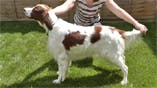 The Irish Red and White Setter is one of the earliest Irish Gundogs. They are energetic and intelligent and work well over any kind of terrain.
They are similar to, and possibly even the predecessor of, the Irish setter but have a slightly heavier build and a broader head. Their coat is finely textured and white with red patches.
Irish Red and White Setters were originally bred to accompany hunters out on shoots. They are affectionate, high spirited and very trainable without a strong guarding instinct but they need plenty of outlets for their energy. They are naturally friendly and get along with other animals, children and strangers and need a long, daily, brisk walk or run.
A regular short brush keeps their coat looking good and free from tangles. Through careful breeding the Irish Red and White setters are generally a healthy breed and can live a long life without any problems at all. Previously Von Willebrand and CLAD were found in the breed but over time has become very rare.
The Irish Red and White Setter is one of the earliest Irish Gundogs. They are energetic and intelligent and work well over any kind of terrain.
They are similar to, and possibly even the predecessor of, the Irish setter but have a slightly heavier build and a broader head. Their coat is finely textured and white with red patches.
Irish Red and White Setters were originally bred to accompany hunters out on shoots. They are affectionate, high spirited and very trainable without a strong guarding instinct but they need plenty of outlets for their energy. They are naturally friendly and get along with other animals, children and strangers and need a long, daily, brisk walk or run.
A regular short brush keeps their coat looking good and free from tangles. Through careful breeding the Irish Red and White setters are generally a healthy breed and can live a long life without any problems at all. Previously Von Willebrand and CLAD were found in the breed but over time has become very rare.
The Irish Red and White Setter is one of the earliest Irish Gundogs. They are energetic and intelligent and work well over any kind of terrain.
They are similar to, and possibly even the predecessor of, the Irish setter but have a slightly heavier build and a broader head. Their coat is finely textured and white with red patches.
Irish Red and White Setters were originally bred to accompany hunters out on shoots. They are affectionate, high spirited and very trainable without a strong guarding instinct but they need plenty of outlets for their energy. They are naturally friendly and get along with other animals, children and strangers and need a long, daily, brisk walk or run.
A regular short brush keeps their coat looking good and free from tangles. Through careful breeding the Irish Red and White setters are generally a healthy breed and can live a long life without any problems at all. Previously Von Willebrand and CLAD were found in the breed but over time has become very rare.Irish Setter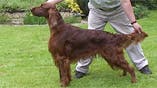 The Irish Setter, with its glossy red coat, is the glamorous descendent of the Irish Red and White Setter.
They are similar to the Irish Red and White Setter but have a more slender, racier look to them and a finer head. Their coat is finely textured and comes in shades of glossy red with the occasional white patch on the chest.
Irish Setters were bred from a mixture of other hunting dogs to produce an all-purpose hunting dog for finding and retrieving game birds and are very swift with an excellent sense of smell. This is an affectionate, intelligent and independent breed. Although high spirited, they are very trainable without a strong guarding instinct. They need plenty of outlets for their energy and are good at competitive obedience and agility. Most are naturally friendly and get along other animals, children and strangers.
A daily short brush keeps their coat looking good and free from tangles. They are prone to bloat, epilepsy, skin allergies, elbow and hip dysplasia, hypothyroidism and eye problems.
The Irish Setter, with its glossy red coat, is the glamorous descendent of the Irish Red and White Setter.
They are similar to the Irish Red and White Setter but have a more slender, racier look to them and a finer head. Their coat is finely textured and comes in shades of glossy red with the occasional white patch on the chest.
Irish Setters were bred from a mixture of other hunting dogs to produce an all-purpose hunting dog for finding and retrieving game birds and are very swift with an excellent sense of smell. This is an affectionate, intelligent and independent breed. Although high spirited, they are very trainable without a strong guarding instinct. They need plenty of outlets for their energy and are good at competitive obedience and agility. Most are naturally friendly and get along other animals, children and strangers.
A daily short brush keeps their coat looking good and free from tangles. They are prone to bloat, epilepsy, skin allergies, elbow and hip dysplasia, hypothyroidism and eye problems.
The Irish Setter, with its glossy red coat, is the glamorous descendent of the Irish Red and White Setter.
They are similar to the Irish Red and White Setter but have a more slender, racier look to them and a finer head. Their coat is finely textured and comes in shades of glossy red with the occasional white patch on the chest.
Irish Setters were bred from a mixture of other hunting dogs to produce an all-purpose hunting dog for finding and retrieving game birds and are very swift with an excellent sense of smell. This is an affectionate, intelligent and independent breed. Although high spirited, they are very trainable without a strong guarding instinct. They need plenty of outlets for their energy and are good at competitive obedience and agility. Most are naturally friendly and get along other animals, children and strangers.
A daily short brush keeps their coat looking good and free from tangles. They are prone to bloat, epilepsy, skin allergies, elbow and hip dysplasia, hypothyroidism and eye problems.Irish Terrier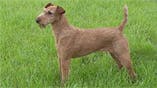 The brave, entertaining Irish Terrier is often referred to as a "daredevil" by his supporters.
This medium-sized dog is rather like a smaller version of the Airedale with his bearded face. Their wiry coat lies close to the body in shades of red to wheaten and has a thick undercoat. From 5 weeks puppies often develop black top hair which gradually disappears by around 16 weeks.
They are considered to be one of the oldest Terrier breeds and were originally used for hunting animals that live in dens, such as otters and water rats, but have since been a working dog in other areas, too, such as with the police. Good natured and full of energy, they are ready for anything.
Most are intelligent and very trainable, but have a strong protective instinct so their training has to take this into account. They are very adult and child friendly but may not be trusted around some small animals because of their strong urge to chase anything that moves and they need plenty of daily exercise.
Regular weekly brushing is usually all that is required, although they should be hand stripped twice a year. Irish Terriers are generally a very healthy breed with no common health problems. There has been a condition in the past relating to the pads but this is rarely seen these days.
The brave, entertaining Irish Terrier is often referred to as a "daredevil" by his supporters.
This medium-sized dog is rather like a smaller version of the Airedale with his bearded face. Their wiry coat lies close to the body in shades of red to wheaten and has a thick undercoat. From 5 weeks puppies often develop black top hair which gradually disappears by around 16 weeks.
They are considered to be one of the oldest Terrier breeds and were originally used for hunting animals that live in dens, such as otters and water rats, but have since been a working dog in other areas, too, such as with the police. Good natured and full of energy, they are ready for anything.
Most are intelligent and very trainable, but have a strong protective instinct so their training has to take this into account. They are very adult and child friendly but may not be trusted around some small animals because of their strong urge to chase anything that moves and they need plenty of daily exercise.
Regular weekly brushing is usually all that is required, although they should be hand stripped twice a year. Irish Terriers are generally a very healthy breed with no common health problems. There has been a condition in the past relating to the pads but this is rarely seen these days.
The brave, entertaining Irish Terrier is often referred to as a "daredevil" by his supporters.
This medium-sized dog is rather like a smaller version of the Airedale with his bearded face. Their wiry coat lies close to the body in shades of red to wheaten and has a thick undercoat. From 5 weeks puppies often develop black top hair which gradually disappears by around 16 weeks.
They are considered to be one of the oldest Terrier breeds and were originally used for hunting animals that live in dens, such as otters and water rats, but have since been a working dog in other areas, too, such as with the police. Good natured and full of energy, they are ready for anything.
Most are intelligent and very trainable, but have a strong protective instinct so their training has to take this into account. They are very adult and child friendly but may not be trusted around some small animals because of their strong urge to chase anything that moves and they need plenty of daily exercise.
Regular weekly brushing is usually all that is required, although they should be hand stripped twice a year. Irish Terriers are generally a very healthy breed with no common health problems. There has been a condition in the past relating to the pads but this is rarely seen these days.Irish WolfhoundThe Irish Wolfhound is the tallest breed in the world so, despite their gentle and affectionate nature, a lot of thought has to be given before taking on a dog of this size.
They are the size of a small pony, everything about them is long but well-built and they have a shaggy, wiry coat that comes in a range of colours but is commonly grey. Their name derives from the fact that they were, at one time, actually used for hunting prey like wolves, boar and deer and they were highly prized but they fell out of favour when there were no more boar and wolves in Ireland to hunt.
Like other giant dogs, Irish Wolfhounds are good natured, loyal, intelligent and eager to please but they can be rather clumsy as they grow and have to get used to their size. They get along well with all other animals, adults and children. They need a decent amount of exercise but no more than many of the smaller breeds and care must be taken when they are young not to put too much strain on their giant frame.
Their coat needs regular brushing and occasional stripping. They can be prone to cardiomyopathy, bone cancer, bloat, PRA, Von Willebrand disease and hip dysplasia.
The Irish Wolfhound is the tallest breed in the world so, despite their gentle and affectionate nature, a lot of thought has to be given before taking on a dog of this size.
They are the size of a small pony, everything about them is long but well-built and they have a shaggy, wiry coat that comes in a range of colours but is commonly grey. Their name derives from the fact that they were, at one time, actually used for hunting prey like wolves, boar and deer and they were highly prized but they fell out of favour when there were no more boar and wolves in Ireland to hunt.
Like other giant dogs, Irish Wolfhounds are good natured, loyal, intelligent and eager to please but they can be rather clumsy as they grow and have to get used to their size. They get along well with all other animals, adults and children. They need a decent amount of exercise but no more than many of the smaller breeds and care must be taken when they are young not to put too much strain on their giant frame.
Their coat needs regular brushing and occasional stripping. They can be prone to cardiomyopathy, bone cancer, bloat, PRA, Von Willebrand disease and hip dysplasia.Italian Greyhound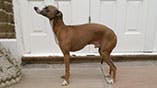 Although this little dog can run like the wind, he loves all the comforts of home.
They are a fine and delicate looking little dog with the slim frame and deep narrow chest of a standard Greyhound but in miniature. Their coat is short and glossy and is either white with coloured markings or coloured with white markings.
Images of dogs like Italian Greyhounds have been found all over the world, including ancient Egypt, for thousands of years but despite their racey shape, they have largely been prized pets.
They are playful, intelligent, affectionate, eager to please and enjoy being cuddled as much as going for a good run. They naturally get on well with people and animals. They are an active little dog both indoors and out so a good daily run is important.
To keep the coat looking glossy it is only necessary to rub it with towelling. They are prone to epilepsy, slipped stifle, fractures and PRA. The delicate puppies can fracture a bone easily so extra care must be taken with them although the adults are hardier than they look.
Although this little dog can run like the wind, he loves all the comforts of home.
They are a fine and delicate looking little dog with the slim frame and deep narrow chest of a standard Greyhound but in miniature. Their coat is short and glossy and is either white with coloured markings or coloured with white markings.
Images of dogs like Italian Greyhounds have been found all over the world, including ancient Egypt, for thousands of years but despite their racey shape, they have largely been prized pets.
They are playful, intelligent, affectionate, eager to please and enjoy being cuddled as much as going for a good run. They naturally get on well with people and animals. They are an active little dog both indoors and out so a good daily run is important.
To keep the coat looking glossy it is only necessary to rub it with towelling. They are prone to epilepsy, slipped stifle, fractures and PRA. The delicate puppies can fracture a bone easily so extra care must be taken with them although the adults are hardier than they look.
Although this little dog can run like the wind, he loves all the comforts of home.
They are a fine and delicate looking little dog with the slim frame and deep narrow chest of a standard Greyhound but in miniature. Their coat is short and glossy and is either white with coloured markings or coloured with white markings.
Images of dogs like Italian Greyhounds have been found all over the world, including ancient Egypt, for thousands of years but despite their racey shape, they have largely been prized pets.
They are playful, intelligent, affectionate, eager to please and enjoy being cuddled as much as going for a good run. They naturally get on well with people and animals. They are an active little dog both indoors and out so a good daily run is important.
To keep the coat looking glossy it is only necessary to rub it with towelling. They are prone to epilepsy, slipped stifle, fractures and PRA. The delicate puppies can fracture a bone easily so extra care must be taken with them although the adults are hardier than they look.Italian SpinoneThe Italian Spinone is a dependable dog both with the family and out in the field.
They are a large, rugged looking dog with a thick, wiry coat which is essentially white but can have shades of cream, orange and roan in it. The head is long and has a moustached look and the back has a slight dip.
They are sometimes known as the Italian Pointer and have a long history of being a popular dog for taking hunting. Images of them go back as far as the Renaissance. They are an intelligent, tolerant, happy and easy-going breed that takes instruction well and is normally very quiet, although might occasionally howl. They have good scenting ability and a very soft mouth. They get along very well with all people, children especially, and all animals. They enjoy a long walk and have tremendous stamina but are not a "racy" sort of dog. Their coat protects them from all weather conditions and many love to swim.
As with most wire-haired dogs, regular brushing and occasional stripping are needed. They are generally a healthy dog but cases of hip dysplasia and bloat have been known. There is one hereditary disease worth checking for which is an abnormality in movement caused by a problem in the brain.
The Italian Spinone is a dependable dog both with the family and out in the field.
They are a large, rugged looking dog with a thick, wiry coat which is essentially white but can have shades of cream, orange and roan in it. The head is long and has a moustached look and the back has a slight dip.
They are sometimes known as the Italian Pointer and have a long history of being a popular dog for taking hunting. Images of them go back as far as the Renaissance. They are an intelligent, tolerant, happy and easy-going breed that takes instruction well and is normally very quiet, although might occasionally howl. They have good scenting ability and a very soft mouth. They get along very well with all people, children especially, and all animals. They enjoy a long walk and have tremendous stamina but are not a "racy" sort of dog. Their coat protects them from all weather conditions and many love to swim.
As with most wire-haired dogs, regular brushing and occasional stripping are needed. They are generally a healthy dog but cases of hip dysplasia and bloat have been known. There is one hereditary disease worth checking for which is an abnormality in movement caused by a problem in the brain.Jack Russell TerrierWhile many people are familiar with the term 'Jack Russell Terrier', the breed has only been officially recognised by the Kennel Club in the UK since 2016.
The Jack Russell Terrier is a working dog, able to run with the hounds, or squeeze into underground dens. They can be a wonderful companion, but their excellent hunting skills do need an outlet if they are to be content family pets!
Common health issues affecting the Jack Russell Terrier include inherited eye diseases and deafness. They can be prone to dislocation of the knee caps and a disease of the hip joints.
While many people are familiar with the term 'Jack Russell Terrier', the breed has only been officially recognised by the Kennel Club in the UK since 2016.
The Jack Russell Terrier is a working dog, able to run with the hounds, or squeeze into underground dens. They can be a wonderful companion, but their excellent hunting skills do need an outlet if they are to be content family pets!
Common health issues affecting the Jack Russell Terrier include inherited eye diseases and deafness. They can be prone to dislocation of the knee caps and a disease of the hip joints. Japanese Akita InuThe Japanese Akita Inu is considered a national dog of Japan and one of seven breeds designated as a National Monument.
In recent years the Akita and Akita Inu were separated into two distinct breeds. The Akita Inu has a lighter weight body and very specific colouring but they are still a large spitz type with a thick double coat, a plush tail carried over their back, quite a heavy, flat head and small triangular eyes.
Used originally as a hunting dog, they have proved useful more recently in the police and armed forces. Although loyal and good natured towards their family, they can also be territorial and stubborn so need firm and careful training. They need to be trained to not show aggression towards strangers and other animals and they need long daily walks.
Their coat requires a good deal of brushing and will shed heavily at certain times of the year. They should only be bathed when necessary as this removes the coat's natural waterproofing. They can be prone to a number of problems with hips, thyroid, skin, eyes, immune diseases and knee problems.
The Japanese Akita Inu is considered a national dog of Japan and one of seven breeds designated as a National Monument.
In recent years the Akita and Akita Inu were separated into two distinct breeds. The Akita Inu has a lighter weight body and very specific colouring but they are still a large spitz type with a thick double coat, a plush tail carried over their back, quite a heavy, flat head and small triangular eyes.
Used originally as a hunting dog, they have proved useful more recently in the police and armed forces. Although loyal and good natured towards their family, they can also be territorial and stubborn so need firm and careful training. They need to be trained to not show aggression towards strangers and other animals and they need long daily walks.
Their coat requires a good deal of brushing and will shed heavily at certain times of the year. They should only be bathed when necessary as this removes the coat's natural waterproofing. They can be prone to a number of problems with hips, thyroid, skin, eyes, immune diseases and knee problems.Japanese ChinThe Japanese Chin, also known as the Japanese Spaniel, has royal connections, favoured as a pet of the Japanese nobility.
They are a toy dog with a broad head, large eyes and short muzzle. They have a very long coat which is white with markings in one colour e.g. black, lemon, sable, red etc. Officially, the nose should match the coloured patch on the coat.
Although called the Japanese Chin, they actually come from China and were bred as a companion dog. They are naturally lively, loyal and affectionate to their owners and are very intelligent. They can be good at learning tricks. They may need to be taught not to be wary of strangers and in turn, children should be taught not to play rough with them but they generally get on well with other animals. They are an active dog indoors and although not in need of a lot of exercise, appreciate a daily walk too.
The coat needs to be brushed regularly and the eyes and ears checked for signs of infection. They are prone to eye and breathing problems and are sensitive to extremes of temperature.
The Japanese Chin, also known as the Japanese Spaniel, has royal connections, favoured as a pet of the Japanese nobility.
They are a toy dog with a broad head, large eyes and short muzzle. They have a very long coat which is white with markings in one colour e.g. black, lemon, sable, red etc. Officially, the nose should match the coloured patch on the coat.
Although called the Japanese Chin, they actually come from China and were bred as a companion dog. They are naturally lively, loyal and affectionate to their owners and are very intelligent. They can be good at learning tricks. They may need to be taught not to be wary of strangers and in turn, children should be taught not to play rough with them but they generally get on well with other animals. They are an active dog indoors and although not in need of a lot of exercise, appreciate a daily walk too.
The coat needs to be brushed regularly and the eyes and ears checked for signs of infection. They are prone to eye and breathing problems and are sensitive to extremes of temperature.Japanese Shiba InuWith it's short haired, stiff coat, the Japanese Shiba Inu is a handsome and tidy little dog.
They are the smallest of the spitz type breeds from Japan. They have typical spitz proportions with a curled tail and fairly short double coat. The coat tends to be reddish with distinctive white markings especially on the cheeks, sides of muzzle and chest.
They were bred to hunt small game and flush out birds, although they have been used to hunt larger game such as deer too. The name Shiba means "small" and "brushwood". They are alert, brave, loving and very trainable. They are also quite clean and quiet. They tend to get on well with children but may be wary around strangers. They are usually trustworthy around dogs and cats but possibly less so around small pets and wildlife. They need plenty of exercise and have great stamina.
The stiff, shorthaired coat is easy to groom but it's best not to bath them too often as it removes the natural waterproofing. They are prone to hip dysplasia, slipped kneecap and PRA.
With it's short haired, stiff coat, the Japanese Shiba Inu is a handsome and tidy little dog.
They are the smallest of the spitz type breeds from Japan. They have typical spitz proportions with a curled tail and fairly short double coat. The coat tends to be reddish with distinctive white markings especially on the cheeks, sides of muzzle and chest.
They were bred to hunt small game and flush out birds, although they have been used to hunt larger game such as deer too. The name Shiba means "small" and "brushwood". They are alert, brave, loving and very trainable. They are also quite clean and quiet. They tend to get on well with children but may be wary around strangers. They are usually trustworthy around dogs and cats but possibly less so around small pets and wildlife. They need plenty of exercise and have great stamina.
The stiff, shorthaired coat is easy to groom but it's best not to bath them too often as it removes the natural waterproofing. They are prone to hip dysplasia, slipped kneecap and PRA.Japanese SpitzThe feisty little Japanese Spitz has an attractive personality but they do like the sound of their own voice.
They are a small spitz breed with a striking, long, pure white coat that stands out. The whiteness makes the black eyes and nose stand out. The hair on the legs is shorter but has feathering.
Their origins are unknown except that they come from Japan. They look very much like a small Samoyed and it has been suggested that they originated from them. They are intelligent, alert and playful. They are active and enjoy sports like agility. They have a tendency to bark unless this is curbed. They are generally sociable to adults, children and other animals. Although active indoors, they need a good daily walk too.
The long coat with its thick undercoat needs brushing and combing regularly but there are no known health problems.
The feisty little Japanese Spitz has an attractive personality but they do like the sound of their own voice.
They are a small spitz breed with a striking, long, pure white coat that stands out. The whiteness makes the black eyes and nose stand out. The hair on the legs is shorter but has feathering.
Their origins are unknown except that they come from Japan. They look very much like a small Samoyed and it has been suggested that they originated from them. They are intelligent, alert and playful. They are active and enjoy sports like agility. They have a tendency to bark unless this is curbed. They are generally sociable to adults, children and other animals. Although active indoors, they need a good daily walk too.
The long coat with its thick undercoat needs brushing and combing regularly but there are no known health problems.Keeshond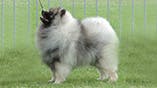 The Keeshond is friendly and sociable with everyone and keen to tell them so.
The Keeshond is a spitz-type dog, a little like a small Samoyed with a long coat that stands out. They are larger than the similar looking Japanese Spitz and tend to come in shades of grey rather than white.
It is unknown what they were bred for in their native Holland but when they came to the USA, they were nicknamed the Dutch Barge Dog and worked as a watch dog and guard dog on river boats, barges and farms.
They are very trainable and affectionate and can be good at performing. They are good at warning of danger but need to be discouraged from barking too much. They generally get on well with people, are excellent with children and are normally fine with other animals. Although active indoors, they need a good daily walk too but their thick coat makes hot climates difficult for them.
The long coat and thick undercoat need regular brushing and they will moult heavily twice a year. They are prone to hip dysplasia, skin problems and heart disease.
The Keeshond is friendly and sociable with everyone and keen to tell them so.
The Keeshond is a spitz-type dog, a little like a small Samoyed with a long coat that stands out. They are larger than the similar looking Japanese Spitz and tend to come in shades of grey rather than white.
It is unknown what they were bred for in their native Holland but when they came to the USA, they were nicknamed the Dutch Barge Dog and worked as a watch dog and guard dog on river boats, barges and farms.
They are very trainable and affectionate and can be good at performing. They are good at warning of danger but need to be discouraged from barking too much. They generally get on well with people, are excellent with children and are normally fine with other animals. Although active indoors, they need a good daily walk too but their thick coat makes hot climates difficult for them.
The long coat and thick undercoat need regular brushing and they will moult heavily twice a year. They are prone to hip dysplasia, skin problems and heart disease.
The Keeshond is friendly and sociable with everyone and keen to tell them so.
The Keeshond is a spitz-type dog, a little like a small Samoyed with a long coat that stands out. They are larger than the similar looking Japanese Spitz and tend to come in shades of grey rather than white.
It is unknown what they were bred for in their native Holland but when they came to the USA, they were nicknamed the Dutch Barge Dog and worked as a watch dog and guard dog on river boats, barges and farms.
They are very trainable and affectionate and can be good at performing. They are good at warning of danger but need to be discouraged from barking too much. They generally get on well with people, are excellent with children and are normally fine with other animals. Although active indoors, they need a good daily walk too but their thick coat makes hot climates difficult for them.
The long coat and thick undercoat need regular brushing and they will moult heavily twice a year. They are prone to hip dysplasia, skin problems and heart disease.Kerry Blue TerrierThe Kerry Blue is the national terrier of Ireland and has a reputation for being a natural entertainer.
These are a sturdy, medium-sized dog. They have a long head with ears that flop forward at the tips and a bearded chin. Unlike many similar looking terriers, the coat is soft and wavy and comes in shades of blue to grey.
They hail from County Kerry in Ireland and were originally used for hunting, guarding and as a general companion. They are very intelligent and are natural performers. Fond of their owners, they are also a good guard dog although they don't bark unnecessarily. They are naturally protective and can be willful but can also be trained to be sociable to strangers, children and animals. They are a sporty dog and even though they tend to be active indoors, they will need plenty of outdoor exercise too.
They need quite a lot of brushing and combing, they can be trimmed and need the hair pulling out of their ears to avoid infection. However, they have practically no odour, even when wet. They are normally a very healthy, long-lived breed.
The Kerry Blue is the national terrier of Ireland and has a reputation for being a natural entertainer.
These are a sturdy, medium-sized dog. They have a long head with ears that flop forward at the tips and a bearded chin. Unlike many similar looking terriers, the coat is soft and wavy and comes in shades of blue to grey.
They hail from County Kerry in Ireland and were originally used for hunting, guarding and as a general companion. They are very intelligent and are natural performers. Fond of their owners, they are also a good guard dog although they don't bark unnecessarily. They are naturally protective and can be willful but can also be trained to be sociable to strangers, children and animals. They are a sporty dog and even though they tend to be active indoors, they will need plenty of outdoor exercise too.
They need quite a lot of brushing and combing, they can be trimmed and need the hair pulling out of their ears to avoid infection. However, they have practically no odour, even when wet. They are normally a very healthy, long-lived breed.King Charles SpanielThe King Charles Spaniel is often confused with the Cavalier King Charles Spaniel but it is actually smaller and a much older and rarer breed.
They are small with a domed head and short muzzle, the result of cross-breeding with the Pug in the nineteenth century. Their bite is slightly undershot, their ears are long and their coat silky. They come in the same range of colours as the Cavalier King Charles Spaniel: tricolour, red, black and tan, and red and white.
Although originally bred as a small gun dog, they have been popular since the fifteenth century in the royal courts of Europe as a companion. They are reserved but gentle and affectionate with a stable temperament. They enjoy nothing more than affection from their owners. They naturally get on well with adults, children and animals. They are not a high energy dog but enjoy a daily walk.
Their long, silky coat needs regular grooming but is not difficult to maintain. They are prone to eye and heart problems and their short muzzle also inclines them to respiratory problems which may cause difficulties with anaesthetics.
The King Charles Spaniel is often confused with the Cavalier King Charles Spaniel but it is actually smaller and a much older and rarer breed.
They are small with a domed head and short muzzle, the result of cross-breeding with the Pug in the nineteenth century. Their bite is slightly undershot, their ears are long and their coat silky. They come in the same range of colours as the Cavalier King Charles Spaniel: tricolour, red, black and tan, and red and white.
Although originally bred as a small gun dog, they have been popular since the fifteenth century in the royal courts of Europe as a companion. They are reserved but gentle and affectionate with a stable temperament. They enjoy nothing more than affection from their owners. They naturally get on well with adults, children and animals. They are not a high energy dog but enjoy a daily walk.
Their long, silky coat needs regular grooming but is not difficult to maintain. They are prone to eye and heart problems and their short muzzle also inclines them to respiratory problems which may cause difficulties with anaesthetics.KomondorThe Komondor, with his white, flocked coat, easily blends in with the sheep he has been bred to guard. But, beware of thinking of him as a meek little lamb, he is a fierce protector.
They are a large, muscular dog with a large head and big bone structure. However, it is difficult to see any part of the dog clearly because of the enormous, white, felted, corded coat that can reach up 11 inches long.
They came with the Cumans into Tibet hundreds of years ago. Their name means "Cuman Dog". They were, and still are, used to guard sheep. They are bred to work independently, guarding a flock against any kind of threat including wolves and bears. As a result, they are fiercely protective and not naturally biddable. They need to be trained to be sociable towards other animals and strangers and, if they are to live with children, it is best to raise them with children. They need quite a lot of exercise but left to their own devices will tend to sleep so need to be taken for a brisk daily walk. Due to their coat, they are happiest outdoors and can live outdoors in many climates for most of the year.
Their coat must never be brushed or combed but they can be bathed, although the coat takes a long time to dry and must be dried fully. They are prone to hip dysplasia, bloat and skin problems.
The Komondor, with his white, flocked coat, easily blends in with the sheep he has been bred to guard. But, beware of thinking of him as a meek little lamb, he is a fierce protector.
They are a large, muscular dog with a large head and big bone structure. However, it is difficult to see any part of the dog clearly because of the enormous, white, felted, corded coat that can reach up 11 inches long.
They came with the Cumans into Tibet hundreds of years ago. Their name means "Cuman Dog". They were, and still are, used to guard sheep. They are bred to work independently, guarding a flock against any kind of threat including wolves and bears. As a result, they are fiercely protective and not naturally biddable. They need to be trained to be sociable towards other animals and strangers and, if they are to live with children, it is best to raise them with children. They need quite a lot of exercise but left to their own devices will tend to sleep so need to be taken for a brisk daily walk. Due to their coat, they are happiest outdoors and can live outdoors in many climates for most of the year.
Their coat must never be brushed or combed but they can be bathed, although the coat takes a long time to dry and must be dried fully. They are prone to hip dysplasia, bloat and skin problems.Kooikerhondje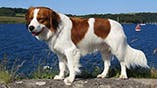 This attractive little dog is the only one known to have "earrings". This is the name given to the long, dark hairs that dangle from the tips of the ears.
They are a small Spaniel type of dog with a silky coat which is white but covered in distinctive red and orange markings. They have a slender but nearly square frame. Along with their "earrings", they also have a white plume on their tail.
They originate from Holland where they were originally used for duck hunting. They are good-natured, friendly and intelligent. They're also very agile. They can be wary of strangers but can be socialised to strangers, children and animals. They tend to be quite sedate indoors but need plenty of exercise outdoors.
Their waterproof coat is easy to maintain with regular grooming. They are prone to blood clotting problems, eye problems, kneecap problems and a particular neurological disease.
This attractive little dog is the only one known to have "earrings". This is the name given to the long, dark hairs that dangle from the tips of the ears.
They are a small Spaniel type of dog with a silky coat which is white but covered in distinctive red and orange markings. They have a slender but nearly square frame. Along with their "earrings", they also have a white plume on their tail.
They originate from Holland where they were originally used for duck hunting. They are good-natured, friendly and intelligent. They're also very agile. They can be wary of strangers but can be socialised to strangers, children and animals. They tend to be quite sedate indoors but need plenty of exercise outdoors.
Their waterproof coat is easy to maintain with regular grooming. They are prone to blood clotting problems, eye problems, kneecap problems and a particular neurological disease.
This attractive little dog is the only one known to have "earrings". This is the name given to the long, dark hairs that dangle from the tips of the ears.
They are a small Spaniel type of dog with a silky coat which is white but covered in distinctive red and orange markings. They have a slender but nearly square frame. Along with their "earrings", they also have a white plume on their tail.
They originate from Holland where they were originally used for duck hunting. They are good-natured, friendly and intelligent. They're also very agile. They can be wary of strangers but can be socialised to strangers, children and animals. They tend to be quite sedate indoors but need plenty of exercise outdoors.
Their waterproof coat is easy to maintain with regular grooming. They are prone to blood clotting problems, eye problems, kneecap problems and a particular neurological disease.Korean JindoThe Korean Jindo is an official national treasure of Korea and because of this it is very difficult to export purebreds out of Korea.
They are a medium-sized spitz-type breed with a squarish body and a double but short coat that comes in a wide variety of colours. In Korea they were originally used for hunting. They worked independently, returning to the huntsman with the prey.
They are intelligent, strong-willed and independent and can be quite territorial but they bond closely with their owner and can be very loyal and obedient. They have a strong protective instinct and prey drive so are wary of strangers and a possible threat to small wildlife. Careful training needs to be undertaken to overcome this. They need plenty of exercise but teaching a very secure recall is necessary because of their prey drive. It is not wise to leave them in a yard as they get bored easily and have amazing abilities to scale walls up to eight feet high.
The short coat does not need too much looking after throughout most of the year but it sheds heavily twice a year when daily brushing is a necessity. The only health problem they are known to be prone to is hypothyroidism.
The Korean Jindo is an official national treasure of Korea and because of this it is very difficult to export purebreds out of Korea.
They are a medium-sized spitz-type breed with a squarish body and a double but short coat that comes in a wide variety of colours. In Korea they were originally used for hunting. They worked independently, returning to the huntsman with the prey.
They are intelligent, strong-willed and independent and can be quite territorial but they bond closely with their owner and can be very loyal and obedient. They have a strong protective instinct and prey drive so are wary of strangers and a possible threat to small wildlife. Careful training needs to be undertaken to overcome this. They need plenty of exercise but teaching a very secure recall is necessary because of their prey drive. It is not wise to leave them in a yard as they get bored easily and have amazing abilities to scale walls up to eight feet high.
The short coat does not need too much looking after throughout most of the year but it sheds heavily twice a year when daily brushing is a necessity. The only health problem they are known to be prone to is hypothyroidism.Korthals GriffonThe excellent all-terrain gundog can make a loving and loyal companion as long as he is given plenty to do.
This is a wirehaired, strong, pointing type of gundog. They have the bushy eyebrows, beard and moustache of many wirehaireds. They can come in a variety of colours.
They were developed by a Dutch breeder called Eduard Korthals who wanted a gundog that could hunt in all kinds of terrain. They are intelligent and full of enthusiasm and are most skilled at hunting small game. They love to work and have an exceptional sense of smell as well as the ability to think for themselves, but they can be gentle and affectionate too in a family setting. As long as there are plenty of outlets for physical and mental exercise, these are friendly and loving to children, strangers and other dogs. They have a lot of energy and stamina and love to run and swim. They need a good deal of exercise.
Their coat needs occasional brushing and combing but also trimming and stripping. There have been cases of hip dysplasia.
The excellent all-terrain gundog can make a loving and loyal companion as long as he is given plenty to do.
This is a wirehaired, strong, pointing type of gundog. They have the bushy eyebrows, beard and moustache of many wirehaireds. They can come in a variety of colours.
They were developed by a Dutch breeder called Eduard Korthals who wanted a gundog that could hunt in all kinds of terrain. They are intelligent and full of enthusiasm and are most skilled at hunting small game. They love to work and have an exceptional sense of smell as well as the ability to think for themselves, but they can be gentle and affectionate too in a family setting. As long as there are plenty of outlets for physical and mental exercise, these are friendly and loving to children, strangers and other dogs. They have a lot of energy and stamina and love to run and swim. They need a good deal of exercise.
Their coat needs occasional brushing and combing but also trimming and stripping. There have been cases of hip dysplasia.Lagotto Romagnolo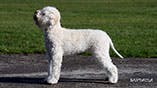 The Lagotto is a medium sized dog, quite well muscled with a largish head. They can come in brown (which fades to Brown roan) or white with patches in shades of orange or brown. Never black nor pure white. The most distinctive adult feature is the tightly curled coat.
Although originally used for duck hunting in their native Italy, they later became specialised truffle hunters, the only dog used for this specific purpose. Outside Italy, they are still used for hunting waterfowl and their waterproof coat helps to protect them in this. When out hunting truffles in Italy, the closely curled coat helps to protect them from low lying shrub.
They are loyal, friendly, intelligent and very trainable but need an experienced dog owner who will be committed to focused training. They make an excellent working dog but if not working, they need plenty of opportunity to exercise their brain. They do well in competitive sports. They are devoted to their owners but may be initially reserved with strangers. They can easily be trained to get along with other animals. They need a lot of exercise and have a natural ability to retrieve. They love to dig so fencing would need to be secure and maybe their own separate area of garden if you are an avid gardener. They're also very fond of water...and mud!
The coat does not shed and as a consequence is prone to matting if allowed to get too long so needs regular care by combing and should be clipped off completely several times a year. It should never be brushed or blow-dried as this destroys the distinctive curls.
There are a range of health conditions that can be tested for, including Juvenile Epilepsy, Lagotto Storage Disease and Improper Coat as well as hip and elbow dysplasia. Responsible breeders will ensure that their breeding dogs are screened to avoid occurrence.
This breed is very rare in the UK and most of the few responsible breeders have waiting lists, so be prepared to be patient for a puppy. Because of the rarity, "rescues" seldom happen.
The Lagotto is a medium sized dog, quite well muscled with a largish head. They can come in brown (which fades to Brown roan) or white with patches in shades of orange or brown. Never black nor pure white. The most distinctive adult feature is the tightly curled coat.
Although originally used for duck hunting in their native Italy, they later became specialised truffle hunters, the only dog used for this specific purpose. Outside Italy, they are still used for hunting waterfowl and their waterproof coat helps to protect them in this. When out hunting truffles in Italy, the closely curled coat helps to protect them from low lying shrub.
They are loyal, friendly, intelligent and very trainable but need an experienced dog owner who will be committed to focused training. They make an excellent working dog but if not working, they need plenty of opportunity to exercise their brain. They do well in competitive sports. They are devoted to their owners but may be initially reserved with strangers. They can easily be trained to get along with other animals. They need a lot of exercise and have a natural ability to retrieve. They love to dig so fencing would need to be secure and maybe their own separate area of garden if you are an avid gardener. They're also very fond of water...and mud!
The coat does not shed and as a consequence is prone to matting if allowed to get too long so needs regular care by combing and should be clipped off completely several times a year. It should never be brushed or blow-dried as this destroys the distinctive curls.
There are a range of health conditions that can be tested for, including Juvenile Epilepsy, Lagotto Storage Disease and Improper Coat as well as hip and elbow dysplasia. Responsible breeders will ensure that their breeding dogs are screened to avoid occurrence.
This breed is very rare in the UK and most of the few responsible breeders have waiting lists, so be prepared to be patient for a puppy. Because of the rarity, "rescues" seldom happen.
The Lagotto is a medium sized dog, quite well muscled with a largish head. They can come in brown (which fades to Brown roan) or white with patches in shades of orange or brown. Never black nor pure white. The most distinctive adult feature is the tightly curled coat.
Although originally used for duck hunting in their native Italy, they later became specialised truffle hunters, the only dog used for this specific purpose. Outside Italy, they are still used for hunting waterfowl and their waterproof coat helps to protect them in this. When out hunting truffles in Italy, the closely curled coat helps to protect them from low lying shrub.
They are loyal, friendly, intelligent and very trainable but need an experienced dog owner who will be committed to focused training. They make an excellent working dog but if not working, they need plenty of opportunity to exercise their brain. They do well in competitive sports. They are devoted to their owners but may be initially reserved with strangers. They can easily be trained to get along with other animals. They need a lot of exercise and have a natural ability to retrieve. They love to dig so fencing would need to be secure and maybe their own separate area of garden if you are an avid gardener. They're also very fond of water...and mud!
The coat does not shed and as a consequence is prone to matting if allowed to get too long so needs regular care by combing and should be clipped off completely several times a year. It should never be brushed or blow-dried as this destroys the distinctive curls.
There are a range of health conditions that can be tested for, including Juvenile Epilepsy, Lagotto Storage Disease and Improper Coat as well as hip and elbow dysplasia. Responsible breeders will ensure that their breeding dogs are screened to avoid occurrence.
This breed is very rare in the UK and most of the few responsible breeders have waiting lists, so be prepared to be patient for a puppy. Because of the rarity, "rescues" seldom happen.Lakeland TerrierThe Lakeland Terrier is a busy, friendly and confident little dog but they might need to be reminded that they don't need to bark to let you know that they're around.
They are small and sturdy with a generally rectangular look and straight front legs. Their double coat is soft underneath and wiry on top. They come in a variety of solid colours and also with "saddle" markings in specific areas.
The breed dates back to the 1800s in the UK. They were bred to hunt den animals like badgers and foxes to protect farm animals and crops. They are alert, affectionate, lively, brave and intelligent. They may be a little wilful but are very trainable and like mental stimulation. They are naturally sociable with people, very good with children and other dogs but need to be taught to get on with other animals. They are an active breed indoors but need good, daily, outdoor exercise too. They are agile and have good stamina.
The wiry coat needs minimal grooming but does need occasional trimming and stripping. They are hardy with no known health problems.
The Lakeland Terrier is a busy, friendly and confident little dog but they might need to be reminded that they don't need to bark to let you know that they're around.
They are small and sturdy with a generally rectangular look and straight front legs. Their double coat is soft underneath and wiry on top. They come in a variety of solid colours and also with "saddle" markings in specific areas.
The breed dates back to the 1800s in the UK. They were bred to hunt den animals like badgers and foxes to protect farm animals and crops. They are alert, affectionate, lively, brave and intelligent. They may be a little wilful but are very trainable and like mental stimulation. They are naturally sociable with people, very good with children and other dogs but need to be taught to get on with other animals. They are an active breed indoors but need good, daily, outdoor exercise too. They are agile and have good stamina.
The wiry coat needs minimal grooming but does need occasional trimming and stripping. They are hardy with no known health problems.
Lancashire Heeler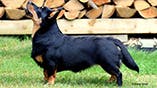 The Lancashire Heeler is a tough little character who likes to be busy.
They are a small dog with a long body and short legs in relation to the body length. The coat is black with tan markings or liver with tan markings. It is short and sleek in summer but grows thicker in winter when it develops a noticeable mane.
Like other low to the ground dogs such as the Corgi, the Heeler was bred to herd cattle by nipping at the ankles, but is rarely used for herding today. They are intelligent and eager to learn but may not be the easiest breed to train. Because of their instinct to nip ankles, especially when excited, this needs to be trained out of them.
They generally like people but may be a little wary of strangers and they tend to prefer the company of older rather than younger children. They can be friendly to other dogs but naturally want to be in charge. Care needs to be taken around small mammals as they are the Heeler's normal prey. They enjoy a daily walk but tend to be very active indoors too.
The coat is easy to maintain with regular brushing and combing. There is a health condition in the breed called Primary Lens Luxation for which there is a DNA test. All puppies should be bred from health tested parents or those that are hereditarily clear of lens luxation.
The Lancashire Heeler is a tough little character who likes to be busy.
They are a small dog with a long body and short legs in relation to the body length. The coat is black with tan markings or liver with tan markings. It is short and sleek in summer but grows thicker in winter when it develops a noticeable mane.
Like other low to the ground dogs such as the Corgi, the Heeler was bred to herd cattle by nipping at the ankles, but is rarely used for herding today. They are intelligent and eager to learn but may not be the easiest breed to train. Because of their instinct to nip ankles, especially when excited, this needs to be trained out of them.
They generally like people but may be a little wary of strangers and they tend to prefer the company of older rather than younger children. They can be friendly to other dogs but naturally want to be in charge. Care needs to be taken around small mammals as they are the Heeler's normal prey. They enjoy a daily walk but tend to be very active indoors too.
The coat is easy to maintain with regular brushing and combing. There is a health condition in the breed called Primary Lens Luxation for which there is a DNA test. All puppies should be bred from health tested parents or those that are hereditarily clear of lens luxation.
The Lancashire Heeler is a tough little character who likes to be busy.
They are a small dog with a long body and short legs in relation to the body length. The coat is black with tan markings or liver with tan markings. It is short and sleek in summer but grows thicker in winter when it develops a noticeable mane.
Like other low to the ground dogs such as the Corgi, the Heeler was bred to herd cattle by nipping at the ankles, but is rarely used for herding today. They are intelligent and eager to learn but may not be the easiest breed to train. Because of their instinct to nip ankles, especially when excited, this needs to be trained out of them.
They generally like people but may be a little wary of strangers and they tend to prefer the company of older rather than younger children. They can be friendly to other dogs but naturally want to be in charge. Care needs to be taken around small mammals as they are the Heeler's normal prey. They enjoy a daily walk but tend to be very active indoors too.
The coat is easy to maintain with regular brushing and combing. There is a health condition in the breed called Primary Lens Luxation for which there is a DNA test. All puppies should be bred from health tested parents or those that are hereditarily clear of lens luxation.Large Munsterlander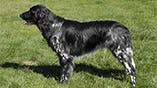 The Large Munsterlander is a fine companion, either out hunting with his elegant gait or enjoying the company of a family who love the great outdoors.
They are a large gundog with a balanced body and a fine, black head. Their coat is white with multiple black patches and is long, silky and dense.
They originate from Munster in Germany and were bred as a track, point and retrieve gundog. They can work on both land and water. They love to play, are brave, friendly, loyal, intelligent and very trainable. They do well in obedience competitions. They usually get on well with strangers, children, and other animals although may have a tendency to chase small mammals. They are happiest outdoors and active with lots to exercise their body and brain. They love to retrieve, especially love water and have great stamina.
They need regular brushing and combing with the males' longer coat needing to be groomed more regularly. They also shed heavily at certain times in the year. The breed is generally healthy although there have been some cases of hip dysplasia.
The Large Munsterlander is a fine companion, either out hunting with his elegant gait or enjoying the company of a family who love the great outdoors.
They are a large gundog with a balanced body and a fine, black head. Their coat is white with multiple black patches and is long, silky and dense.
They originate from Munster in Germany and were bred as a track, point and retrieve gundog. They can work on both land and water. They love to play, are brave, friendly, loyal, intelligent and very trainable. They do well in obedience competitions. They usually get on well with strangers, children, and other animals although may have a tendency to chase small mammals. They are happiest outdoors and active with lots to exercise their body and brain. They love to retrieve, especially love water and have great stamina.
They need regular brushing and combing with the males' longer coat needing to be groomed more regularly. They also shed heavily at certain times in the year. The breed is generally healthy although there have been some cases of hip dysplasia.
The Large Munsterlander is a fine companion, either out hunting with his elegant gait or enjoying the company of a family who love the great outdoors.
They are a large gundog with a balanced body and a fine, black head. Their coat is white with multiple black patches and is long, silky and dense.
They originate from Munster in Germany and were bred as a track, point and retrieve gundog. They can work on both land and water. They love to play, are brave, friendly, loyal, intelligent and very trainable. They do well in obedience competitions. They usually get on well with strangers, children, and other animals although may have a tendency to chase small mammals. They are happiest outdoors and active with lots to exercise their body and brain. They love to retrieve, especially love water and have great stamina.
They need regular brushing and combing with the males' longer coat needing to be groomed more regularly. They also shed heavily at certain times in the year. The breed is generally healthy although there have been some cases of hip dysplasia.LeonbergerA well trained Leonberger is a gentle giant that loves human company and is great with children.
They are a huge, muscular dog with a dense, thick, waterproof double coat. This comes in shades of creamy yellow through to reddish brown in a variety of combinations. The face should have a black "mask" within clearly specified limits. They have a thick mane and often have webbed feet which often makes them powerful swimmers.
They were bred in the 19th century by Heinrich Essing, the Mayor of Leonberg in Germany. His aim was to breed something that resembled a lion. Although a good guard dog, they have a very steady temperament and will normally walk away from aggravation rather than respond to it. They are fearless, affectionate, obedient, loyal and very intelligent. They naturally tend to be tolerant and get on well with strangers, children and other animals. They are generally quite sedentary indoors so a good daily walk is essential although they don't need a lot of exercise. They love to swim and adult Leonbergers can be taught to pull carts and sledges.
The thick coat needs regular grooming and they will shed heavily at certain times of the year. They are prone to hip dysplasia and other bone disorders and have been known to have eyelid problems too.
A well trained Leonberger is a gentle giant that loves human company and is great with children.
They are a huge, muscular dog with a dense, thick, waterproof double coat. This comes in shades of creamy yellow through to reddish brown in a variety of combinations. The face should have a black "mask" within clearly specified limits. They have a thick mane and often have webbed feet which often makes them powerful swimmers.
They were bred in the 19th century by Heinrich Essing, the Mayor of Leonberg in Germany. His aim was to breed something that resembled a lion. Although a good guard dog, they have a very steady temperament and will normally walk away from aggravation rather than respond to it. They are fearless, affectionate, obedient, loyal and very intelligent. They naturally tend to be tolerant and get on well with strangers, children and other animals. They are generally quite sedentary indoors so a good daily walk is essential although they don't need a lot of exercise. They love to swim and adult Leonbergers can be taught to pull carts and sledges.
The thick coat needs regular grooming and they will shed heavily at certain times of the year. They are prone to hip dysplasia and other bone disorders and have been known to have eyelid problems too.Lhasa Apso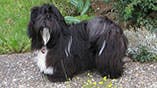 Named after the sacred city of Lhasa in Tibet, the Lhasa Apso was at one time considered a sacred dog. It was believed that when the dog's master died, his soul entered the Lhasa Apso's body.
They are a hardy little dog with a body longer than it is high and a tail that curls over the back. They have a dense, double coat which covers the whole body including the head and ears which can come in many colours. The coat could naturally reach the floor but they are often trimmed to make grooming easier.
They were bred by Tibetan monks as a guard dog for temples and monasteries. They are friendly, spirited and intelligent. They have a stubborn streak but can make a very good pet, affectionate and loving to friends and family. While they are head strong, they are keen to learn with gentle, positive training methods. They are quite jovial dogs and a bit of a clown.
They have excellent hearing and will give plenty of vocal warning of any perceived threat. They are naturally wary of strangers but a well brought up Lhasa Apso can be sociable with strangers, children and other animals. They are an active breed indoors but enjoy a daily walk too and have surprising stamina.
Regular brushing and combing keeps the coat matt free but this is easier if they are trimmed. Some health problems have been reported: skin problems, hip dysplasia, kidney problems, eye problems and ulcers but they are generally a very healthy and long-living dog. Diet plays a huge role in some of the skin conditions and regular grooming helps with skin issues.
Named after the sacred city of Lhasa in Tibet, the Lhasa Apso was at one time considered a sacred dog. It was believed that when the dog's master died, his soul entered the Lhasa Apso's body.
They are a hardy little dog with a body longer than it is high and a tail that curls over the back. They have a dense, double coat which covers the whole body including the head and ears which can come in many colours. The coat could naturally reach the floor but they are often trimmed to make grooming easier.
They were bred by Tibetan monks as a guard dog for temples and monasteries. They are friendly, spirited and intelligent. They have a stubborn streak but can make a very good pet, affectionate and loving to friends and family. While they are head strong, they are keen to learn with gentle, positive training methods. They are quite jovial dogs and a bit of a clown.
They have excellent hearing and will give plenty of vocal warning of any perceived threat. They are naturally wary of strangers but a well brought up Lhasa Apso can be sociable with strangers, children and other animals. They are an active breed indoors but enjoy a daily walk too and have surprising stamina.
Regular brushing and combing keeps the coat matt free but this is easier if they are trimmed. Some health problems have been reported: skin problems, hip dysplasia, kidney problems, eye problems and ulcers but they are generally a very healthy and long-living dog. Diet plays a huge role in some of the skin conditions and regular grooming helps with skin issues.
Named after the sacred city of Lhasa in Tibet, the Lhasa Apso was at one time considered a sacred dog. It was believed that when the dog's master died, his soul entered the Lhasa Apso's body.
They are a hardy little dog with a body longer than it is high and a tail that curls over the back. They have a dense, double coat which covers the whole body including the head and ears which can come in many colours. The coat could naturally reach the floor but they are often trimmed to make grooming easier.
They were bred by Tibetan monks as a guard dog for temples and monasteries. They are friendly, spirited and intelligent. They have a stubborn streak but can make a very good pet, affectionate and loving to friends and family. While they are head strong, they are keen to learn with gentle, positive training methods. They are quite jovial dogs and a bit of a clown.
They have excellent hearing and will give plenty of vocal warning of any perceived threat. They are naturally wary of strangers but a well brought up Lhasa Apso can be sociable with strangers, children and other animals. They are an active breed indoors but enjoy a daily walk too and have surprising stamina.
Regular brushing and combing keeps the coat matt free but this is easier if they are trimmed. Some health problems have been reported: skin problems, hip dysplasia, kidney problems, eye problems and ulcers but they are generally a very healthy and long-living dog. Diet plays a huge role in some of the skin conditions and regular grooming helps with skin issues.Lowchen (Little Lion Dog)In the 1600s, the Lowchen or "Little Lion" had to tolerate not just being groomed to look like a lion but to having it's exposed skin used as a foot warmer for noble ladies.
They are a small but sturdy dog with a long, soft, dense, silky coat that comes in white, black or lemon but they can also be speckled. They are often clipped to look like a lion: the hindquarters, all but the tip of the tail and part of the front legs are clipped.
They found favour as a companion dog and originate in Europe, probably Germany because Lowchen means "Little Lion" in German. They are tougher than they look and can be a little wilful but they are basically sweet natured, cheerful, intelligent and eager to learn. They are normally good natured towards strangers, children and other animals. They are an active breed indoors but enjoy a daily walk too.
They shed very little but their coat needs regular grooming as it tangles easily. They are usually very healthy but can be prone to kneecap problems.
In the 1600s, the Lowchen or "Little Lion" had to tolerate not just being groomed to look like a lion but to having it's exposed skin used as a foot warmer for noble ladies.
They are a small but sturdy dog with a long, soft, dense, silky coat that comes in white, black or lemon but they can also be speckled. They are often clipped to look like a lion: the hindquarters, all but the tip of the tail and part of the front legs are clipped.
They found favour as a companion dog and originate in Europe, probably Germany because Lowchen means "Little Lion" in German. They are tougher than they look and can be a little wilful but they are basically sweet natured, cheerful, intelligent and eager to learn. They are normally good natured towards strangers, children and other animals. They are an active breed indoors but enjoy a daily walk too.
They shed very little but their coat needs regular grooming as it tangles easily. They are usually very healthy but can be prone to kneecap problems.MalteseOnce loved by royalty, it is said that noble ladies carried these little dogs around in their sleeves.
They are a small, sturdy dog with long, silky white or off-white hair which sets off their black eyes and black nose. For ease of grooming the coat is often trimmed into a "puppy" cut.
They originate in Italy where they were a popular lap dog owned by nobility all over the world. Bred to be a companion, they are lovable and loving, lively and playful. They are a good watch dog and will not hesitate to warn of intruders. They are highly intelligent and good at learning tricks and they are normally sociable with people and other animals. They are an active breed indoors but enjoy a daily walk too. They love to play outdoors and may enjoy jumping in puddles.
The very soft coat needs a lot of care with daily brushing and combing. They find very cold or very hot conditions difficult, are prone to chills and sunburn. They may have digestive problems, teeth problems, skin, eye and breathing problems and slipped stifle.
Once loved by royalty, it is said that noble ladies carried these little dogs around in their sleeves.
They are a small, sturdy dog with long, silky white or off-white hair which sets off their black eyes and black nose. For ease of grooming the coat is often trimmed into a "puppy" cut.
They originate in Italy where they were a popular lap dog owned by nobility all over the world. Bred to be a companion, they are lovable and loving, lively and playful. They are a good watch dog and will not hesitate to warn of intruders. They are highly intelligent and good at learning tricks and they are normally sociable with people and other animals. They are an active breed indoors but enjoy a daily walk too. They love to play outdoors and may enjoy jumping in puddles.
The very soft coat needs a lot of care with daily brushing and combing. They find very cold or very hot conditions difficult, are prone to chills and sunburn. They may have digestive problems, teeth problems, skin, eye and breathing problems and slipped stifle.Manchester TerrierAlthough elegant in appearance, the Manchester Terrier has the reputation of being the best rat catcher of all the breeds although they can also make a very loving companion to humans.
There are two types, Toy and Standard. Both are compact and muscular with a shining, short, black and tan coat. Their heads are long and tapering with long, erect ears, although in the Standard the ear tips fold forward.
They are the oldest known terrier, originating in the Uk and bred to hunt vermin. The Manchester Terrier needs plenty of outlets for physical and mental exercise. They are very intelligent and eager to learn and although independent are loving and faithful to their owners. They can do well in agility and obedience. They can be sociable with strangers, children and other dogs but may not be trustable with small mammals. They are powerful and agile and although very active indoors, need plenty of exercise outside too. They can run very fast but their prey instinct inclines them to chase too.
The short, smooth coat is very easy to care for. They are generally healthy but problems have been found with certain blood disorders.
Although elegant in appearance, the Manchester Terrier has the reputation of being the best rat catcher of all the breeds although they can also make a very loving companion to humans.
There are two types, Toy and Standard. Both are compact and muscular with a shining, short, black and tan coat. Their heads are long and tapering with long, erect ears, although in the Standard the ear tips fold forward.
They are the oldest known terrier, originating in the Uk and bred to hunt vermin. The Manchester Terrier needs plenty of outlets for physical and mental exercise. They are very intelligent and eager to learn and although independent are loving and faithful to their owners. They can do well in agility and obedience. They can be sociable with strangers, children and other dogs but may not be trustable with small mammals. They are powerful and agile and although very active indoors, need plenty of exercise outside too. They can run very fast but their prey instinct inclines them to chase too.
The short, smooth coat is very easy to care for. They are generally healthy but problems have been found with certain blood disorders.Maremma SheepdogThe Maremma Sheepdog is a large guardian who will naturally protect his family and home in a calm and dignified manner.
They are a very large dog with a dense double coat and a bear-like head. The coat is quite long, harsh, has a slight wave and comes in shades of white and cream.
They originate in Italy where they were used for guarding sheep and are still used for that today. As flock guardians they are brave, an excellent guard dog and naturally independent so are not an easy dog to obedience train but they are affectionate, loyal and intelligent. They are normally good with children, other dogs and other animals but may be a little wary of strangers. They much prefer to be outside and do not fair well in hot conditions. If not living outside, they need long daily walks.
The thick hair needs regular grooming but there are no known health problems.
The Maremma Sheepdog is a large guardian who will naturally protect his family and home in a calm and dignified manner.
They are a very large dog with a dense double coat and a bear-like head. The coat is quite long, harsh, has a slight wave and comes in shades of white and cream.
They originate in Italy where they were used for guarding sheep and are still used for that today. As flock guardians they are brave, an excellent guard dog and naturally independent so are not an easy dog to obedience train but they are affectionate, loyal and intelligent. They are normally good with children, other dogs and other animals but may be a little wary of strangers. They much prefer to be outside and do not fair well in hot conditions. If not living outside, they need long daily walks.
The thick hair needs regular grooming but there are no known health problems.Mastiff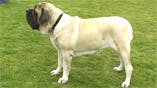 The Mastiff (often referred to as the English Mastiff) is huge. In the eighteenth century, they were given this description: "As a lion is to a cat, so is a Mastiff compared to a dog".
This is a powerful, muscular dog with a smooth, short coat which comes in golden, tiger or brindle. Their head is large and square with a black mask and soft jowls.
They have a long history. During the time of the Roman invasion of Britain, some were taken back to Rome for fighting in the Arenas but their main use, over the years has been for guarding and pulling weights. A natural guard: watchful, intelligent and calm, they will not warn of danger, they seldom bark, neither are they aggressive, their tendency is to simply hold an intruder. Their size makes it important to ensure that they are trained to behave impeccably.
Mastiffs are often good with children and other animals but may be wary of strangers. They are inclined to be sedentary indoors so a good daily walk is important to keep them fit. The short coat is easy to care for with occasional brushing and bathing.
They are prone to hip and elbow dysplasia and bloat and some suffer from CHD, gastric torsion, ectropion, PPM, vaginal hyperplasia and PRA. Many also tend to drool, wheeze and snore.
The Mastiff (often referred to as the English Mastiff) is huge. In the eighteenth century, they were given this description: "As a lion is to a cat, so is a Mastiff compared to a dog".
This is a powerful, muscular dog with a smooth, short coat which comes in golden, tiger or brindle. Their head is large and square with a black mask and soft jowls.
They have a long history. During the time of the Roman invasion of Britain, some were taken back to Rome for fighting in the Arenas but their main use, over the years has been for guarding and pulling weights. A natural guard: watchful, intelligent and calm, they will not warn of danger, they seldom bark, neither are they aggressive, their tendency is to simply hold an intruder. Their size makes it important to ensure that they are trained to behave impeccably.
Mastiffs are often good with children and other animals but may be wary of strangers. They are inclined to be sedentary indoors so a good daily walk is important to keep them fit. The short coat is easy to care for with occasional brushing and bathing.
They are prone to hip and elbow dysplasia and bloat and some suffer from CHD, gastric torsion, ectropion, PPM, vaginal hyperplasia and PRA. Many also tend to drool, wheeze and snore.
The Mastiff (often referred to as the English Mastiff) is huge. In the eighteenth century, they were given this description: "As a lion is to a cat, so is a Mastiff compared to a dog".
This is a powerful, muscular dog with a smooth, short coat which comes in golden, tiger or brindle. Their head is large and square with a black mask and soft jowls.
They have a long history. During the time of the Roman invasion of Britain, some were taken back to Rome for fighting in the Arenas but their main use, over the years has been for guarding and pulling weights. A natural guard: watchful, intelligent and calm, they will not warn of danger, they seldom bark, neither are they aggressive, their tendency is to simply hold an intruder. Their size makes it important to ensure that they are trained to behave impeccably.
Mastiffs are often good with children and other animals but may be wary of strangers. They are inclined to be sedentary indoors so a good daily walk is important to keep them fit. The short coat is easy to care for with occasional brushing and bathing.
They are prone to hip and elbow dysplasia and bloat and some suffer from CHD, gastric torsion, ectropion, PPM, vaginal hyperplasia and PRA. Many also tend to drool, wheeze and snore.Mexican HairlessThe Mexican Hairless, or Xolo, is one of the oldest known breeds, dating back over 3,000 years. Not only valued as a companion, they were a popular "hot water bottle" on a cold night. Bitterly cold weather called for a "Three Dog Night".
There are three sizes: Intermediate, Miniature and Standard and actually two "coat" types which come in a variety of colours. The completely hairless are the more popular but around one in every 5 born has a short, shiny coat. They are a muscular and hardy dog with a broad skull and large upright ears.
Their Mexican name means "God-Dog" and the ancient Aztecs and Mayans thought they had healing properties and a special connection to the gods. This meant that they were sometimes sacrificed as an offering or buried with their owners when they died. The smaller Xolos were companions, bed warmers and even eaten as a delicacy. The larger were more for protection.
They are extremely loyal and bond quickly and easily. They have been known to climb trees and ride horses to be with their owner. It is important that they are given the opportunity to bond with the whole family or they can become a one person dog. They are very intelligent and athletic and do well at agility and obedience. They are naturally protective of their family so need to be taught to accept strangers and other animals.
Young Xolos need a lot of exercise for their body and brain. They do calm down as they mature but they'll always enjoy a daily walk. They tend not to run off as they'd rather be with their owner.
Obviously the hairless do not need brushing but a little moisturiser and sun screen in hot weather is a good idea, something mild and hypoallergenic. They are normally a long-lived breed with no known health problems.
The Mexican Hairless, or Xolo, is one of the oldest known breeds, dating back over 3,000 years. Not only valued as a companion, they were a popular "hot water bottle" on a cold night. Bitterly cold weather called for a "Three Dog Night".
There are three sizes: Intermediate, Miniature and Standard and actually two "coat" types which come in a variety of colours. The completely hairless are the more popular but around one in every 5 born has a short, shiny coat. They are a muscular and hardy dog with a broad skull and large upright ears.
Their Mexican name means "God-Dog" and the ancient Aztecs and Mayans thought they had healing properties and a special connection to the gods. This meant that they were sometimes sacrificed as an offering or buried with their owners when they died. The smaller Xolos were companions, bed warmers and even eaten as a delicacy. The larger were more for protection.
They are extremely loyal and bond quickly and easily. They have been known to climb trees and ride horses to be with their owner. It is important that they are given the opportunity to bond with the whole family or they can become a one person dog. They are very intelligent and athletic and do well at agility and obedience. They are naturally protective of their family so need to be taught to accept strangers and other animals.
Young Xolos need a lot of exercise for their body and brain. They do calm down as they mature but they'll always enjoy a daily walk. They tend not to run off as they'd rather be with their owner.
Obviously the hairless do not need brushing but a little moisturiser and sun screen in hot weather is a good idea, something mild and hypoallergenic. They are normally a long-lived breed with no known health problems.Miniature Pinscher The Miniature Pinscher is a hardy, friendly and spirited little companion, often called the "King of the Toys".
They look like a little Doberman, a small, compact, well proportioned dog with a short, sleek coat. The coat comes in variations of a dark colour with reddish markings: black and rust, chocolate and tan, red and stag red (red with black hairs).
They originate from Germany where they were bred to be ratters. They are playful, alert and intelligent, responding well to training and often doing well in competitive obedience and agility. They can be something of a watchdog too and will alert you to the presence of strangers. They are easy to train to be sociable with strangers and tend to naturally be good with other pets and children. They have plenty of energy and tend to be active indoors as well as enjoying a daily walk.
The smooth, short hair is easy to care for and they are generally healthy and not prone to any specific problems.
The Miniature Pinscher is a hardy, friendly and spirited little companion, often called the "King of the Toys".
They look like a little Doberman, a small, compact, well proportioned dog with a short, sleek coat. The coat comes in variations of a dark colour with reddish markings: black and rust, chocolate and tan, red and stag red (red with black hairs).
They originate from Germany where they were bred to be ratters. They are playful, alert and intelligent, responding well to training and often doing well in competitive obedience and agility. They can be something of a watchdog too and will alert you to the presence of strangers. They are easy to train to be sociable with strangers and tend to naturally be good with other pets and children. They have plenty of energy and tend to be active indoors as well as enjoying a daily walk.
The smooth, short hair is easy to care for and they are generally healthy and not prone to any specific problems.
The Miniature Pinscher is a hardy, friendly and spirited little companion, often called the "King of the Toys".
They look like a little Doberman, a small, compact, well proportioned dog with a short, sleek coat. The coat comes in variations of a dark colour with reddish markings: black and rust, chocolate and tan, red and stag red (red with black hairs).
They originate from Germany where they were bred to be ratters. They are playful, alert and intelligent, responding well to training and often doing well in competitive obedience and agility. They can be something of a watchdog too and will alert you to the presence of strangers. They are easy to train to be sociable with strangers and tend to naturally be good with other pets and children. They have plenty of energy and tend to be active indoors as well as enjoying a daily walk.
The smooth, short hair is easy to care for and they are generally healthy and not prone to any specific problems.Miniature SchnauzerThe Miniature Schnauzer was developed by crossing the Schnauzer with the Affenpinscher to create a handy scaled down version suitable for town living.
They are a small, sturdy, squarely-proportioned dog. Their head is approximately rectangular-shaped and clipped to give the appearance of a bushy beard, moustache and eyebrows with ears that sit close in the shape of small Vs. Their double coat is wiry with a soft undercoat and comes in black, white, salt / pepper and black / silver.
They are German in origin and were used as ratters, although the name Schnauzer comes from the German word "Schnauze", meaning "muzzle".
They are a happy little dog, intelligent, loving and playful. They are an alert watchdog but do not bark but have a kind of low howl. They generally enjoy human company and can be trained to get along with other dogs although may be inclined to chase small wildlife. They tend not to be too active indoors but are quite agile and enjoy daily brisk walks or jogs.
They need regular brushing and combing and occasional trimming or stripping. They are generally hardy but can be prone to liver disease, kidney stones, diabetes, skin disorders, von Willebrand's disease, cysts and hereditary eye problems.
The Miniature Schnauzer was developed by crossing the Schnauzer with the Affenpinscher to create a handy scaled down version suitable for town living.
They are a small, sturdy, squarely-proportioned dog. Their head is approximately rectangular-shaped and clipped to give the appearance of a bushy beard, moustache and eyebrows with ears that sit close in the shape of small Vs. Their double coat is wiry with a soft undercoat and comes in black, white, salt / pepper and black / silver.
They are German in origin and were used as ratters, although the name Schnauzer comes from the German word "Schnauze", meaning "muzzle".
They are a happy little dog, intelligent, loving and playful. They are an alert watchdog but do not bark but have a kind of low howl. They generally enjoy human company and can be trained to get along with other dogs although may be inclined to chase small wildlife. They tend not to be too active indoors but are quite agile and enjoy daily brisk walks or jogs.
They need regular brushing and combing and occasional trimming or stripping. They are generally hardy but can be prone to liver disease, kidney stones, diabetes, skin disorders, von Willebrand's disease, cysts and hereditary eye problems.Neapolitan Mastiff The Neapolitan Mastiff has an impressively ancient line, going back to the time when they were a Roman fighting dog, but their temperament is much more stable than their appearance would suggest.
They are a powerfully built, stocky looking dog. Their impressively large head is enhanced with a mass of wrinkles and folds with a large dewlap. Their coat is short and shiny and comes in gray, blue, black, mahogany, tawny and, rarely but occasionally, chocolate, sometimes with brindle and white markings. A small amount of white markings are allowed on their chest and toes but none on their face.
In ancient Roman times, they were used for combat, both in a war situation and in the arena. They subsequently went on to find favour as a guard dog.
Neapolitan Mastiffs can be affectionate, intelligent, calm and well behaved. Although their first instinct is to protect, a well trained Neapolitan Mastiff will only use their full force when commanded. Usually quiet, only barking if necessary, they can be wary of strangers although loving to the family and they can be trained to accept other people and animals. They tend to be inactive indoors but need a good deal of exercise so a long daily walk each day is essential.
The short coat is easy to maintain but the amount of drool they produce often needs regular attention and a towel kept nearby. They are prone to cherry eye, hip dysplasia, bloat and joint pain from growth (this last usually stops naturally). Because of the large head size, puppies are usually born via caesarian.
The Neapolitan Mastiff has an impressively ancient line, going back to the time when they were a Roman fighting dog, but their temperament is much more stable than their appearance would suggest.
They are a powerfully built, stocky looking dog. Their impressively large head is enhanced with a mass of wrinkles and folds with a large dewlap. Their coat is short and shiny and comes in gray, blue, black, mahogany, tawny and, rarely but occasionally, chocolate, sometimes with brindle and white markings. A small amount of white markings are allowed on their chest and toes but none on their face.
In ancient Roman times, they were used for combat, both in a war situation and in the arena. They subsequently went on to find favour as a guard dog.
Neapolitan Mastiffs can be affectionate, intelligent, calm and well behaved. Although their first instinct is to protect, a well trained Neapolitan Mastiff will only use their full force when commanded. Usually quiet, only barking if necessary, they can be wary of strangers although loving to the family and they can be trained to accept other people and animals. They tend to be inactive indoors but need a good deal of exercise so a long daily walk each day is essential.
The short coat is easy to maintain but the amount of drool they produce often needs regular attention and a towel kept nearby. They are prone to cherry eye, hip dysplasia, bloat and joint pain from growth (this last usually stops naturally). Because of the large head size, puppies are usually born via caesarian.
The Neapolitan Mastiff has an impressively ancient line, going back to the time when they were a Roman fighting dog, but their temperament is much more stable than their appearance would suggest.
They are a powerfully built, stocky looking dog. Their impressively large head is enhanced with a mass of wrinkles and folds with a large dewlap. Their coat is short and shiny and comes in gray, blue, black, mahogany, tawny and, rarely but occasionally, chocolate, sometimes with brindle and white markings. A small amount of white markings are allowed on their chest and toes but none on their face.
In ancient Roman times, they were used for combat, both in a war situation and in the arena. They subsequently went on to find favour as a guard dog.
Neapolitan Mastiffs can be affectionate, intelligent, calm and well behaved. Although their first instinct is to protect, a well trained Neapolitan Mastiff will only use their full force when commanded. Usually quiet, only barking if necessary, they can be wary of strangers although loving to the family and they can be trained to accept other people and animals. They tend to be inactive indoors but need a good deal of exercise so a long daily walk each day is essential.
The short coat is easy to maintain but the amount of drool they produce often needs regular attention and a towel kept nearby. They are prone to cherry eye, hip dysplasia, bloat and joint pain from growth (this last usually stops naturally). Because of the large head size, puppies are usually born via caesarian.Newfoundland What the St Bernard is to land, the Newfoundland is to the sea. They are a natural and outstanding water-rescue dog to whom many people have owed their lives. In 1919, a 'Newfie' was awarded a gold medal for pulling a lifeboat containing 20 people to safety.
They look like a huge, fluffy bear but underneath the thick, double coat is a strong and powerful dog. Their feet are webbed and their coat is oily and water-resistant. They can be black, brown or 'landseer' which is white with black markings. The black or brown can have a splash of white on chest, toes and tip of tail.
They have a long history of helping the fishermen in Canada, they rescued people and goods from the sea and could also haul things on land and be an effective watch and guard dog. They can be slow to train but are very sweet natured. They are calm and obedient, loyal and trustworthy. Although they make a good guard dog, they are more likely to hold than attack an intruder. They are good natured with people, including strangers if reassured that they are friends, good with other animals and especially with children. They are quite sedentary indoors so need a decent daily walk. They prefer cool and shade, their thick coat makes them uncomfortable in hot climates.
They should be brushed regularly, especially during times of seasonal heavy shedding but bathing should be avoided as this strips away the coat's natural waterproofing oils. They are prone to a heart disease called sub-aortic stenosis (SAS) and hip dysplasia.
What the St Bernard is to land, the Newfoundland is to the sea. They are a natural and outstanding water-rescue dog to whom many people have owed their lives. In 1919, a 'Newfie' was awarded a gold medal for pulling a lifeboat containing 20 people to safety.
They look like a huge, fluffy bear but underneath the thick, double coat is a strong and powerful dog. Their feet are webbed and their coat is oily and water-resistant. They can be black, brown or 'landseer' which is white with black markings. The black or brown can have a splash of white on chest, toes and tip of tail.
They have a long history of helping the fishermen in Canada, they rescued people and goods from the sea and could also haul things on land and be an effective watch and guard dog. They can be slow to train but are very sweet natured. They are calm and obedient, loyal and trustworthy. Although they make a good guard dog, they are more likely to hold than attack an intruder. They are good natured with people, including strangers if reassured that they are friends, good with other animals and especially with children. They are quite sedentary indoors so need a decent daily walk. They prefer cool and shade, their thick coat makes them uncomfortable in hot climates.
They should be brushed regularly, especially during times of seasonal heavy shedding but bathing should be avoided as this strips away the coat's natural waterproofing oils. They are prone to a heart disease called sub-aortic stenosis (SAS) and hip dysplasia.
What the St Bernard is to land, the Newfoundland is to the sea. They are a natural and outstanding water-rescue dog to whom many people have owed their lives. In 1919, a 'Newfie' was awarded a gold medal for pulling a lifeboat containing 20 people to safety.
They look like a huge, fluffy bear but underneath the thick, double coat is a strong and powerful dog. Their feet are webbed and their coat is oily and water-resistant. They can be black, brown or 'landseer' which is white with black markings. The black or brown can have a splash of white on chest, toes and tip of tail.
They have a long history of helping the fishermen in Canada, they rescued people and goods from the sea and could also haul things on land and be an effective watch and guard dog. They can be slow to train but are very sweet natured. They are calm and obedient, loyal and trustworthy. Although they make a good guard dog, they are more likely to hold than attack an intruder. They are good natured with people, including strangers if reassured that they are friends, good with other animals and especially with children. They are quite sedentary indoors so need a decent daily walk. They prefer cool and shade, their thick coat makes them uncomfortable in hot climates.
They should be brushed regularly, especially during times of seasonal heavy shedding but bathing should be avoided as this strips away the coat's natural waterproofing oils. They are prone to a heart disease called sub-aortic stenosis (SAS) and hip dysplasia.Norfolk TerrierNorfolk Terriers are one of the smallest of the working terriers but are sweeter natured than many.
They are a short-legged, sturdy little dog with a wiry coat that comes in red, wheaten, tan, black and tan, or grizzle. They are very similar to Norwich Terriers and until 1964 were considered the same dog (collectively known as the Norwich Terrier), but Norfolks have ears that are dropped at the tip and are more angular in shape.
They originate in the UK where they were used as ratters and to flush out foxes that had gone to ground. They are a busy, brave, affectionate little dog. They're intelligent and trainable but need to be kept busy. A bored Norfolk Terrier might start barking or digging. They are a sociable little dog that enjoys the company of people, children and other dogs but may not be trusted around small mammals. They are active most of the time and enjoy a daily walk and a good game of fetch.
The wiry coat needs regular brushing and combing and occasional clipping. They are generally healthy but may be prone to back problems and eye disease.
Norfolk Terriers are one of the smallest of the working terriers but are sweeter natured than many.
They are a short-legged, sturdy little dog with a wiry coat that comes in red, wheaten, tan, black and tan, or grizzle. They are very similar to Norwich Terriers and until 1964 were considered the same dog (collectively known as the Norwich Terrier), but Norfolks have ears that are dropped at the tip and are more angular in shape.
They originate in the UK where they were used as ratters and to flush out foxes that had gone to ground. They are a busy, brave, affectionate little dog. They're intelligent and trainable but need to be kept busy. A bored Norfolk Terrier might start barking or digging. They are a sociable little dog that enjoys the company of people, children and other dogs but may not be trusted around small mammals. They are active most of the time and enjoy a daily walk and a good game of fetch.
The wiry coat needs regular brushing and combing and occasional clipping. They are generally healthy but may be prone to back problems and eye disease.Norwegian Buhund The Norwegian Buhund is a quick learner with a natural desire to please. They are considered by many to be the easiest of the spitz breeds to train.
They are a medium-sized spitz-style dog with an alert little face and erect, mobile ears. Their double coat has a smooth, harsh outer and comes in wheaten, light red, black and wolf-sable.
Early Buhunds worked with Vikings, herding and guarding cattle and sheep and were then buried alongside their owners to accompany them in the afterlife. Now Buhunds can be found in many roles from hearing dog to police dog.
The Norwegian Buhund can be a little wilful but is generally a cheerful, intelligent and attentive dog. They make a good watch dog but are just as happy as a family pet. They are people friendly and especially fond of children and not naturally aggressive to other animals. They are a very active dog that needs plenty of regular physical and mental exercise.
They need regular brushing and combing and shed heavily at certain times of the year but their coat is easy to keep clean. They are prone to hip dysplasia and eye problems.
The Norwegian Buhund is a quick learner with a natural desire to please. They are considered by many to be the easiest of the spitz breeds to train.
They are a medium-sized spitz-style dog with an alert little face and erect, mobile ears. Their double coat has a smooth, harsh outer and comes in wheaten, light red, black and wolf-sable.
Early Buhunds worked with Vikings, herding and guarding cattle and sheep and were then buried alongside their owners to accompany them in the afterlife. Now Buhunds can be found in many roles from hearing dog to police dog.
The Norwegian Buhund can be a little wilful but is generally a cheerful, intelligent and attentive dog. They make a good watch dog but are just as happy as a family pet. They are people friendly and especially fond of children and not naturally aggressive to other animals. They are a very active dog that needs plenty of regular physical and mental exercise.
They need regular brushing and combing and shed heavily at certain times of the year but their coat is easy to keep clean. They are prone to hip dysplasia and eye problems.
The Norwegian Buhund is a quick learner with a natural desire to please. They are considered by many to be the easiest of the spitz breeds to train.
They are a medium-sized spitz-style dog with an alert little face and erect, mobile ears. Their double coat has a smooth, harsh outer and comes in wheaten, light red, black and wolf-sable.
Early Buhunds worked with Vikings, herding and guarding cattle and sheep and were then buried alongside their owners to accompany them in the afterlife. Now Buhunds can be found in many roles from hearing dog to police dog.
The Norwegian Buhund can be a little wilful but is generally a cheerful, intelligent and attentive dog. They make a good watch dog but are just as happy as a family pet. They are people friendly and especially fond of children and not naturally aggressive to other animals. They are a very active dog that needs plenty of regular physical and mental exercise.
They need regular brushing and combing and shed heavily at certain times of the year but their coat is easy to keep clean. They are prone to hip dysplasia and eye problems.Norwegian ElkhoundThe Elkhound is one of the oldest hunting dogs. They have a fine sense of scent, capable of smelling game from over a mile away, and were around at the time of cave men.
They are a strong and sturdy medium-sized spitz-style dog. Their double coat is thick and hard and comes in grey with black tips. They have a black muzzle, ears and tip of the tail too.
The name Elkhound is translated from a Norwegian word meaning "Moose Dog" and originally they were a hunting dog used for tracking and hunting a range of animals including moose, elk, bear and mountain lion. Their working method was to hold prey and bark until the hunter arrived so they are inclined to be insistently vocal in trying to get attention.
They can be difficult to obedience train but are friendly, loving and loyal to their family. They are usually fine with children and other dogs but may be wary of strangers and possibly not trustworthy around other animals. Although active indoors they can take a lot of outdoor exercise too but are happy with less if need be.
They need regular brushing and combing and shed heavily at certain times of the year. A special brush is needed at shedding time as the old hair clings to the new but their coat is easy to keep clean. They are prone to hip dysplasia, some skin problems and PRA.
The Elkhound is one of the oldest hunting dogs. They have a fine sense of scent, capable of smelling game from over a mile away, and were around at the time of cave men.
They are a strong and sturdy medium-sized spitz-style dog. Their double coat is thick and hard and comes in grey with black tips. They have a black muzzle, ears and tip of the tail too.
The name Elkhound is translated from a Norwegian word meaning "Moose Dog" and originally they were a hunting dog used for tracking and hunting a range of animals including moose, elk, bear and mountain lion. Their working method was to hold prey and bark until the hunter arrived so they are inclined to be insistently vocal in trying to get attention.
They can be difficult to obedience train but are friendly, loving and loyal to their family. They are usually fine with children and other dogs but may be wary of strangers and possibly not trustworthy around other animals. Although active indoors they can take a lot of outdoor exercise too but are happy with less if need be.
They need regular brushing and combing and shed heavily at certain times of the year. A special brush is needed at shedding time as the old hair clings to the new but their coat is easy to keep clean. They are prone to hip dysplasia, some skin problems and PRA.Norwich Terrier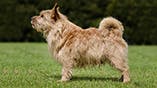 Norfolk Terriers are one of the smallest of the working terriers but are sweeter natured than many.
They are a short-legged, sturdy little dog with a wiry coat that comes in red, wheaten, tan, black and tan, or grizzle. They are very similar to Norfolk Terriers and until 1964 were considered the same dog called the Norwich Terrier, but today's Norwich has pricked-up ears and is more rounded in shape.
They originate in the UK where they were used as ratters and to flush out foxes that had gone to ground. They are a busy, brave, affectionate little dog. They're intelligent and trainable but need to be kept busy. A bored Norwich Terrier might start barking or digging. They are a sociable little dog that enjoys the company of people, children and other dogs but may have difficulty around small mammals. They are active most of the time and enjoy a daily walk and a good game of fetch.
The wiry coat needs regular brushing and combing and occasional clipping. They are generally healthy but may be prone to back problems and eye disease.
Norfolk Terriers are one of the smallest of the working terriers but are sweeter natured than many.
They are a short-legged, sturdy little dog with a wiry coat that comes in red, wheaten, tan, black and tan, or grizzle. They are very similar to Norfolk Terriers and until 1964 were considered the same dog called the Norwich Terrier, but today's Norwich has pricked-up ears and is more rounded in shape.
They originate in the UK where they were used as ratters and to flush out foxes that had gone to ground. They are a busy, brave, affectionate little dog. They're intelligent and trainable but need to be kept busy. A bored Norwich Terrier might start barking or digging. They are a sociable little dog that enjoys the company of people, children and other dogs but may have difficulty around small mammals. They are active most of the time and enjoy a daily walk and a good game of fetch.
The wiry coat needs regular brushing and combing and occasional clipping. They are generally healthy but may be prone to back problems and eye disease.
Norfolk Terriers are one of the smallest of the working terriers but are sweeter natured than many.
They are a short-legged, sturdy little dog with a wiry coat that comes in red, wheaten, tan, black and tan, or grizzle. They are very similar to Norfolk Terriers and until 1964 were considered the same dog called the Norwich Terrier, but today's Norwich has pricked-up ears and is more rounded in shape.
They originate in the UK where they were used as ratters and to flush out foxes that had gone to ground. They are a busy, brave, affectionate little dog. They're intelligent and trainable but need to be kept busy. A bored Norwich Terrier might start barking or digging. They are a sociable little dog that enjoys the company of people, children and other dogs but may have difficulty around small mammals. They are active most of the time and enjoy a daily walk and a good game of fetch.
The wiry coat needs regular brushing and combing and occasional clipping. They are generally healthy but may be prone to back problems and eye disease.Old English Sheepdog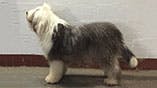 The Old English Sheepdog has a distinctive shaggy coat. Back in the 18th Century, the farmers would shear them along with the sheep to make warm clothes and blankets for the winter.
They are a large and strong but compact dog with a large head. Their double coat has a coarse outer coat with a soft, waterproof undercoat. The outercoat is long and covers their entire body including hanging over their eyes. It comes in combinations of greys and whites. They are sometimes born tailless.
Possibly originating in Europe but finding favour as a sheep herder in the UK, the Old English Sheepdog has been used to herd reindeer, too, as their coat enables them to cope with the cold. They make a good family pet: stable, friendly, loving and happy to fit in around people. They are loyal, intelligent, trainable and protective with a resonant bark that sounds like a cracked bell. They are people friendly, good with children and get along with other animals. They are fairly active indoors but need a good daily run outside too.
The long hair needs a lot of brushing and combing to stop it from matting and needs clipping regularly. They can be prone to certain blood disorders, hip dysplasia and cataracts and may have a gene that makes them sensitive to certain drugs.
The Old English Sheepdog has a distinctive shaggy coat. Back in the 18th Century, the farmers would shear them along with the sheep to make warm clothes and blankets for the winter.
They are a large and strong but compact dog with a large head. Their double coat has a coarse outer coat with a soft, waterproof undercoat. The outercoat is long and covers their entire body including hanging over their eyes. It comes in combinations of greys and whites. They are sometimes born tailless.
Possibly originating in Europe but finding favour as a sheep herder in the UK, the Old English Sheepdog has been used to herd reindeer, too, as their coat enables them to cope with the cold. They make a good family pet: stable, friendly, loving and happy to fit in around people. They are loyal, intelligent, trainable and protective with a resonant bark that sounds like a cracked bell. They are people friendly, good with children and get along with other animals. They are fairly active indoors but need a good daily run outside too.
The long hair needs a lot of brushing and combing to stop it from matting and needs clipping regularly. They can be prone to certain blood disorders, hip dysplasia and cataracts and may have a gene that makes them sensitive to certain drugs.
The Old English Sheepdog has a distinctive shaggy coat. Back in the 18th Century, the farmers would shear them along with the sheep to make warm clothes and blankets for the winter.
They are a large and strong but compact dog with a large head. Their double coat has a coarse outer coat with a soft, waterproof undercoat. The outercoat is long and covers their entire body including hanging over their eyes. It comes in combinations of greys and whites. They are sometimes born tailless.
Possibly originating in Europe but finding favour as a sheep herder in the UK, the Old English Sheepdog has been used to herd reindeer, too, as their coat enables them to cope with the cold. They make a good family pet: stable, friendly, loving and happy to fit in around people. They are loyal, intelligent, trainable and protective with a resonant bark that sounds like a cracked bell. They are people friendly, good with children and get along with other animals. They are fairly active indoors but need a good daily run outside too.
The long hair needs a lot of brushing and combing to stop it from matting and needs clipping regularly. They can be prone to certain blood disorders, hip dysplasia and cataracts and may have a gene that makes them sensitive to certain drugs.Otterhound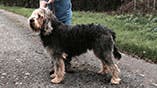 The Otterhound is said to have a sense of smell that is so good that they can detect the scent of an otter in the morning when the otter passed through the water the night before.
They are a large scent hound, rectangular in shape. Their head is rectangular, too, with long-hanging ears and a shaggy face with bushy eyebrows. They have webbed feet and a coarse double coat which is dense and very weather resistant. They come in all typical hound colours - grizzle, sandy, red, wheaten, blue, white with slight lemon, blue or badger pied markings, black and tan, blue and tan, black and cream, occasional liver, tan and liver, tan and white.
They were bred to hunt otter when otters were plentiful and endangered the fish supply.
Otterhounds are not the most trainable of dogs but are brave, lively, loving, devoted and friendly. They love water and can happily spend hours in it. They are loud with a baying call that can carry for a considerable distance. They are people friendly, good with children and get along with other dogs and even non-canines in the family but may well chase wildlife. They need a lot of exercise and, if possible, opportunities for swimming but they can be single-minded about running off if they get an interesting scent.
Their coat tends to attract the nature they like to ramble in and they need brushing and combing regularly but should not be clipped. They can be prone to hip dysplasia, thrombocytopenia, hemophilia and bloat.
The Otterhound is said to have a sense of smell that is so good that they can detect the scent of an otter in the morning when the otter passed through the water the night before.
They are a large scent hound, rectangular in shape. Their head is rectangular, too, with long-hanging ears and a shaggy face with bushy eyebrows. They have webbed feet and a coarse double coat which is dense and very weather resistant. They come in all typical hound colours - grizzle, sandy, red, wheaten, blue, white with slight lemon, blue or badger pied markings, black and tan, blue and tan, black and cream, occasional liver, tan and liver, tan and white.
They were bred to hunt otter when otters were plentiful and endangered the fish supply.
Otterhounds are not the most trainable of dogs but are brave, lively, loving, devoted and friendly. They love water and can happily spend hours in it. They are loud with a baying call that can carry for a considerable distance. They are people friendly, good with children and get along with other dogs and even non-canines in the family but may well chase wildlife. They need a lot of exercise and, if possible, opportunities for swimming but they can be single-minded about running off if they get an interesting scent.
Their coat tends to attract the nature they like to ramble in and they need brushing and combing regularly but should not be clipped. They can be prone to hip dysplasia, thrombocytopenia, hemophilia and bloat.
The Otterhound is said to have a sense of smell that is so good that they can detect the scent of an otter in the morning when the otter passed through the water the night before.
They are a large scent hound, rectangular in shape. Their head is rectangular, too, with long-hanging ears and a shaggy face with bushy eyebrows. They have webbed feet and a coarse double coat which is dense and very weather resistant. They come in all typical hound colours - grizzle, sandy, red, wheaten, blue, white with slight lemon, blue or badger pied markings, black and tan, blue and tan, black and cream, occasional liver, tan and liver, tan and white.
They were bred to hunt otter when otters were plentiful and endangered the fish supply.
Otterhounds are not the most trainable of dogs but are brave, lively, loving, devoted and friendly. They love water and can happily spend hours in it. They are loud with a baying call that can carry for a considerable distance. They are people friendly, good with children and get along with other dogs and even non-canines in the family but may well chase wildlife. They need a lot of exercise and, if possible, opportunities for swimming but they can be single-minded about running off if they get an interesting scent.
Their coat tends to attract the nature they like to ramble in and they need brushing and combing regularly but should not be clipped. They can be prone to hip dysplasia, thrombocytopenia, hemophilia and bloat.PapillonThe name "Papillon" means "butterfly" and it's easy to see where the name comes. For such a delicate little dog, they have very large erect ears exaggerated by long fringes.
They are a fine-boned little dog with a slightly rounded head and those distinctive ears. Occasionally, Papillons have ears with drop tips. They are called Phalene Papillons (moth). Their tail is carried over their back with long hair that fountains down and they come in white with coloured patches and a coloured mask.
They are one of the oldest breeds of dog and were always a companion. The original dog, known as the Dwarf Spaniel, had drop ears like Phalenes. The erect ears and change of name came later.
They can be a charming dog: friendly, intelligent, playful and proud. They are very trainable and can be good at agility, obedience and learning tricks. They are naturally people, children and animal friendly. They are a good watchdog too. They are fairly active indoors but are tougher than they look and enjoy a good daily walk outside.
The silky coat needs daily brushing and combing and occasional bathing. Teeth need regular cleaning as they are particularly prone to building up tartar. They can be prone to kneecap problems and some have difficulty under anaesthesia. Occasionally, their fontanel (soft spot in the skull) does not close properly.
The name "Papillon" means "butterfly" and it's easy to see where the name comes. For such a delicate little dog, they have very large erect ears exaggerated by long fringes.
They are a fine-boned little dog with a slightly rounded head and those distinctive ears. Occasionally, Papillons have ears with drop tips. They are called Phalene Papillons (moth). Their tail is carried over their back with long hair that fountains down and they come in white with coloured patches and a coloured mask.
They are one of the oldest breeds of dog and were always a companion. The original dog, known as the Dwarf Spaniel, had drop ears like Phalenes. The erect ears and change of name came later.
They can be a charming dog: friendly, intelligent, playful and proud. They are very trainable and can be good at agility, obedience and learning tricks. They are naturally people, children and animal friendly. They are a good watchdog too. They are fairly active indoors but are tougher than they look and enjoy a good daily walk outside.
The silky coat needs daily brushing and combing and occasional bathing. Teeth need regular cleaning as they are particularly prone to building up tartar. They can be prone to kneecap problems and some have difficulty under anaesthesia. Occasionally, their fontanel (soft spot in the skull) does not close properly.Parson Russell Terrier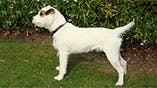 A well-trained Parson Russell Terrier is an amazing little dog, capable of learning an impressive range of tricks, which is why they have been a popular choice for film and television.
They used to be known as the Jack Russell Terrier in the USA. They are a strong, compact and well proportioned little dog with V-shaped ears that fold forward. Their harsh double coat comes in smooth and wire-haired and is mainly white with coloured markings.
Many small terriers are rat-catchers but the Parson Russell Terrier is more of a hunting hound named after the Reverend John Russell. They were used for flushing out small game such as foxes.
They are wilful, fearless and extremely intelligent. In the right hands they are cheerful, loving, friendly and can be trained to a very high level. In inexperienced hands, or if allowed to get bored, they may be destructive, aggressive and noisy. They can be trained to get along well with strangers, children and other animals although they have very strong hunting instincts, stronger than most terriers, so may not be trusted around small wildlife. They are an active dog indoors but need a lot of physical and mental exercise. Gardens need to be secure: they are excellent climbers, leapers and diggers.
Brushing, combing and occasional stripping keep their coat looking good. They can be prone to dislocation of the kneecaps, eye diseases, deafness and Legg Calve Perthes disease.
A well-trained Parson Russell Terrier is an amazing little dog, capable of learning an impressive range of tricks, which is why they have been a popular choice for film and television.
They used to be known as the Jack Russell Terrier in the USA. They are a strong, compact and well proportioned little dog with V-shaped ears that fold forward. Their harsh double coat comes in smooth and wire-haired and is mainly white with coloured markings.
Many small terriers are rat-catchers but the Parson Russell Terrier is more of a hunting hound named after the Reverend John Russell. They were used for flushing out small game such as foxes.
They are wilful, fearless and extremely intelligent. In the right hands they are cheerful, loving, friendly and can be trained to a very high level. In inexperienced hands, or if allowed to get bored, they may be destructive, aggressive and noisy. They can be trained to get along well with strangers, children and other animals although they have very strong hunting instincts, stronger than most terriers, so may not be trusted around small wildlife. They are an active dog indoors but need a lot of physical and mental exercise. Gardens need to be secure: they are excellent climbers, leapers and diggers.
Brushing, combing and occasional stripping keep their coat looking good. They can be prone to dislocation of the kneecaps, eye diseases, deafness and Legg Calve Perthes disease.
A well-trained Parson Russell Terrier is an amazing little dog, capable of learning an impressive range of tricks, which is why they have been a popular choice for film and television.
They used to be known as the Jack Russell Terrier in the USA. They are a strong, compact and well proportioned little dog with V-shaped ears that fold forward. Their harsh double coat comes in smooth and wire-haired and is mainly white with coloured markings.
Many small terriers are rat-catchers but the Parson Russell Terrier is more of a hunting hound named after the Reverend John Russell. They were used for flushing out small game such as foxes.
They are wilful, fearless and extremely intelligent. In the right hands they are cheerful, loving, friendly and can be trained to a very high level. In inexperienced hands, or if allowed to get bored, they may be destructive, aggressive and noisy. They can be trained to get along well with strangers, children and other animals although they have very strong hunting instincts, stronger than most terriers, so may not be trusted around small wildlife. They are an active dog indoors but need a lot of physical and mental exercise. Gardens need to be secure: they are excellent climbers, leapers and diggers.
Brushing, combing and occasional stripping keep their coat looking good. They can be prone to dislocation of the kneecaps, eye diseases, deafness and Legg Calve Perthes disease.PekingeseAt one time Pekingese could only be owned by Chinese royalty. Anyone who stole one would be executed and if you were not of noble birth you had to bow to them.
They are a small, compact dog with a stocky body that is slightly longer than it is tall. Their head is large for the body-size with a flat front face and long ears that seem to blend in. The double coat has a long outer layer that comes in a variety of colours.
Named after the ancient Chinese city of Peking, now Beijing, they were owned by Chinese emperors and sacrificed with them on their death to accompany them to the afterlife. They are spirited but sensitive, playful yet dignified and naturally brave although need to be taught not to guard their possessions. They can be very loving and make excellent companions. They are often people, children and animal friendly. They are quite inactive indoors and can easily become overweight so care needs to be taken of their food intake and they need a daily walk.
The long coat needs daily brushing and combing. Pekingese are prone to catching colds, herniated disks dislocated kneecaps, ingrowing eyelashes breathing problems and heart problems. They also often have difficult births.
At one time Pekingese could only be owned by Chinese royalty. Anyone who stole one would be executed and if you were not of noble birth you had to bow to them.
They are a small, compact dog with a stocky body that is slightly longer than it is tall. Their head is large for the body-size with a flat front face and long ears that seem to blend in. The double coat has a long outer layer that comes in a variety of colours.
Named after the ancient Chinese city of Peking, now Beijing, they were owned by Chinese emperors and sacrificed with them on their death to accompany them to the afterlife. They are spirited but sensitive, playful yet dignified and naturally brave although need to be taught not to guard their possessions. They can be very loving and make excellent companions. They are often people, children and animal friendly. They are quite inactive indoors and can easily become overweight so care needs to be taken of their food intake and they need a daily walk.
The long coat needs daily brushing and combing. Pekingese are prone to catching colds, herniated disks dislocated kneecaps, ingrowing eyelashes breathing problems and heart problems. They also often have difficult births.Pharaoh HoundThe Pharaoh Hound is one of the oldest breeds in the world, possibly going back as far as 4,000 BC. Artwork from ancient Egypt certainly shows a dog very like them.
They are tall, slim and athletic looking with a deep chest. Their neck is long and slightly arched and their head a long wedge with large, erect ears and amber eyes. Their short, smooth and glossy coat is a reddish tan with a few white markings and ideally a white tip to the tail.
They were used as a scent hound and sight hound for small game as well as a royal companion. They are now the national dog of Malta. The Pharaoh Hound loves to play outside and is a pleasant, loving and peaceful dog indoors as long as they are given enough opportunity for exercise. They do need handling with care though, as they can be sensitive and have a unique tendency to "blush" when excited with their ears and nose becoming bright pink.
They are normally child-friendly, ok around other dogs but wary of strangers and like to chase small game. They are relatively inactive indoors but can run very fast and enjoy the opportunity to do so outside.
Their short coat is easy to look after. They tend to stay clean and have no doggy smell but they may need to wear a coat against the cold in winter. They are generally very hardy and healthy but they may be sensitive to insecticides and certain medicines.
The Pharaoh Hound is one of the oldest breeds in the world, possibly going back as far as 4,000 BC. Artwork from ancient Egypt certainly shows a dog very like them.
They are tall, slim and athletic looking with a deep chest. Their neck is long and slightly arched and their head a long wedge with large, erect ears and amber eyes. Their short, smooth and glossy coat is a reddish tan with a few white markings and ideally a white tip to the tail.
They were used as a scent hound and sight hound for small game as well as a royal companion. They are now the national dog of Malta. The Pharaoh Hound loves to play outside and is a pleasant, loving and peaceful dog indoors as long as they are given enough opportunity for exercise. They do need handling with care though, as they can be sensitive and have a unique tendency to "blush" when excited with their ears and nose becoming bright pink.
They are normally child-friendly, ok around other dogs but wary of strangers and like to chase small game. They are relatively inactive indoors but can run very fast and enjoy the opportunity to do so outside.
Their short coat is easy to look after. They tend to stay clean and have no doggy smell but they may need to wear a coat against the cold in winter. They are generally very hardy and healthy but they may be sensitive to insecticides and certain medicines.Picardy SheepdogPicardy Sheepdogs, known as Berger Picard in their native France, were nearly extinct after World Wars 1 and 2 but have had something of a revival since then. They have appeared in a number of films in the USA because their rustic look gives them the appearance of a lovable cross-breed.
They are a medium-sized dog with a thick, wiry, waterproof coat that is normally fawn or brindle, which is quite easy to maintain. They can also be quite amusing with a tendency to look as though they're laughing or smiling.
The Picardy is hardy and well-muscled but not a heavy dog and they can take plenty of exercise. They are lively and intelligent, if a little reserved around strangers, but are quiet, loyal and love company.
Picardy Sheepdogs, known as Berger Picard in their native France, were nearly extinct after World Wars 1 and 2 but have had something of a revival since then. They have appeared in a number of films in the USA because their rustic look gives them the appearance of a lovable cross-breed.
They are a medium-sized dog with a thick, wiry, waterproof coat that is normally fawn or brindle, which is quite easy to maintain. They can also be quite amusing with a tendency to look as though they're laughing or smiling.
The Picardy is hardy and well-muscled but not a heavy dog and they can take plenty of exercise. They are lively and intelligent, if a little reserved around strangers, but are quiet, loyal and love company.PointerThe Pointer name comes from the way the dog stands absolutely still with their body showing the direction of sitting game as if they are pointing at it.
They are an elegant, powerful hunting dog with a deep chest, long neck, hanging ears and deep muzzle with slight dip in it. Their coat is short and smooth, with a sheen, and largely white with patches or speckles of other colours.
They were popularly used in England and were developed in the 1600s from crossing a number of other breeds. They work by using their excellent scenting ability to find game and show its location. They can flush out birds but don't normally work in water or cold, neither do they retrieve.
They have enormous energy so need a lot of opportunity to run this off. Given enough exercise, they will be calm in the home. They are intelligent, loyal and affectionate. They are naturally child-friendly, although can be wary of strangers, and are generally good with dogs and other pets. They need a lot of outdoor exercise and can cover large areas at great speed.
The short coat is easy to maintain and they are normally a clean dog but the ears and feet should be checked regularly. They are prone to hip dysplasia, thyroid problems, skin conditions and dwarfism.
The Pointer name comes from the way the dog stands absolutely still with their body showing the direction of sitting game as if they are pointing at it.
They are an elegant, powerful hunting dog with a deep chest, long neck, hanging ears and deep muzzle with slight dip in it. Their coat is short and smooth, with a sheen, and largely white with patches or speckles of other colours.
They were popularly used in England and were developed in the 1600s from crossing a number of other breeds. They work by using their excellent scenting ability to find game and show its location. They can flush out birds but don't normally work in water or cold, neither do they retrieve.
They have enormous energy so need a lot of opportunity to run this off. Given enough exercise, they will be calm in the home. They are intelligent, loyal and affectionate. They are naturally child-friendly, although can be wary of strangers, and are generally good with dogs and other pets. They need a lot of outdoor exercise and can cover large areas at great speed.
The short coat is easy to maintain and they are normally a clean dog but the ears and feet should be checked regularly. They are prone to hip dysplasia, thyroid problems, skin conditions and dwarfism.Polish Lowland Sheepdog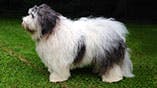 The Polish Lowland Sheepdog may look cuddly but they need plenty of opportunity to exercise their body and brain.
They are a medium-sized, shaggy dog with a lot of hair around their forehead, cheeks and chin, which gives them a friendly appearance. They are quite well muscled and broad and all coat colours are acceptable.
They may have descended from corded herding dogs and have excellent herding skills although today are often more of a pet. With firm and clear training, they can make a happy, dependable and affectionate family dog. They are intelligent, fairly easy to train and have an excellent memory. Naturally child-friendly, they can be wary of strangers, but are generally good with dogs and other pets. They are bred to be a working dog, to be outside and follow instruction. As a result, they need a lot of mental and physical exercise.
Regular grooming is needed, at least once a week, to keep their coat free from matting. They are a hardy dog with no known health problems.
The Polish Lowland Sheepdog may look cuddly but they need plenty of opportunity to exercise their body and brain.
They are a medium-sized, shaggy dog with a lot of hair around their forehead, cheeks and chin, which gives them a friendly appearance. They are quite well muscled and broad and all coat colours are acceptable.
They may have descended from corded herding dogs and have excellent herding skills although today are often more of a pet. With firm and clear training, they can make a happy, dependable and affectionate family dog. They are intelligent, fairly easy to train and have an excellent memory. Naturally child-friendly, they can be wary of strangers, but are generally good with dogs and other pets. They are bred to be a working dog, to be outside and follow instruction. As a result, they need a lot of mental and physical exercise.
Regular grooming is needed, at least once a week, to keep their coat free from matting. They are a hardy dog with no known health problems.
The Polish Lowland Sheepdog may look cuddly but they need plenty of opportunity to exercise their body and brain.
They are a medium-sized, shaggy dog with a lot of hair around their forehead, cheeks and chin, which gives them a friendly appearance. They are quite well muscled and broad and all coat colours are acceptable.
They may have descended from corded herding dogs and have excellent herding skills although today are often more of a pet. With firm and clear training, they can make a happy, dependable and affectionate family dog. They are intelligent, fairly easy to train and have an excellent memory. Naturally child-friendly, they can be wary of strangers, but are generally good with dogs and other pets. They are bred to be a working dog, to be outside and follow instruction. As a result, they need a lot of mental and physical exercise.
Regular grooming is needed, at least once a week, to keep their coat free from matting. They are a hardy dog with no known health problems.PomeranianThe Pomeranian's lively, affectionate nature make it likeable to many people, even those who are not normally drawn to small dogs.
They are like a tiny spitz-type with a little pointed face, tail held up and over the body and a thick double coat. The outer coat is long, slightly harsh and comes in a huge range of colours.
The originate from Germany where they were originally a much larger herding dog. It was Queen Victoria who started to breed them down in size to be a companion.
The Pomeranian is a proud, lively little dog. It is intelligent, eager to learn, very loyal to its handler and family. The Pom is a wonderful companion and show dog. The breed's docile temper and affectionate nature endear it to many. It is alert, inquisitive and active: one of the most independent of the toy breeds, they needs a firm, gentle hand. They naturally get on well with adults, children and other animals. They tend to be active indoors but enjoy a daily walk outdoors too.
They need frequent brushing and combing to keep the coat looking good and will shed continually. They are prone to dislocated patella, slipped stifle, heart problems, eye infections, skin irritations and tooth decay.
The Pomeranian's lively, affectionate nature make it likeable to many people, even those who are not normally drawn to small dogs.
They are like a tiny spitz-type with a little pointed face, tail held up and over the body and a thick double coat. The outer coat is long, slightly harsh and comes in a huge range of colours.
The originate from Germany where they were originally a much larger herding dog. It was Queen Victoria who started to breed them down in size to be a companion.
The Pomeranian is a proud, lively little dog. It is intelligent, eager to learn, very loyal to its handler and family. The Pom is a wonderful companion and show dog. The breed's docile temper and affectionate nature endear it to many. It is alert, inquisitive and active: one of the most independent of the toy breeds, they needs a firm, gentle hand. They naturally get on well with adults, children and other animals. They tend to be active indoors but enjoy a daily walk outdoors too.
They need frequent brushing and combing to keep the coat looking good and will shed continually. They are prone to dislocated patella, slipped stifle, heart problems, eye infections, skin irritations and tooth decay.
Poodle (Miniature)The lively little Miniature Poodle is a natural performer and has a long history of working in the circus.
Poodles come in a variety of sizes: Standard (the largest), Miniature (smaller) and Toy (smallest), although some countries also recognise a Medium-sized which sits between Standard and Miniature. They all have a generally square look, a long, straight muzzle and hanging ears. They do not shed but their curly coat is typically close cut and comes in a variety of solid colours. The coat can be corded but keeping it curly is more popular.
The original Standard Poodle was bred in Europe, as a water retrieval dog and the Miniature and Toy poodles have been bred down from that. The smaller types were sometimes used to hunt truffles but they have mainly found favour as performers and companions.
They are highly intelligent, alert, active and eager to please. They do well at active sports such as agility and are very good at learning tricks. With the right training they can be stranger, children and dog friendly as long as their cuteness doesn't encourage people to spoil them. They have plenty of energy and greatly enjoy being outside. They love water.
Poodles need their long ears checking and their coat clipping regularly. There are a variety of clips, but Miniature and Toy Poodles often just have a "puppy clip" - short all over. They are prone to eye problems, heart disease, diabetes, epilepsy, ear infections and skin allergies.
The lively little Miniature Poodle is a natural performer and has a long history of working in the circus.
Poodles come in a variety of sizes: Standard (the largest), Miniature (smaller) and Toy (smallest), although some countries also recognise a Medium-sized which sits between Standard and Miniature. They all have a generally square look, a long, straight muzzle and hanging ears. They do not shed but their curly coat is typically close cut and comes in a variety of solid colours. The coat can be corded but keeping it curly is more popular.
The original Standard Poodle was bred in Europe, as a water retrieval dog and the Miniature and Toy poodles have been bred down from that. The smaller types were sometimes used to hunt truffles but they have mainly found favour as performers and companions.
They are highly intelligent, alert, active and eager to please. They do well at active sports such as agility and are very good at learning tricks. With the right training they can be stranger, children and dog friendly as long as their cuteness doesn't encourage people to spoil them. They have plenty of energy and greatly enjoy being outside. They love water.
Poodles need their long ears checking and their coat clipping regularly. There are a variety of clips, but Miniature and Toy Poodles often just have a "puppy clip" - short all over. They are prone to eye problems, heart disease, diabetes, epilepsy, ear infections and skin allergies.Poodle (Standard)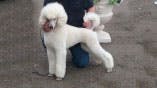 The Standard Poodle is possibly the most elegant of all the poodles.
Poodles come in a variety of sizes: Standard (the largest), Miniature (smaller) and Toy (smallest) although some countries also recognise a Medium-sized which sits between Standard and Miniature. They all have a generally square look, a long, straight muzzle and hanging ears. They do not shed but their curly coat is normally close cut and comes in a variety of usually solid colours. The coat can be corded but keeping it curly is more popular.
The original Standard Poodle was bred in Europe, as a water retrieval dog and the Miniature and Toy poodles have been bred down from that. The smaller types were sometimes used to hunt truffles but they have mainly found favour as performers and companions.
The Standard Poodle is normally a good-natured dog. Like all Poodles, they are highly intelligent and trainable. They also tend to be less busy and calmer around the home than the smaller varieties. Of all the Poodles, they tend to be the most naturally friendly towards, people, children and other dogs. All Poodles need plenty of exercise but the Standard type retains the stamina of a working dog so needs more than the smaller varieties. They particularly love any exercise involving water.
The Poodle needs their long ears checking and their coat clipping regularly. There are a variety of clips. Sometimes the rear half of the body is shaved, bracelets are left around the ankles, and pom-poms are left on the tails and hips. Although this looks showy, it stems from the time hair was shaved to help the dog to swim when retrieving game but hair was left in specific areas to protect their joints against cold and reeds.
Although generally long lived, Standard Poodles are prone to certain diseases: eye problems, skin allergies, hip dysplasia, ear infections, bloat and Von Willebrand's Disease.
The Standard Poodle is possibly the most elegant of all the poodles.
Poodles come in a variety of sizes: Standard (the largest), Miniature (smaller) and Toy (smallest) although some countries also recognise a Medium-sized which sits between Standard and Miniature. They all have a generally square look, a long, straight muzzle and hanging ears. They do not shed but their curly coat is normally close cut and comes in a variety of usually solid colours. The coat can be corded but keeping it curly is more popular.
The original Standard Poodle was bred in Europe, as a water retrieval dog and the Miniature and Toy poodles have been bred down from that. The smaller types were sometimes used to hunt truffles but they have mainly found favour as performers and companions.
The Standard Poodle is normally a good-natured dog. Like all Poodles, they are highly intelligent and trainable. They also tend to be less busy and calmer around the home than the smaller varieties. Of all the Poodles, they tend to be the most naturally friendly towards, people, children and other dogs. All Poodles need plenty of exercise but the Standard type retains the stamina of a working dog so needs more than the smaller varieties. They particularly love any exercise involving water.
The Poodle needs their long ears checking and their coat clipping regularly. There are a variety of clips. Sometimes the rear half of the body is shaved, bracelets are left around the ankles, and pom-poms are left on the tails and hips. Although this looks showy, it stems from the time hair was shaved to help the dog to swim when retrieving game but hair was left in specific areas to protect their joints against cold and reeds.
Although generally long lived, Standard Poodles are prone to certain diseases: eye problems, skin allergies, hip dysplasia, ear infections, bloat and Von Willebrand's Disease.
The Standard Poodle is possibly the most elegant of all the poodles.
Poodles come in a variety of sizes: Standard (the largest), Miniature (smaller) and Toy (smallest) although some countries also recognise a Medium-sized which sits between Standard and Miniature. They all have a generally square look, a long, straight muzzle and hanging ears. They do not shed but their curly coat is normally close cut and comes in a variety of usually solid colours. The coat can be corded but keeping it curly is more popular.
The original Standard Poodle was bred in Europe, as a water retrieval dog and the Miniature and Toy poodles have been bred down from that. The smaller types were sometimes used to hunt truffles but they have mainly found favour as performers and companions.
The Standard Poodle is normally a good-natured dog. Like all Poodles, they are highly intelligent and trainable. They also tend to be less busy and calmer around the home than the smaller varieties. Of all the Poodles, they tend to be the most naturally friendly towards, people, children and other dogs. All Poodles need plenty of exercise but the Standard type retains the stamina of a working dog so needs more than the smaller varieties. They particularly love any exercise involving water.
The Poodle needs their long ears checking and their coat clipping regularly. There are a variety of clips. Sometimes the rear half of the body is shaved, bracelets are left around the ankles, and pom-poms are left on the tails and hips. Although this looks showy, it stems from the time hair was shaved to help the dog to swim when retrieving game but hair was left in specific areas to protect their joints against cold and reeds.
Although generally long lived, Standard Poodles are prone to certain diseases: eye problems, skin allergies, hip dysplasia, ear infections, bloat and Von Willebrand's Disease.Poodle (Toy)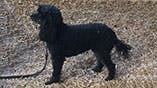 The sweet little Toy Poodle is probably the Poodle most suited to town life but has a history of performing tricks in the Circus too.
Poodles come in a variety of sizes: Standard (the largest), Miniature (smaller) and Toy (smallest) although some countries also recognise a Medium-sized which sits between Standard and Miniature. They all have a generally square look, a long, straight muzzle and hanging ears. They do not shed but their curly coat is typically close cut and comes in a variety of solid colours. The coat can be corded but keeping it curly is more popular.
The original Standard Poodle was bred in Europe, as a water retrieval dog and the Miniature and Toy poodles have been bred down from that. The smaller types were sometimes used to hunt truffles but they have mainly found favour as performers and companions.
Like all Poodles, the Toy is highly intelligent and trainable. They are a cheerful, lively little dog.
With the right training they can be stranger, children and dog friendly as long as their cuteness doesn't encourage people to spoil them. They are an active dog but will settle indoors as long as given plenty of exercise outside. They love water.
The poodle needs their long ears checking and their coat clipping regularly. There are a variety of clips but miniature Poodles often just have a "puppy clip" - short all over. They are prone to eye problems, heart disease, Anemia, diabetes, epilepsy, slipped stifle, ear infections digestive problems and skin allergies.
The sweet little Toy Poodle is probably the Poodle most suited to town life but has a history of performing tricks in the Circus too.
Poodles come in a variety of sizes: Standard (the largest), Miniature (smaller) and Toy (smallest) although some countries also recognise a Medium-sized which sits between Standard and Miniature. They all have a generally square look, a long, straight muzzle and hanging ears. They do not shed but their curly coat is typically close cut and comes in a variety of solid colours. The coat can be corded but keeping it curly is more popular.
The original Standard Poodle was bred in Europe, as a water retrieval dog and the Miniature and Toy poodles have been bred down from that. The smaller types were sometimes used to hunt truffles but they have mainly found favour as performers and companions.
Like all Poodles, the Toy is highly intelligent and trainable. They are a cheerful, lively little dog.
With the right training they can be stranger, children and dog friendly as long as their cuteness doesn't encourage people to spoil them. They are an active dog but will settle indoors as long as given plenty of exercise outside. They love water.
The poodle needs their long ears checking and their coat clipping regularly. There are a variety of clips but miniature Poodles often just have a "puppy clip" - short all over. They are prone to eye problems, heart disease, Anemia, diabetes, epilepsy, slipped stifle, ear infections digestive problems and skin allergies.
The sweet little Toy Poodle is probably the Poodle most suited to town life but has a history of performing tricks in the Circus too.
Poodles come in a variety of sizes: Standard (the largest), Miniature (smaller) and Toy (smallest) although some countries also recognise a Medium-sized which sits between Standard and Miniature. They all have a generally square look, a long, straight muzzle and hanging ears. They do not shed but their curly coat is typically close cut and comes in a variety of solid colours. The coat can be corded but keeping it curly is more popular.
The original Standard Poodle was bred in Europe, as a water retrieval dog and the Miniature and Toy poodles have been bred down from that. The smaller types were sometimes used to hunt truffles but they have mainly found favour as performers and companions.
Like all Poodles, the Toy is highly intelligent and trainable. They are a cheerful, lively little dog.
With the right training they can be stranger, children and dog friendly as long as their cuteness doesn't encourage people to spoil them. They are an active dog but will settle indoors as long as given plenty of exercise outside. They love water.
The poodle needs their long ears checking and their coat clipping regularly. There are a variety of clips but miniature Poodles often just have a "puppy clip" - short all over. They are prone to eye problems, heart disease, Anemia, diabetes, epilepsy, slipped stifle, ear infections digestive problems and skin allergies.Portuguese Podengo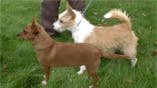 The Podengo is the National Breed of Portugal. Podengos actually come in three sizes: small, medium and large, but only the small are recognised by the kennel club in the UK.
They are a well proportioned and muscular dog. All sizes of Podengo come in two coat types: smooth and wiry. The smooth coat type is much older, the wiry was created by mixing with other breeds. They usually come in fawn (all shades from light to dark) often with white patches. They can come in yellow but not plain white.
All three sizes were bred for hunting, what prey they hunt depends on their size. Generally they hunt in packs and flush out their prey. They then either kill it or wait for the huntsman to catch up and kill it. As Podengos are all hunting dogs, they have a keen sense of sight and smell. They can all be a little wilful but are intelligent and very trainable.
The Portuguese Podengo has a tendency to return to their owner when out on walks to check that they are still following. All sizes make loving companion dogs with their owners but the small and medium are naturally more friendly and sociable with strangers, children and other animals. They all need plenty of exercise so regular walks are important, the medium type is probably the fastest. They also like to dig and are good jumpers so fencing would need to be secure.
None of the types present any problems with grooming, in fact the breed standard states that they are not trimmed, even for the show ring. For both coat types, an occasional groom with a comb or brush is all that is needed. They are generally very hardy and healthy.
The Podengo is the National Breed of Portugal. Podengos actually come in three sizes: small, medium and large, but only the small are recognised by the kennel club in the UK.
They are a well proportioned and muscular dog. All sizes of Podengo come in two coat types: smooth and wiry. The smooth coat type is much older, the wiry was created by mixing with other breeds. They usually come in fawn (all shades from light to dark) often with white patches. They can come in yellow but not plain white.
All three sizes were bred for hunting, what prey they hunt depends on their size. Generally they hunt in packs and flush out their prey. They then either kill it or wait for the huntsman to catch up and kill it. As Podengos are all hunting dogs, they have a keen sense of sight and smell. They can all be a little wilful but are intelligent and very trainable.
The Portuguese Podengo has a tendency to return to their owner when out on walks to check that they are still following. All sizes make loving companion dogs with their owners but the small and medium are naturally more friendly and sociable with strangers, children and other animals. They all need plenty of exercise so regular walks are important, the medium type is probably the fastest. They also like to dig and are good jumpers so fencing would need to be secure.
None of the types present any problems with grooming, in fact the breed standard states that they are not trimmed, even for the show ring. For both coat types, an occasional groom with a comb or brush is all that is needed. They are generally very hardy and healthy.
The Podengo is the National Breed of Portugal. Podengos actually come in three sizes: small, medium and large, but only the small are recognised by the kennel club in the UK.
They are a well proportioned and muscular dog. All sizes of Podengo come in two coat types: smooth and wiry. The smooth coat type is much older, the wiry was created by mixing with other breeds. They usually come in fawn (all shades from light to dark) often with white patches. They can come in yellow but not plain white.
All three sizes were bred for hunting, what prey they hunt depends on their size. Generally they hunt in packs and flush out their prey. They then either kill it or wait for the huntsman to catch up and kill it. As Podengos are all hunting dogs, they have a keen sense of sight and smell. They can all be a little wilful but are intelligent and very trainable.
The Portuguese Podengo has a tendency to return to their owner when out on walks to check that they are still following. All sizes make loving companion dogs with their owners but the small and medium are naturally more friendly and sociable with strangers, children and other animals. They all need plenty of exercise so regular walks are important, the medium type is probably the fastest. They also like to dig and are good jumpers so fencing would need to be secure.
None of the types present any problems with grooming, in fact the breed standard states that they are not trimmed, even for the show ring. For both coat types, an occasional groom with a comb or brush is all that is needed. They are generally very hardy and healthy.Portuguese PointerAlthough it is thought that the Portuguese Pointer might go back as far as the 14th Century, they are still one of the most popular dogs to be used for hunting in Portugal and Spain today.
They are a medium-sized, balanced dog with a square head and a short, sleek coat. The coat on the body feels a little coarser than might be expected but the face and ears feel like velvet. They are normally yellow or tan in colour, with or without white markings.
It is thought that they descended from the ancient Iberian hunting dogs and were used by royalty for hunting game birds, mainly Red-legged Partridge but later became popular with the poorer in society too.
They are very affectionate, loyal, intelligent and eager to please. They love to work and if not working out in the field will respond enthusiastically to anything that occupies their body and brain. They make a good watchdog without being too vocal. They are good with children and other dogs but may be wary of strangers. They need a great deal of physical and mental exercise.
They need more brushing and combing than might be expected for a short-haired breed and also need trimming fairly regularly. There are no known health problems.
Although it is thought that the Portuguese Pointer might go back as far as the 14th Century, they are still one of the most popular dogs to be used for hunting in Portugal and Spain today.
They are a medium-sized, balanced dog with a square head and a short, sleek coat. The coat on the body feels a little coarser than might be expected but the face and ears feel like velvet. They are normally yellow or tan in colour, with or without white markings.
It is thought that they descended from the ancient Iberian hunting dogs and were used by royalty for hunting game birds, mainly Red-legged Partridge but later became popular with the poorer in society too.
They are very affectionate, loyal, intelligent and eager to please. They love to work and if not working out in the field will respond enthusiastically to anything that occupies their body and brain. They make a good watchdog without being too vocal. They are good with children and other dogs but may be wary of strangers. They need a great deal of physical and mental exercise.
They need more brushing and combing than might be expected for a short-haired breed and also need trimming fairly regularly. There are no known health problems.Portuguese Water Dog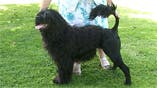 Despite the name, the Portuguese Water Dog might originally have come from North Africa.
They are a medium-sized, muscular dog, with long, hanging ears and a thick coat that is either curly or wavy. As their name suggests, they are excellent swimmers and this is aided by having webbed feet. The coat can come in black, white, various shades of brown, black and white or brown and white.
They found favour in Portugal for many years, performing a multitude of tasks for the fishermen, including retrieving items from the water and carrying messages between ships. They are loyal, loving and extremely intelligent and can be great fun to have around, but they do have a stubborn streak and are quite capable of outsmarting their owner. Many also love to chew so would need to be given something suitable for this. Generally good with people, children and most pets, they may need careful introduction to cats. An active working type of dog that needs plenty of physical and mental exercise, they can be very good at sports like agility and, obviously, they love to swim too!
Portuguese Water Dogs shed very little so their coat needs trimming, although less frequently than the poodle as the coat is slower to grow. They can be given an even trim all over or a "lion trim" - developed from their work in the water where the rear and muzzle were shaved to help with swimming but thick hair was left around their front to protect their vital organs and joints. They can be prone to hip dysplasia, PRA and GM-1 Storage Disease, a fatal disease that effects the nerves.
Despite the name, the Portuguese Water Dog might originally have come from North Africa.
They are a medium-sized, muscular dog, with long, hanging ears and a thick coat that is either curly or wavy. As their name suggests, they are excellent swimmers and this is aided by having webbed feet. The coat can come in black, white, various shades of brown, black and white or brown and white.
They found favour in Portugal for many years, performing a multitude of tasks for the fishermen, including retrieving items from the water and carrying messages between ships. They are loyal, loving and extremely intelligent and can be great fun to have around, but they do have a stubborn streak and are quite capable of outsmarting their owner. Many also love to chew so would need to be given something suitable for this. Generally good with people, children and most pets, they may need careful introduction to cats. An active working type of dog that needs plenty of physical and mental exercise, they can be very good at sports like agility and, obviously, they love to swim too!
Portuguese Water Dogs shed very little so their coat needs trimming, although less frequently than the poodle as the coat is slower to grow. They can be given an even trim all over or a "lion trim" - developed from their work in the water where the rear and muzzle were shaved to help with swimming but thick hair was left around their front to protect their vital organs and joints. They can be prone to hip dysplasia, PRA and GM-1 Storage Disease, a fatal disease that effects the nerves.
Despite the name, the Portuguese Water Dog might originally have come from North Africa.
They are a medium-sized, muscular dog, with long, hanging ears and a thick coat that is either curly or wavy. As their name suggests, they are excellent swimmers and this is aided by having webbed feet. The coat can come in black, white, various shades of brown, black and white or brown and white.
They found favour in Portugal for many years, performing a multitude of tasks for the fishermen, including retrieving items from the water and carrying messages between ships. They are loyal, loving and extremely intelligent and can be great fun to have around, but they do have a stubborn streak and are quite capable of outsmarting their owner. Many also love to chew so would need to be given something suitable for this. Generally good with people, children and most pets, they may need careful introduction to cats. An active working type of dog that needs plenty of physical and mental exercise, they can be very good at sports like agility and, obviously, they love to swim too!
Portuguese Water Dogs shed very little so their coat needs trimming, although less frequently than the poodle as the coat is slower to grow. They can be given an even trim all over or a "lion trim" - developed from their work in the water where the rear and muzzle were shaved to help with swimming but thick hair was left around their front to protect their vital organs and joints. They can be prone to hip dysplasia, PRA and GM-1 Storage Disease, a fatal disease that effects the nerves.Pug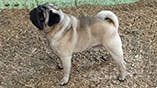 There have been a number of famous Pugs throughout history. Josephine is reputed to have told Napoleon on their wedding night "If the Pug does not sleep in our bed, neither do I!"
They are small but thick-set and stocky. For the size of the dog, their head is surprisingly large and surprisingly wrinkled and their muzzle is very short. Their tail is curled and carried over the back and their coat is short and smooth. They come in apricot, fawn, black and silver.
They are one of the oldest known breeds and originate from somewhere in Asia, possibly China, where they were bred to be a companion, particularly to royalty, similar to the Pekingese. They are normally a happy little dog, loyal, loving, robust, spirited and full of fun. They are highly intelligent and good guard dogs without being yappy. Pugs generally get along very well with children, visitors, dogs and other pets. They enjoy exercise outside but can have breathing difficulties if over exerted - little and often is the key. They have difficulty coping with extreme weather conditions.
The short coat is easy to maintain but care must be taken to ensure the creases on the face are cleaned regularly too. Apart from difficulties with hot and cold, they are prone to a number of health problems: allergies, breathing problems, skin problems, eye problems and Pug Dog Encephalitis. Puppies often have to be born by cesarean too.
There have been a number of famous Pugs throughout history. Josephine is reputed to have told Napoleon on their wedding night "If the Pug does not sleep in our bed, neither do I!"
They are small but thick-set and stocky. For the size of the dog, their head is surprisingly large and surprisingly wrinkled and their muzzle is very short. Their tail is curled and carried over the back and their coat is short and smooth. They come in apricot, fawn, black and silver.
They are one of the oldest known breeds and originate from somewhere in Asia, possibly China, where they were bred to be a companion, particularly to royalty, similar to the Pekingese. They are normally a happy little dog, loyal, loving, robust, spirited and full of fun. They are highly intelligent and good guard dogs without being yappy. Pugs generally get along very well with children, visitors, dogs and other pets. They enjoy exercise outside but can have breathing difficulties if over exerted - little and often is the key. They have difficulty coping with extreme weather conditions.
The short coat is easy to maintain but care must be taken to ensure the creases on the face are cleaned regularly too. Apart from difficulties with hot and cold, they are prone to a number of health problems: allergies, breathing problems, skin problems, eye problems and Pug Dog Encephalitis. Puppies often have to be born by cesarean too.
There have been a number of famous Pugs throughout history. Josephine is reputed to have told Napoleon on their wedding night "If the Pug does not sleep in our bed, neither do I!"
They are small but thick-set and stocky. For the size of the dog, their head is surprisingly large and surprisingly wrinkled and their muzzle is very short. Their tail is curled and carried over the back and their coat is short and smooth. They come in apricot, fawn, black and silver.
They are one of the oldest known breeds and originate from somewhere in Asia, possibly China, where they were bred to be a companion, particularly to royalty, similar to the Pekingese. They are normally a happy little dog, loyal, loving, robust, spirited and full of fun. They are highly intelligent and good guard dogs without being yappy. Pugs generally get along very well with children, visitors, dogs and other pets. They enjoy exercise outside but can have breathing difficulties if over exerted - little and often is the key. They have difficulty coping with extreme weather conditions.
The short coat is easy to maintain but care must be taken to ensure the creases on the face are cleaned regularly too. Apart from difficulties with hot and cold, they are prone to a number of health problems: allergies, breathing problems, skin problems, eye problems and Pug Dog Encephalitis. Puppies often have to be born by cesarean too.Pyrenean MastiffThe Pyrenean Mastiff is calm and loyal to their own family but their natural tendency is to guard.
They are a very large and powerful dog with a large head and a heavy, coarse, white coat with dark markings. The neck has loose folds of skin and a double dewlap. They are a Spanish mountain dog whose role was to guard sheep against attack from wolves and bears.
They are very intelligent, independent and protective. Within their own family, they are even-tempered with children, animals and people they know. Because it is in their nature to want to look after their family, they need to be socialised well with people, children and animals from outside. They do not need a lot of exercise but outings need to be frequent and regular as they will become bored if cooped up.
The fairly long coat needs regular brushing and combing and they are a seasonal heavy shedder. They are a generally very healthy breed although can suffer from digestive problems.
The Pyrenean Mastiff is calm and loyal to their own family but their natural tendency is to guard.
They are a very large and powerful dog with a large head and a heavy, coarse, white coat with dark markings. The neck has loose folds of skin and a double dewlap. They are a Spanish mountain dog whose role was to guard sheep against attack from wolves and bears.
They are very intelligent, independent and protective. Within their own family, they are even-tempered with children, animals and people they know. Because it is in their nature to want to look after their family, they need to be socialised well with people, children and animals from outside. They do not need a lot of exercise but outings need to be frequent and regular as they will become bored if cooped up.
The fairly long coat needs regular brushing and combing and they are a seasonal heavy shedder. They are a generally very healthy breed although can suffer from digestive problems.Pyrenean Mountain Dog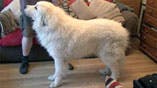 This gentle giant is a natural guard dog who is normally affectionate toward their own family.
The Pyrenean Mountain Dog is a very large well-proportioned dog with a large body and a great, thick weather-resistant double coat. The undercoat is soft and woolly and the top coat, coarse and flat. They also have a mane around the shoulders and neck. The coat is mainly white but can have small patches of badger, wolf-grey or pale yellow.
Originally, they were used as a flock guard in the Pyrenees. They are very intelligent, independent and protective. Within their own family they are serious but can be affectionate with children, animals and people they know. Because it is in their nature to want to look after their family, they need to be socialised well with people, children and animals from outside. Pyrenean Mountain Dogs need a moderate amount of exercise so need a good daily walk if not being used as a working dog.
The heavy coat needs regular brushing and combing, they shed continually but more so at certain times of the year. They can be prone to bloat, hip dysplasia, bone cancer and kneecap problems.
This gentle giant is a natural guard dog who is normally affectionate toward their own family.
The Pyrenean Mountain Dog is a very large well-proportioned dog with a large body and a great, thick weather-resistant double coat. The undercoat is soft and woolly and the top coat, coarse and flat. They also have a mane around the shoulders and neck. The coat is mainly white but can have small patches of badger, wolf-grey or pale yellow.
Originally, they were used as a flock guard in the Pyrenees. They are very intelligent, independent and protective. Within their own family they are serious but can be affectionate with children, animals and people they know. Because it is in their nature to want to look after their family, they need to be socialised well with people, children and animals from outside. Pyrenean Mountain Dogs need a moderate amount of exercise so need a good daily walk if not being used as a working dog.
The heavy coat needs regular brushing and combing, they shed continually but more so at certain times of the year. They can be prone to bloat, hip dysplasia, bone cancer and kneecap problems.
This gentle giant is a natural guard dog who is normally affectionate toward their own family.
The Pyrenean Mountain Dog is a very large well-proportioned dog with a large body and a great, thick weather-resistant double coat. The undercoat is soft and woolly and the top coat, coarse and flat. They also have a mane around the shoulders and neck. The coat is mainly white but can have small patches of badger, wolf-grey or pale yellow.
Originally, they were used as a flock guard in the Pyrenees. They are very intelligent, independent and protective. Within their own family they are serious but can be affectionate with children, animals and people they know. Because it is in their nature to want to look after their family, they need to be socialised well with people, children and animals from outside. Pyrenean Mountain Dogs need a moderate amount of exercise so need a good daily walk if not being used as a working dog.
The heavy coat needs regular brushing and combing, they shed continually but more so at certain times of the year. They can be prone to bloat, hip dysplasia, bone cancer and kneecap problems.Pyrenean Sheepdog (Long Haired)Although a sheepdog, many Pyrenean Sheepdogs are more like a Terrier in personality.
They are a small-medium sized dog, very slender underneath their shaggy coat. The breed standard states that the ribs should be easy to feel. Their hairy face, little semi-pricked ears and rough coat leads many people to believe they are some kind of terrier mix than a purebred.
They were bred to herd sheep in the French mountains. They are not the easiest dog to train, they are highly intelligent and knowing with a hint of mischief in their make up. Given an experienced dog-handler with the time to devote to their training, they can be an impressive dog but they are easily bored, love to bark and have a high prey drive. Care needs to be taken to properly socialise them in their early life as they can be wary of strangers. They also have a tendency to chase small mammals. They need a lot of physical and mental exercise, they are athletic and very fast.
The long coat needs regular brushing and combing. They are a generally healthy and long lived breed but it's worth checking them for hip and elbow problems and eye and hearing problems.
Although a sheepdog, many Pyrenean Sheepdogs are more like a Terrier in personality.
They are a small-medium sized dog, very slender underneath their shaggy coat. The breed standard states that the ribs should be easy to feel. Their hairy face, little semi-pricked ears and rough coat leads many people to believe they are some kind of terrier mix than a purebred.
They were bred to herd sheep in the French mountains. They are not the easiest dog to train, they are highly intelligent and knowing with a hint of mischief in their make up. Given an experienced dog-handler with the time to devote to their training, they can be an impressive dog but they are easily bored, love to bark and have a high prey drive. Care needs to be taken to properly socialise them in their early life as they can be wary of strangers. They also have a tendency to chase small mammals. They need a lot of physical and mental exercise, they are athletic and very fast.
The long coat needs regular brushing and combing. They are a generally healthy and long lived breed but it's worth checking them for hip and elbow problems and eye and hearing problems.Retriever (Chesapeake Bay)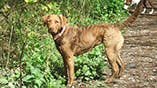 The oily coat of the Chesapeake Bay Retriever means that wet rolls of it, quite literally, like water off a duck's back.
They are a muscular dog with quite a broad head and amber/yellow eyes. They have webbed feet and a wavy but short coat. They come in shades of reds and browns.
It is said that in the early 1800s two Newfoundland-type dogs were rescued from a shipwreck off the coast of Maryland and later bred with other local dogs to produce the best water-retrieving dog around. They are more independent than most retrievers and so less easy to train but they are brave, intelligent and keen, if a little slow, to learn. They can be affectionate, loving and friendly and good with children. They are normally OK with strangers and other dogs and should be fine with cats in the home but may chase other mammals. They are strong and energetic, they need plenty of exercise and opportunities to swim, if possible. Heat makes them uncomfortable but icy water presents no problem.
They need regular brushing but should not be bathed too often as it removes the protective oils in the coat which give it a distinctive smell. They are prone to eye problems and hip dysplasia.
The oily coat of the Chesapeake Bay Retriever means that wet rolls of it, quite literally, like water off a duck's back.
They are a muscular dog with quite a broad head and amber/yellow eyes. They have webbed feet and a wavy but short coat. They come in shades of reds and browns.
It is said that in the early 1800s two Newfoundland-type dogs were rescued from a shipwreck off the coast of Maryland and later bred with other local dogs to produce the best water-retrieving dog around. They are more independent than most retrievers and so less easy to train but they are brave, intelligent and keen, if a little slow, to learn. They can be affectionate, loving and friendly and good with children. They are normally OK with strangers and other dogs and should be fine with cats in the home but may chase other mammals. They are strong and energetic, they need plenty of exercise and opportunities to swim, if possible. Heat makes them uncomfortable but icy water presents no problem.
They need regular brushing but should not be bathed too often as it removes the protective oils in the coat which give it a distinctive smell. They are prone to eye problems and hip dysplasia.
The oily coat of the Chesapeake Bay Retriever means that wet rolls of it, quite literally, like water off a duck's back.
They are a muscular dog with quite a broad head and amber/yellow eyes. They have webbed feet and a wavy but short coat. They come in shades of reds and browns.
It is said that in the early 1800s two Newfoundland-type dogs were rescued from a shipwreck off the coast of Maryland and later bred with other local dogs to produce the best water-retrieving dog around. They are more independent than most retrievers and so less easy to train but they are brave, intelligent and keen, if a little slow, to learn. They can be affectionate, loving and friendly and good with children. They are normally OK with strangers and other dogs and should be fine with cats in the home but may chase other mammals. They are strong and energetic, they need plenty of exercise and opportunities to swim, if possible. Heat makes them uncomfortable but icy water presents no problem.
They need regular brushing but should not be bathed too often as it removes the protective oils in the coat which give it a distinctive smell. They are prone to eye problems and hip dysplasia.Retriever (Curly Coated) The Curly Coated Retriever is very easy to identify from having a shiny, tightly-curled coat and yet smooth hair on their head.
The coat on this large, hardy dog comes in liver or black. It is water-resistant and helps to protect against brambles. Black coated dogs have black or brown eyes but the liver coated can have amber eyes.
They originate from eighteenth century England where they were bred for hunting, particularly for hunting duck and quail. They have great stamina and excellent scenting skills. They are trainable loyal and eager to please but can be a little wilful and do not fully mature until they are about three years old so are not a dog for everyone. They are generally good natured with children and animals and will be fine with strangers too if socialised from an early age. They are friendly but a natural guard dog too. They are a high energy very intelligent dog that needs plenty of opportunity to exercise their body and brain. They love swimming and can be good at agility and obedience.
The coat should not be brushed except for when it is shedding although it may need occasional clipping. They are prone to eye problems, epilepsy and hip dysplasia.
The Curly Coated Retriever is very easy to identify from having a shiny, tightly-curled coat and yet smooth hair on their head.
The coat on this large, hardy dog comes in liver or black. It is water-resistant and helps to protect against brambles. Black coated dogs have black or brown eyes but the liver coated can have amber eyes.
They originate from eighteenth century England where they were bred for hunting, particularly for hunting duck and quail. They have great stamina and excellent scenting skills. They are trainable loyal and eager to please but can be a little wilful and do not fully mature until they are about three years old so are not a dog for everyone. They are generally good natured with children and animals and will be fine with strangers too if socialised from an early age. They are friendly but a natural guard dog too. They are a high energy very intelligent dog that needs plenty of opportunity to exercise their body and brain. They love swimming and can be good at agility and obedience.
The coat should not be brushed except for when it is shedding although it may need occasional clipping. They are prone to eye problems, epilepsy and hip dysplasia.
The Curly Coated Retriever is very easy to identify from having a shiny, tightly-curled coat and yet smooth hair on their head.
The coat on this large, hardy dog comes in liver or black. It is water-resistant and helps to protect against brambles. Black coated dogs have black or brown eyes but the liver coated can have amber eyes.
They originate from eighteenth century England where they were bred for hunting, particularly for hunting duck and quail. They have great stamina and excellent scenting skills. They are trainable loyal and eager to please but can be a little wilful and do not fully mature until they are about three years old so are not a dog for everyone. They are generally good natured with children and animals and will be fine with strangers too if socialised from an early age. They are friendly but a natural guard dog too. They are a high energy very intelligent dog that needs plenty of opportunity to exercise their body and brain. They love swimming and can be good at agility and obedience.
The coat should not be brushed except for when it is shedding although it may need occasional clipping. They are prone to eye problems, epilepsy and hip dysplasia.Retriever (Flat Coated) Although retaining a youthful enthusiasm for years, the Flat-Coated Retriever is very sound and friendly and particularly gentle with children.
They come in two colours, black and liver. They're the raciest of the retriever breeds, with a well balanced body and nicely moulded one piece head. They also, as the name suggests, have a flat coat which lies close to the body.
Flat-Coated Retrievers were bred to be a "picking up dog", a dog who goes to fetch game, particularly game birds, when they have been shot. Retrieving comes naturally, they always want to bring you something. Their deep bark makes them good as a guard dog but they are not a noisy breed. They are excellent swimmers and love water but this can also include muddy puddles! Intelligent and easy to train, they respond well to food rewards and toys. Excellent with people and children, this breed enjoys the company of other dogs and can be good with cats. They enjoy and require a good amount of exercise.
Flat-Coated Retrievers need regular grooming to keep the coat matt free and shiny but don't need as much grooming as some breeds. Some health tests are recommended, including eye tests and hip scores and there is some history of cancer but this problem is being tackled and there are less instances of this now.
Although retaining a youthful enthusiasm for years, the Flat-Coated Retriever is very sound and friendly and particularly gentle with children.
They come in two colours, black and liver. They're the raciest of the retriever breeds, with a well balanced body and nicely moulded one piece head. They also, as the name suggests, have a flat coat which lies close to the body.
Flat-Coated Retrievers were bred to be a "picking up dog", a dog who goes to fetch game, particularly game birds, when they have been shot. Retrieving comes naturally, they always want to bring you something. Their deep bark makes them good as a guard dog but they are not a noisy breed. They are excellent swimmers and love water but this can also include muddy puddles! Intelligent and easy to train, they respond well to food rewards and toys. Excellent with people and children, this breed enjoys the company of other dogs and can be good with cats. They enjoy and require a good amount of exercise.
Flat-Coated Retrievers need regular grooming to keep the coat matt free and shiny but don't need as much grooming as some breeds. Some health tests are recommended, including eye tests and hip scores and there is some history of cancer but this problem is being tackled and there are less instances of this now.
Although retaining a youthful enthusiasm for years, the Flat-Coated Retriever is very sound and friendly and particularly gentle with children.
They come in two colours, black and liver. They're the raciest of the retriever breeds, with a well balanced body and nicely moulded one piece head. They also, as the name suggests, have a flat coat which lies close to the body.
Flat-Coated Retrievers were bred to be a "picking up dog", a dog who goes to fetch game, particularly game birds, when they have been shot. Retrieving comes naturally, they always want to bring you something. Their deep bark makes them good as a guard dog but they are not a noisy breed. They are excellent swimmers and love water but this can also include muddy puddles! Intelligent and easy to train, they respond well to food rewards and toys. Excellent with people and children, this breed enjoys the company of other dogs and can be good with cats. They enjoy and require a good amount of exercise.
Flat-Coated Retrievers need regular grooming to keep the coat matt free and shiny but don't need as much grooming as some breeds. Some health tests are recommended, including eye tests and hip scores and there is some history of cancer but this problem is being tackled and there are less instances of this now.Retriever (Golden) Golden Retrievers are one of the most popular breeds around today which is not surprising given their sweet natures and versatility.
They are a sturdy, medium-size dog with a broad head, dark brown eyes and close hanging ears. Their coat is thick and can be wavy with long feathering. It comes in shades of cream through to rich gold.
Golden Retrievers originate from Scotland in the 1800's where they were bred as a gun dog, specifically for water birds, but are widely used as assistance dogs in all kinds of roles now. They are loving, good natured and intelligent and very easy to train. Generally considered excellent family dogs, they are also good at hunting, obedience and agility. They are normally friendly toward all people and animals and are excellent with children. They enjoy a decent daily walk and love to retrieve and many are fond of water.
The double coat is easy to groom but they shed constantly. They are prone to cancer, hip dysplasia, Von Willebrand's disease, heart and eye problems and skin allergies.
Golden Retrievers are one of the most popular breeds around today which is not surprising given their sweet natures and versatility.
They are a sturdy, medium-size dog with a broad head, dark brown eyes and close hanging ears. Their coat is thick and can be wavy with long feathering. It comes in shades of cream through to rich gold.
Golden Retrievers originate from Scotland in the 1800's where they were bred as a gun dog, specifically for water birds, but are widely used as assistance dogs in all kinds of roles now. They are loving, good natured and intelligent and very easy to train. Generally considered excellent family dogs, they are also good at hunting, obedience and agility. They are normally friendly toward all people and animals and are excellent with children. They enjoy a decent daily walk and love to retrieve and many are fond of water.
The double coat is easy to groom but they shed constantly. They are prone to cancer, hip dysplasia, Von Willebrand's disease, heart and eye problems and skin allergies.
Golden Retrievers are one of the most popular breeds around today which is not surprising given their sweet natures and versatility.
They are a sturdy, medium-size dog with a broad head, dark brown eyes and close hanging ears. Their coat is thick and can be wavy with long feathering. It comes in shades of cream through to rich gold.
Golden Retrievers originate from Scotland in the 1800's where they were bred as a gun dog, specifically for water birds, but are widely used as assistance dogs in all kinds of roles now. They are loving, good natured and intelligent and very easy to train. Generally considered excellent family dogs, they are also good at hunting, obedience and agility. They are normally friendly toward all people and animals and are excellent with children. They enjoy a decent daily walk and love to retrieve and many are fond of water.
The double coat is easy to groom but they shed constantly. They are prone to cancer, hip dysplasia, Von Willebrand's disease, heart and eye problems and skin allergies.Retriever (Labrador) The popular Labrador Retriever has proved his worth in a huge range of roles, from gun-dog work to assistance work to competitive sports.
There are actually two types of Labrador Retrievers: the American one is tall and slender while the English one is stockier. They have a broad head, close hanging ears and a short, smooth coat. The most popular colours are yellow and black but they also come in chocolate, 'fox red' and even silver. Their webbed feet and otter-like tail make them excellent swimmers.
They originate from Newfoundland where they worked helping fishermen. They were brought to the UK in the 1800's where they were crossed with other breeds to improve their retrieving skills.
They are naturally loyal, loving, patient and eager to please. Their trainability makes them a good choice for a family dog but also makes them excellent assistance dogs for a range of disabilities. They love to play, especially in water. Their natural tendency is to be reliably friendly to all: strangers, other animals and they are normally excellent with children. They love to work so are happiest when given a purpose. They also love exercise, and as they have a tendency to put on weight, a good daily walk is important.
Their short coat is easy to maintain and they tend to shed little but regularly. They are prone to hip and elbow dysplasia, PRA, mast cell tumours and eye problems.
The popular Labrador Retriever has proved his worth in a huge range of roles, from gun-dog work to assistance work to competitive sports.
There are actually two types of Labrador Retrievers: the American one is tall and slender while the English one is stockier. They have a broad head, close hanging ears and a short, smooth coat. The most popular colours are yellow and black but they also come in chocolate, 'fox red' and even silver. Their webbed feet and otter-like tail make them excellent swimmers.
They originate from Newfoundland where they worked helping fishermen. They were brought to the UK in the 1800's where they were crossed with other breeds to improve their retrieving skills.
They are naturally loyal, loving, patient and eager to please. Their trainability makes them a good choice for a family dog but also makes them excellent assistance dogs for a range of disabilities. They love to play, especially in water. Their natural tendency is to be reliably friendly to all: strangers, other animals and they are normally excellent with children. They love to work so are happiest when given a purpose. They also love exercise, and as they have a tendency to put on weight, a good daily walk is important.
Their short coat is easy to maintain and they tend to shed little but regularly. They are prone to hip and elbow dysplasia, PRA, mast cell tumours and eye problems.
The popular Labrador Retriever has proved his worth in a huge range of roles, from gun-dog work to assistance work to competitive sports.
There are actually two types of Labrador Retrievers: the American one is tall and slender while the English one is stockier. They have a broad head, close hanging ears and a short, smooth coat. The most popular colours are yellow and black but they also come in chocolate, 'fox red' and even silver. Their webbed feet and otter-like tail make them excellent swimmers.
They originate from Newfoundland where they worked helping fishermen. They were brought to the UK in the 1800's where they were crossed with other breeds to improve their retrieving skills.
They are naturally loyal, loving, patient and eager to please. Their trainability makes them a good choice for a family dog but also makes them excellent assistance dogs for a range of disabilities. They love to play, especially in water. Their natural tendency is to be reliably friendly to all: strangers, other animals and they are normally excellent with children. They love to work so are happiest when given a purpose. They also love exercise, and as they have a tendency to put on weight, a good daily walk is important.
Their short coat is easy to maintain and they tend to shed little but regularly. They are prone to hip and elbow dysplasia, PRA, mast cell tumours and eye problems.Retriever (Nova Scotia Duck Tolling)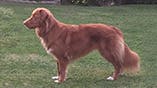 The Nova Scotia Duck Tolling Retriever is a lively, friendly little dog that gained his name from his job of using the waving white tip of his tail to lure ducks towards hunters and then retrieve them after they'd been shot.
They look a little like a smaller version of the Golden Retriever with similar shape and colouring although they also usually have white markings on the feet, chest and tail. The double coat is water-repellent and their feet are webbed.
They come from Canada where they were bred to help hunters with hunting water fowl.
They are intelligent, easy to train and devoted to their family. They do well in active dog sports such as agility and make excellent companion dogs as long as they are given enough opportunity to exercise.
They are normally friendly toward other animals and excellent with children although can be a little more reserved around strangers than the Golden Retriever. They have a lot of energy and enjoy good daily exercise and opportunities to swim.
Their coat should be brushed and combed regularly but not bathed too often as it removes the coat's natural oils. They are prone to thyroid and auto-immune problems and there have been some reported cases of progressive retinal atrophy (PRA).
The Nova Scotia Duck Tolling Retriever is a lively, friendly little dog that gained his name from his job of using the waving white tip of his tail to lure ducks towards hunters and then retrieve them after they'd been shot.
They look a little like a smaller version of the Golden Retriever with similar shape and colouring although they also usually have white markings on the feet, chest and tail. The double coat is water-repellent and their feet are webbed.
They come from Canada where they were bred to help hunters with hunting water fowl.
They are intelligent, easy to train and devoted to their family. They do well in active dog sports such as agility and make excellent companion dogs as long as they are given enough opportunity to exercise.
They are normally friendly toward other animals and excellent with children although can be a little more reserved around strangers than the Golden Retriever. They have a lot of energy and enjoy good daily exercise and opportunities to swim.
Their coat should be brushed and combed regularly but not bathed too often as it removes the coat's natural oils. They are prone to thyroid and auto-immune problems and there have been some reported cases of progressive retinal atrophy (PRA).
The Nova Scotia Duck Tolling Retriever is a lively, friendly little dog that gained his name from his job of using the waving white tip of his tail to lure ducks towards hunters and then retrieve them after they'd been shot.
They look a little like a smaller version of the Golden Retriever with similar shape and colouring although they also usually have white markings on the feet, chest and tail. The double coat is water-repellent and their feet are webbed.
They come from Canada where they were bred to help hunters with hunting water fowl.
They are intelligent, easy to train and devoted to their family. They do well in active dog sports such as agility and make excellent companion dogs as long as they are given enough opportunity to exercise.
They are normally friendly toward other animals and excellent with children although can be a little more reserved around strangers than the Golden Retriever. They have a lot of energy and enjoy good daily exercise and opportunities to swim.
Their coat should be brushed and combed regularly but not bathed too often as it removes the coat's natural oils. They are prone to thyroid and auto-immune problems and there have been some reported cases of progressive retinal atrophy (PRA).Rhodesian Ridgeback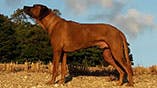 Rhodesian Ridgebacks, used in packs, are excellent at hunting lions with hunters on horseback so they are sometimes known as "African Lion Hound".
They are a large, muscular hound with a flat, triangular head and, sometimes, a black tongue. Their short, smooth coat comes in shades of wheaten and red but their most noticeable feature is the ridge of hairs that grow the wrong way along their back.
They originate from Zimbabwe where they worked as a retriever and guard dog but in Rhodesia they found a new use as a hunter of big game. An excellent hunter, they are loyal, protective and surprisingly calm in the home. They are trainable and will be good natured and well behaved if allowed sufficient opportunity to exercise. They are normally good with children although may be a little boisterous for small children and they can be wary of strangers. They also need to be trained to get along with other animals. They have a lot of energy and stamina and need plenty of opportunity to exercise. They can withstand extremes of temperature.
The smooth, short hair is easy to groom. Rhodesian Ridgebacks are generally very hardy but can be prone to hip dysplasia, dermoid sinus, cysts and mast cell tumours.
Rhodesian Ridgebacks, used in packs, are excellent at hunting lions with hunters on horseback so they are sometimes known as "African Lion Hound".
They are a large, muscular hound with a flat, triangular head and, sometimes, a black tongue. Their short, smooth coat comes in shades of wheaten and red but their most noticeable feature is the ridge of hairs that grow the wrong way along their back.
They originate from Zimbabwe where they worked as a retriever and guard dog but in Rhodesia they found a new use as a hunter of big game. An excellent hunter, they are loyal, protective and surprisingly calm in the home. They are trainable and will be good natured and well behaved if allowed sufficient opportunity to exercise. They are normally good with children although may be a little boisterous for small children and they can be wary of strangers. They also need to be trained to get along with other animals. They have a lot of energy and stamina and need plenty of opportunity to exercise. They can withstand extremes of temperature.
The smooth, short hair is easy to groom. Rhodesian Ridgebacks are generally very hardy but can be prone to hip dysplasia, dermoid sinus, cysts and mast cell tumours.
Rhodesian Ridgebacks, used in packs, are excellent at hunting lions with hunters on horseback so they are sometimes known as "African Lion Hound".
They are a large, muscular hound with a flat, triangular head and, sometimes, a black tongue. Their short, smooth coat comes in shades of wheaten and red but their most noticeable feature is the ridge of hairs that grow the wrong way along their back.
They originate from Zimbabwe where they worked as a retriever and guard dog but in Rhodesia they found a new use as a hunter of big game. An excellent hunter, they are loyal, protective and surprisingly calm in the home. They are trainable and will be good natured and well behaved if allowed sufficient opportunity to exercise. They are normally good with children although may be a little boisterous for small children and they can be wary of strangers. They also need to be trained to get along with other animals. They have a lot of energy and stamina and need plenty of opportunity to exercise. They can withstand extremes of temperature.
The smooth, short hair is easy to groom. Rhodesian Ridgebacks are generally very hardy but can be prone to hip dysplasia, dermoid sinus, cysts and mast cell tumours.Rottweiler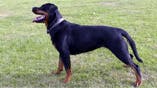 The Rottweiler is an imposing dog who is seemingly impervious to pain and as such has earned something of a bad press, but in the right hands they are calm and reliable.
They are a large, muscular and powerful dog with a broad head. Their short, thick, glossy coat is normally largely black with distinctive tan markings although there is a red colour with brown markings.
They are a mastiff-type dog bred in Germany for herding, guarding and carting. They are highly intelligent, naturally very protective and devoted to their family.
They make an excellent guard dog and with the right upbringing will be peaceful and kind. They have proven to be a great asset to the police and armed forces. They are a natural guard dog so need to be taught to accept strangers but can be trained to be good with children and other animals. They have a lot of stamina and need plenty of exercise.
The short coat is easy to groom. They are prone to hip dysplasia, eyelid problems and tend to snore, they also gain weight easily.
The Rottweiler is an imposing dog who is seemingly impervious to pain and as such has earned something of a bad press, but in the right hands they are calm and reliable.
They are a large, muscular and powerful dog with a broad head. Their short, thick, glossy coat is normally largely black with distinctive tan markings although there is a red colour with brown markings.
They are a mastiff-type dog bred in Germany for herding, guarding and carting. They are highly intelligent, naturally very protective and devoted to their family.
They make an excellent guard dog and with the right upbringing will be peaceful and kind. They have proven to be a great asset to the police and armed forces. They are a natural guard dog so need to be taught to accept strangers but can be trained to be good with children and other animals. They have a lot of stamina and need plenty of exercise.
The short coat is easy to groom. They are prone to hip dysplasia, eyelid problems and tend to snore, they also gain weight easily.
The Rottweiler is an imposing dog who is seemingly impervious to pain and as such has earned something of a bad press, but in the right hands they are calm and reliable.
They are a large, muscular and powerful dog with a broad head. Their short, thick, glossy coat is normally largely black with distinctive tan markings although there is a red colour with brown markings.
They are a mastiff-type dog bred in Germany for herding, guarding and carting. They are highly intelligent, naturally very protective and devoted to their family.
They make an excellent guard dog and with the right upbringing will be peaceful and kind. They have proven to be a great asset to the police and armed forces. They are a natural guard dog so need to be taught to accept strangers but can be trained to be good with children and other animals. They have a lot of stamina and need plenty of exercise.
The short coat is easy to groom. They are prone to hip dysplasia, eyelid problems and tend to snore, they also gain weight easily.Russian Black Terrier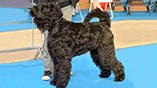 Although bred to catch fugitives in the second world war, the Russian Black Terrier, although effective in his work, is not naturally aggressive.
They are a largish, squarely-built dog rather like a Giant Schnauzer in shape with large, bear-like feet. They are powerful but seem to have a light tread and have a thick, coarse, black, wavy coat. They were developed in Russia in the 1940s by the Red Star army for use as a high spirited but stable working dog able to withstand extremes of temperature.
They are intelligent and trainable and become very attached to their owner. A well trained Russian Black Terrier is confident, eager to please and very loyal. They have a strong protective instinct and are wary of strangers although tend to get on well with children and are tolerant of most other animals. They have plenty of stamina and always enjoy a long walk. They tend to like snow and water too.
The weather-proof coat needs trimming regularly and may need stripping occasionally. They are prone to hip and elbow dysplasia and can suffer with problems with their ears.
Although bred to catch fugitives in the second world war, the Russian Black Terrier, although effective in his work, is not naturally aggressive.
They are a largish, squarely-built dog rather like a Giant Schnauzer in shape with large, bear-like feet. They are powerful but seem to have a light tread and have a thick, coarse, black, wavy coat. They were developed in Russia in the 1940s by the Red Star army for use as a high spirited but stable working dog able to withstand extremes of temperature.
They are intelligent and trainable and become very attached to their owner. A well trained Russian Black Terrier is confident, eager to please and very loyal. They have a strong protective instinct and are wary of strangers although tend to get on well with children and are tolerant of most other animals. They have plenty of stamina and always enjoy a long walk. They tend to like snow and water too.
The weather-proof coat needs trimming regularly and may need stripping occasionally. They are prone to hip and elbow dysplasia and can suffer with problems with their ears.
Although bred to catch fugitives in the second world war, the Russian Black Terrier, although effective in his work, is not naturally aggressive.
They are a largish, squarely-built dog rather like a Giant Schnauzer in shape with large, bear-like feet. They are powerful but seem to have a light tread and have a thick, coarse, black, wavy coat. They were developed in Russia in the 1940s by the Red Star army for use as a high spirited but stable working dog able to withstand extremes of temperature.
They are intelligent and trainable and become very attached to their owner. A well trained Russian Black Terrier is confident, eager to please and very loyal. They have a strong protective instinct and are wary of strangers although tend to get on well with children and are tolerant of most other animals. They have plenty of stamina and always enjoy a long walk. They tend to like snow and water too.
The weather-proof coat needs trimming regularly and may need stripping occasionally. They are prone to hip and elbow dysplasia and can suffer with problems with their ears.Russian ToyThe Russian Toy has only been officially recognised by the Kennel Club in the UK since 2017.
It's a dog similar in size and looks to the chihuahua and can have a smooth or long-haired coat which can be black and tan, blue and tan or red. They have 'pricked' ears with 'fringes' of hair which sometimes don't fully develop until they are around 3 years old.
They were bred initially as watch dogs and rat-catchers. They are very loyal to their family and are often trained for agility and obedience.
Both coat types shed but not overly. The long coated do need a comb occasionally to brush out any tangles.
Puppies can suffer from tooth problems as their adult teeth come through, and as with many small dogs, they can suffer from patellar luxation (slipping kneecap). They can also have very delicate bones, simply due to their size.
The Russian Toy has only been officially recognised by the Kennel Club in the UK since 2017.
It's a dog similar in size and looks to the chihuahua and can have a smooth or long-haired coat which can be black and tan, blue and tan or red. They have 'pricked' ears with 'fringes' of hair which sometimes don't fully develop until they are around 3 years old.
They were bred initially as watch dogs and rat-catchers. They are very loyal to their family and are often trained for agility and obedience.
Both coat types shed but not overly. The long coated do need a comb occasionally to brush out any tangles.
Puppies can suffer from tooth problems as their adult teeth come through, and as with many small dogs, they can suffer from patellar luxation (slipping kneecap). They can also have very delicate bones, simply due to their size.Saluki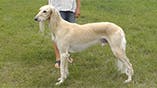 The graceful, athletic Saluki literally flies when it runs. At top speed, all four of its legs are in the air at the same time.
They are a tall, slender, elegant dog that naturally carries their tail between their legs. They are like a long-haired Greyhound. Their coat comes in white, cream, fawn, golden, red, grizzle and tan, black and tan tricolour or white.
They are the royal dog of Egypt and go back to the time of the Pharaohs. They were never sold but offered as treasured gifts and were used to hunt gazelle. Like the Greyhound, they are a gentle, loving dog but can be very sensitive. They are also intelligent and will bore easily if left alone or given insufficient exercise. They are naturally people, children and dog friendly but great care must be taken around other animals as they have a strong prey drive. They have great speed and tremendous stamina but can be single minded when they spot something to chase.
They need little grooming but their feathery ears need checking for signs of infection. They have no natural doggy odour. They are prone to eye problems and cancer and can get sunburnt.
The graceful, athletic Saluki literally flies when it runs. At top speed, all four of its legs are in the air at the same time.
They are a tall, slender, elegant dog that naturally carries their tail between their legs. They are like a long-haired Greyhound. Their coat comes in white, cream, fawn, golden, red, grizzle and tan, black and tan tricolour or white.
They are the royal dog of Egypt and go back to the time of the Pharaohs. They were never sold but offered as treasured gifts and were used to hunt gazelle. Like the Greyhound, they are a gentle, loving dog but can be very sensitive. They are also intelligent and will bore easily if left alone or given insufficient exercise. They are naturally people, children and dog friendly but great care must be taken around other animals as they have a strong prey drive. They have great speed and tremendous stamina but can be single minded when they spot something to chase.
They need little grooming but their feathery ears need checking for signs of infection. They have no natural doggy odour. They are prone to eye problems and cancer and can get sunburnt.
The graceful, athletic Saluki literally flies when it runs. At top speed, all four of its legs are in the air at the same time.
They are a tall, slender, elegant dog that naturally carries their tail between their legs. They are like a long-haired Greyhound. Their coat comes in white, cream, fawn, golden, red, grizzle and tan, black and tan tricolour or white.
They are the royal dog of Egypt and go back to the time of the Pharaohs. They were never sold but offered as treasured gifts and were used to hunt gazelle. Like the Greyhound, they are a gentle, loving dog but can be very sensitive. They are also intelligent and will bore easily if left alone or given insufficient exercise. They are naturally people, children and dog friendly but great care must be taken around other animals as they have a strong prey drive. They have great speed and tremendous stamina but can be single minded when they spot something to chase.
They need little grooming but their feathery ears need checking for signs of infection. They have no natural doggy odour. They are prone to eye problems and cancer and can get sunburnt.Samoyed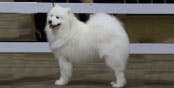 Samoyeds are affectionate and playful with everyone even if they're not 100% reliable in doing as they're told.
They are quite a large spitz-type breed with a huge, thick coat that has a ruff round the neck and shoulders. They normally come in white but can also come in biscuit, yellow or cream. They also have flat feet and hair between and under their pads to cope with very cold ground.
The originate from Siberia where they were used to pull sleds, guard property and herd reindeer. They are gentle, loyal, loving and happy-go-lucky. They are very intelligent and can be trained but on the downside, have a tendency to bark and love to chew. Samoyeds usually get on well with strangers, children and most animals although they do have an instinct to hunt. They need regular exercise and find warmer temperatures harder to cope with because of their coat.
The thick coat needs a good deal of brushing and combing and they can shed excessively at certain times of the year. They are prone to hip dysplasia, diabetes, skin allergies and PRA.
Samoyeds are affectionate and playful with everyone even if they're not 100% reliable in doing as they're told.
They are quite a large spitz-type breed with a huge, thick coat that has a ruff round the neck and shoulders. They normally come in white but can also come in biscuit, yellow or cream. They also have flat feet and hair between and under their pads to cope with very cold ground.
The originate from Siberia where they were used to pull sleds, guard property and herd reindeer. They are gentle, loyal, loving and happy-go-lucky. They are very intelligent and can be trained but on the downside, have a tendency to bark and love to chew. Samoyeds usually get on well with strangers, children and most animals although they do have an instinct to hunt. They need regular exercise and find warmer temperatures harder to cope with because of their coat.
The thick coat needs a good deal of brushing and combing and they can shed excessively at certain times of the year. They are prone to hip dysplasia, diabetes, skin allergies and PRA.
Samoyeds are affectionate and playful with everyone even if they're not 100% reliable in doing as they're told.
They are quite a large spitz-type breed with a huge, thick coat that has a ruff round the neck and shoulders. They normally come in white but can also come in biscuit, yellow or cream. They also have flat feet and hair between and under their pads to cope with very cold ground.
The originate from Siberia where they were used to pull sleds, guard property and herd reindeer. They are gentle, loyal, loving and happy-go-lucky. They are very intelligent and can be trained but on the downside, have a tendency to bark and love to chew. Samoyeds usually get on well with strangers, children and most animals although they do have an instinct to hunt. They need regular exercise and find warmer temperatures harder to cope with because of their coat.
The thick coat needs a good deal of brushing and combing and they can shed excessively at certain times of the year. They are prone to hip dysplasia, diabetes, skin allergies and PRA.SchipperkeIn Flanders, where the Schipperke used to work on canal boats, the word "schip" means boat and they were frequently nicknamed "Little Captain" or "Little Skipper" because they often belonged to the captain.
The name is pronounced 'skip-er-key'. They are a small, fox-like, spitz-type breed with a thick, double coat that has a ruff round the neck and shoulders. They normally come in black but can also come in tan or fawn.
They were bred in Flanders by a canal boat captain named Renssens and were used as a guard dog on boats as well as for ratting. They are lively, intelligent, alert and very loyal. They are a good alert dog but do like the sound of their own bark and will howl too. They are very happy on boats. Schipperkes usually get on well with strangers, children and animals. They need regular exercise but are the sort of dog that is active indoors and out.
Regular brushing and combing is needed to keep the coat looking good. At certain times of the year the coat "blows" - all the undercoat falls out over a period of days - and for a couple of weeks they look practically naked until the thick coat returns. They are prone to hypothyroidism, epilepsy, hip dysplasia slipped hip sockets, Legg Calves Perthes Disease, eye problems and a recently discovered disease called MPS 111B (Mucopolysaccharidosis).
In Flanders, where the Schipperke used to work on canal boats, the word "schip" means boat and they were frequently nicknamed "Little Captain" or "Little Skipper" because they often belonged to the captain.
The name is pronounced 'skip-er-key'. They are a small, fox-like, spitz-type breed with a thick, double coat that has a ruff round the neck and shoulders. They normally come in black but can also come in tan or fawn.
They were bred in Flanders by a canal boat captain named Renssens and were used as a guard dog on boats as well as for ratting. They are lively, intelligent, alert and very loyal. They are a good alert dog but do like the sound of their own bark and will howl too. They are very happy on boats. Schipperkes usually get on well with strangers, children and animals. They need regular exercise but are the sort of dog that is active indoors and out.
Regular brushing and combing is needed to keep the coat looking good. At certain times of the year the coat "blows" - all the undercoat falls out over a period of days - and for a couple of weeks they look practically naked until the thick coat returns. They are prone to hypothyroidism, epilepsy, hip dysplasia slipped hip sockets, Legg Calves Perthes Disease, eye problems and a recently discovered disease called MPS 111B (Mucopolysaccharidosis).SchnauzerThe Schnauzer or Standard Schnauzer sits between the Miniature and Giant in terms of size but is actually the oldest of the three Schnauzer types.
They are a muscular, medium-sized, squarely built dog. Their head is rectangular with long whiskers, beard and eyebrows and their double coat has a wiry outer which comes in black and 'salt and pepper' which looks greyish.
They originate from Germany where they were a general purpose farm dog but they have proved their worth in many areas and were used as messenger dogs in World War 1. They are an excellent guard dog, lively and enthusiastic and can be playful and affectionate but they are highly intelligent and not the easiest of dogs to train. They are normally good with children and can be trained to get on with strangers and animals but do have a high prey drive. They need a good deal of regular exercise.
Their undercoat needs regular brushing and their outer coat needs trimming regularly. They can be prone to hip dysplasia and tumours.
The Schnauzer or Standard Schnauzer sits between the Miniature and Giant in terms of size but is actually the oldest of the three Schnauzer types.
They are a muscular, medium-sized, squarely built dog. Their head is rectangular with long whiskers, beard and eyebrows and their double coat has a wiry outer which comes in black and 'salt and pepper' which looks greyish.
They originate from Germany where they were a general purpose farm dog but they have proved their worth in many areas and were used as messenger dogs in World War 1. They are an excellent guard dog, lively and enthusiastic and can be playful and affectionate but they are highly intelligent and not the easiest of dogs to train. They are normally good with children and can be trained to get on with strangers and animals but do have a high prey drive. They need a good deal of regular exercise.
Their undercoat needs regular brushing and their outer coat needs trimming regularly. They can be prone to hip dysplasia and tumours.Scottish Terrier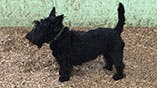 Scottish Terriers have been described as a big dog in a small dog's body. They are game for anything and have great determination, earning them the nickname of "little diehard".
They are a sturdy, short-legged little dog with a long, rectangular head and pricked-up ears. The hair is long on their eyebrows, muzzle and legs. Their coat is coarse with a soft undercoat and comes in black, brindle or wheaten.
They were developed in Scotland in the 1700s for hunting den animals like foxes and badgers. Playful and full of character with the right upbringing, they need firm but gentle handling from an early age. They are intelligent with a stubborn streak, they are also very alert and make a good watchdog. Because they need to be treated with authority, they may not be suitable for a family with small children. They are an active breed indoors but enjoy a daily walk outside too.
Regular brushing and combing of the coat is necessary and they need to be professionally trimmed about twice a year. They can be prone to Scotty Cramp (a movement problem), Von Willebrand's disease, flea allergic dermatitis, skin and jaw problems and mast cell tumours. They can also have difficulty with whelping.
Scottish Terriers have been described as a big dog in a small dog's body. They are game for anything and have great determination, earning them the nickname of "little diehard".
They are a sturdy, short-legged little dog with a long, rectangular head and pricked-up ears. The hair is long on their eyebrows, muzzle and legs. Their coat is coarse with a soft undercoat and comes in black, brindle or wheaten.
They were developed in Scotland in the 1700s for hunting den animals like foxes and badgers. Playful and full of character with the right upbringing, they need firm but gentle handling from an early age. They are intelligent with a stubborn streak, they are also very alert and make a good watchdog. Because they need to be treated with authority, they may not be suitable for a family with small children. They are an active breed indoors but enjoy a daily walk outside too.
Regular brushing and combing of the coat is necessary and they need to be professionally trimmed about twice a year. They can be prone to Scotty Cramp (a movement problem), Von Willebrand's disease, flea allergic dermatitis, skin and jaw problems and mast cell tumours. They can also have difficulty with whelping.
Scottish Terriers have been described as a big dog in a small dog's body. They are game for anything and have great determination, earning them the nickname of "little diehard".
They are a sturdy, short-legged little dog with a long, rectangular head and pricked-up ears. The hair is long on their eyebrows, muzzle and legs. Their coat is coarse with a soft undercoat and comes in black, brindle or wheaten.
They were developed in Scotland in the 1700s for hunting den animals like foxes and badgers. Playful and full of character with the right upbringing, they need firm but gentle handling from an early age. They are intelligent with a stubborn streak, they are also very alert and make a good watchdog. Because they need to be treated with authority, they may not be suitable for a family with small children. They are an active breed indoors but enjoy a daily walk outside too.
Regular brushing and combing of the coat is necessary and they need to be professionally trimmed about twice a year. They can be prone to Scotty Cramp (a movement problem), Von Willebrand's disease, flea allergic dermatitis, skin and jaw problems and mast cell tumours. They can also have difficulty with whelping.Sealyham TerrierSealyham Terriers have been descried as "the most beautiful union between cheerfulness and courage."
They are similar in shape and size to the Scottish Terrier: sturdy, small, short-legged, with long, double coat, wiry on the outer layer, and a bearded face. The differences are they have ears that fold forward and are normally mainly white.
They were developed in Wales in the mid 1800s by Captain John Edwards who bred different terriers together to try to create the best one for hunting den animals. They can be quite difficult to train, but are an intelligent, fun, loving and brave little dog. They make good watchdogs and ratters. They can be reserved around strangers and are better with older children but are generally OK with other pets. Although they enjoy a daily walk, they are quite inactive indoors.
They need brushing, combing, to be stripped occasionally and professionally trimmed. They are a generally healthy breed.
Sealyham Terriers have been descried as "the most beautiful union between cheerfulness and courage."
They are similar in shape and size to the Scottish Terrier: sturdy, small, short-legged, with long, double coat, wiry on the outer layer, and a bearded face. The differences are they have ears that fold forward and are normally mainly white.
They were developed in Wales in the mid 1800s by Captain John Edwards who bred different terriers together to try to create the best one for hunting den animals. They can be quite difficult to train, but are an intelligent, fun, loving and brave little dog. They make good watchdogs and ratters. They can be reserved around strangers and are better with older children but are generally OK with other pets. Although they enjoy a daily walk, they are quite inactive indoors.
They need brushing, combing, to be stripped occasionally and professionally trimmed. They are a generally healthy breed.Segugio ItalianoAlthough very popular in their native Italy, the Segugio Italiano is rarely kept as a pet. They are primarily a hunting dog, capable of working alone or in packs.
They are a medium-sized, squarish hound with a length equal to their height that comes in smooth and wire coated types. Their coat can be fawn coloured or black and tan.
They were bred originally to hunt boar but are now used for hunting rabbits and hares. They work in a unique way, tracking and then herding the prey to bring it to the hunter. When excitedly on the trail, they make a distinctive high-pitched "ba, ba" noise.
They are generally calm, intelligent and affectionate but need plenty of opportunity to exercise their body and brain. They are normally good with other dogs, children and people. They are very fast and have great stamina so need plenty of exercise but their prey drive will incline them to chase if they spot wildlife.
Regular brushing and combing keeps the coat in good condition. They are usually very healthy.
Although very popular in their native Italy, the Segugio Italiano is rarely kept as a pet. They are primarily a hunting dog, capable of working alone or in packs.
They are a medium-sized, squarish hound with a length equal to their height that comes in smooth and wire coated types. Their coat can be fawn coloured or black and tan.
They were bred originally to hunt boar but are now used for hunting rabbits and hares. They work in a unique way, tracking and then herding the prey to bring it to the hunter. When excitedly on the trail, they make a distinctive high-pitched "ba, ba" noise.
They are generally calm, intelligent and affectionate but need plenty of opportunity to exercise their body and brain. They are normally good with other dogs, children and people. They are very fast and have great stamina so need plenty of exercise but their prey drive will incline them to chase if they spot wildlife.
Regular brushing and combing keeps the coat in good condition. They are usually very healthy.Shar Pei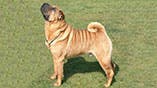 The Shar Pei is easy to recognise from his deeply wrinkled skin which gives the impression of a rather comical frown. Puppies have the most wrinkles and they gradually become less wrinkled as they age.
They are a medium-sized dog with a large head and, like the Chow Chow, have a blueish-black tongue. They come in a wide variety of colours, in fact all Solid colours except white are acceptable. Shading is normal on the coat colours but "Flowered" or "Parti Colour" coat colours are considered faults.
There are three coat types: horse-coat, brush-coat and a bear-coat (which is actually a fault in the breed caused by the addition of other breeds). The last of these is not recognised by some kennel clubs. The horse-coat has a very prickly feel whereas the brush coat is smoother.
They go back many years to early China where they were used as an all-purpose farm dog although the name Shar Pei just means "sandy coat". They were also occasionally used in dog fighting where the prickly horse-coat was an advantage.
They need clear obedience training but are intelligent, playful and affectionate and can form a very good bond with their family. They also make good guard dogs. They are normally good with people and will be with other dogs and children if socialised when young. They need a good deal of daily exercise although care must be taken in hot weather as they are very sensitive to heat.
All coat types need regular brushing. They are prone to kidney failure and mast cell tumours. They are also prone to skin problems but this is not caused, as is commonly believed, by having wrinkles but is a hereditary problem. They can suffer from Shar Pei fever (FSF) which can result in renal and liver failure through accumulation of amyloid in those organs (amyloidosis). They can also suffer from entropion, but responsible breeders are working hard to health test their dogs before breeding to ensure the breed is as healthy as possible.
The Shar Pei is easy to recognise from his deeply wrinkled skin which gives the impression of a rather comical frown. Puppies have the most wrinkles and they gradually become less wrinkled as they age.
They are a medium-sized dog with a large head and, like the Chow Chow, have a blueish-black tongue. They come in a wide variety of colours, in fact all Solid colours except white are acceptable. Shading is normal on the coat colours but "Flowered" or "Parti Colour" coat colours are considered faults.
There are three coat types: horse-coat, brush-coat and a bear-coat (which is actually a fault in the breed caused by the addition of other breeds). The last of these is not recognised by some kennel clubs. The horse-coat has a very prickly feel whereas the brush coat is smoother.
They go back many years to early China where they were used as an all-purpose farm dog although the name Shar Pei just means "sandy coat". They were also occasionally used in dog fighting where the prickly horse-coat was an advantage.
They need clear obedience training but are intelligent, playful and affectionate and can form a very good bond with their family. They also make good guard dogs. They are normally good with people and will be with other dogs and children if socialised when young. They need a good deal of daily exercise although care must be taken in hot weather as they are very sensitive to heat.
All coat types need regular brushing. They are prone to kidney failure and mast cell tumours. They are also prone to skin problems but this is not caused, as is commonly believed, by having wrinkles but is a hereditary problem. They can suffer from Shar Pei fever (FSF) which can result in renal and liver failure through accumulation of amyloid in those organs (amyloidosis). They can also suffer from entropion, but responsible breeders are working hard to health test their dogs before breeding to ensure the breed is as healthy as possible.
The Shar Pei is easy to recognise from his deeply wrinkled skin which gives the impression of a rather comical frown. Puppies have the most wrinkles and they gradually become less wrinkled as they age.
They are a medium-sized dog with a large head and, like the Chow Chow, have a blueish-black tongue. They come in a wide variety of colours, in fact all Solid colours except white are acceptable. Shading is normal on the coat colours but "Flowered" or "Parti Colour" coat colours are considered faults.
There are three coat types: horse-coat, brush-coat and a bear-coat (which is actually a fault in the breed caused by the addition of other breeds). The last of these is not recognised by some kennel clubs. The horse-coat has a very prickly feel whereas the brush coat is smoother.
They go back many years to early China where they were used as an all-purpose farm dog although the name Shar Pei just means "sandy coat". They were also occasionally used in dog fighting where the prickly horse-coat was an advantage.
They need clear obedience training but are intelligent, playful and affectionate and can form a very good bond with their family. They also make good guard dogs. They are normally good with people and will be with other dogs and children if socialised when young. They need a good deal of daily exercise although care must be taken in hot weather as they are very sensitive to heat.
All coat types need regular brushing. They are prone to kidney failure and mast cell tumours. They are also prone to skin problems but this is not caused, as is commonly believed, by having wrinkles but is a hereditary problem. They can suffer from Shar Pei fever (FSF) which can result in renal and liver failure through accumulation of amyloid in those organs (amyloidosis). They can also suffer from entropion, but responsible breeders are working hard to health test their dogs before breeding to ensure the breed is as healthy as possible.Shetland Sheepdog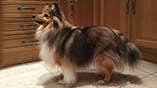 The Shetland Sheepdog is smart, energetic and rather glamorous.
They are a small dog that looks like a miniature Rough Coated Collie: fine featured with a long double coat that has a mane around the neck and chest. Their coat comes in blue merle, sable and black with varying amounts of white and/or tan.
They were bred in the 1700s to guard and herd sheep in the Shetland Islands, off the coast of Scotland. They are eager to please, affectionate and extremely intelligent. They are very trainable with plenty of energy and do particularly well at sports such as agility and obedience. They can be a little reserved around strangers but are generally fine with children and other dogs. Although active indoors, they are a breed with a good deal of energy that needs a daily walk too and they love to chase things.
Regular brushing is important to keep the coat looking good and they are a seasonal heavy shedder. They can have malformed or diseased eyes and are prone to hypothyroidism and kneecap problems. They can also be allergic to certain medicines.
The Shetland Sheepdog is smart, energetic and rather glamorous.
They are a small dog that looks like a miniature Rough Coated Collie: fine featured with a long double coat that has a mane around the neck and chest. Their coat comes in blue merle, sable and black with varying amounts of white and/or tan.
They were bred in the 1700s to guard and herd sheep in the Shetland Islands, off the coast of Scotland. They are eager to please, affectionate and extremely intelligent. They are very trainable with plenty of energy and do particularly well at sports such as agility and obedience. They can be a little reserved around strangers but are generally fine with children and other dogs. Although active indoors, they are a breed with a good deal of energy that needs a daily walk too and they love to chase things.
Regular brushing is important to keep the coat looking good and they are a seasonal heavy shedder. They can have malformed or diseased eyes and are prone to hypothyroidism and kneecap problems. They can also be allergic to certain medicines.
The Shetland Sheepdog is smart, energetic and rather glamorous.
They are a small dog that looks like a miniature Rough Coated Collie: fine featured with a long double coat that has a mane around the neck and chest. Their coat comes in blue merle, sable and black with varying amounts of white and/or tan.
They were bred in the 1700s to guard and herd sheep in the Shetland Islands, off the coast of Scotland. They are eager to please, affectionate and extremely intelligent. They are very trainable with plenty of energy and do particularly well at sports such as agility and obedience. They can be a little reserved around strangers but are generally fine with children and other dogs. Although active indoors, they are a breed with a good deal of energy that needs a daily walk too and they love to chase things.
Regular brushing is important to keep the coat looking good and they are a seasonal heavy shedder. They can have malformed or diseased eyes and are prone to hypothyroidism and kneecap problems. They can also be allergic to certain medicines.Shih TzuAlthough small in stature, the name Shih Tzu actually means "lion dog". They are similar to the Lhasa Apso but with shorter muzzles and a much more outgoing personality.
They are a little, sturdy dog with an abundance of hair that comes in all colours. It flows down their hanging ears, in a long beard and moustache over their round, broad head, over their body and from a tail that curls over their back. The hair on their head is often tied back so that you can see their round, dark eyes and short muzzle.
Chinese royals kept them as a prized companion dog for hundreds of years and refused to sell or give them away as gifts until the 1930s. They are an alert an busy little dog, gentle, loving, brave, and full of character. They make a good watchdog. They are naturally people, children and animal friendly and make a delightful companion, unless their cuteness encourages their owner to spoil them. They are quite an active dog indoors but enjoy a daily walk outside too.
Their long coat needs a good deal of daily brushing and combing. They are prone to slipped stifle and spinal disc disease, ear infections and eye problems and tooth decay. Their short muzzle also makes them prone to respiratory problems. They gain weight easily, too.
Although small in stature, the name Shih Tzu actually means "lion dog". They are similar to the Lhasa Apso but with shorter muzzles and a much more outgoing personality.
They are a little, sturdy dog with an abundance of hair that comes in all colours. It flows down their hanging ears, in a long beard and moustache over their round, broad head, over their body and from a tail that curls over their back. The hair on their head is often tied back so that you can see their round, dark eyes and short muzzle.
Chinese royals kept them as a prized companion dog for hundreds of years and refused to sell or give them away as gifts until the 1930s. They are an alert an busy little dog, gentle, loving, brave, and full of character. They make a good watchdog. They are naturally people, children and animal friendly and make a delightful companion, unless their cuteness encourages their owner to spoil them. They are quite an active dog indoors but enjoy a daily walk outside too.
Their long coat needs a good deal of daily brushing and combing. They are prone to slipped stifle and spinal disc disease, ear infections and eye problems and tooth decay. Their short muzzle also makes them prone to respiratory problems. They gain weight easily, too.Siberian Husky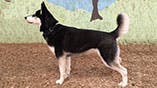 Noted for their great speed and ability to withstand extremes of cold, Siberian Huskies found great favour in 1925 in Alaska when there was a diptheria epidemic and they were used to transport medicine to people in remote areas.
They are a strong, compact, spitz-type breed with a thick double coat for very cold temperatures. They also have hair between the pads on their paws to help them in the snow. They come in a variety of colours but the markings, particularly on the head, are clearly specified. There is a long-coated variety but it is not recognised by most kennel clubs.
They were used by the Chukchi Tribe to pull sleds and herd reindeer in Eastern Siberia. They are highly intelligent with lots of energy so need plenty of outlets to exercise their body and brain. They can also be a little wilful and a bit of a handful but are naturally loving, loyal, enthusiastic and happy dogs. They are not watchdogs but enjoy howling. They are people and child friendly and particularly enjoy the company of other dogs although they may not be trustworthy around other animals. They are very active indoors but need a good deal of outdoor exercise too. They get bored very easily and can be destructive if not properly exercised. They often find warm weather difficult to cope with. Care needs to be taken when they are in a garden as they are excellent diggers. They prefer to live in packs.
Grooming only needs to be intensive twice a year when they shed heavily. They are prone to hip dysplasia, eye problems, PRA, and a skin problem known as zinc responsive dermatitis, which is treatable by giving zinc supplements.
Noted for their great speed and ability to withstand extremes of cold, Siberian Huskies found great favour in 1925 in Alaska when there was a diptheria epidemic and they were used to transport medicine to people in remote areas.
They are a strong, compact, spitz-type breed with a thick double coat for very cold temperatures. They also have hair between the pads on their paws to help them in the snow. They come in a variety of colours but the markings, particularly on the head, are clearly specified. There is a long-coated variety but it is not recognised by most kennel clubs.
They were used by the Chukchi Tribe to pull sleds and herd reindeer in Eastern Siberia. They are highly intelligent with lots of energy so need plenty of outlets to exercise their body and brain. They can also be a little wilful and a bit of a handful but are naturally loving, loyal, enthusiastic and happy dogs. They are not watchdogs but enjoy howling. They are people and child friendly and particularly enjoy the company of other dogs although they may not be trustworthy around other animals. They are very active indoors but need a good deal of outdoor exercise too. They get bored very easily and can be destructive if not properly exercised. They often find warm weather difficult to cope with. Care needs to be taken when they are in a garden as they are excellent diggers. They prefer to live in packs.
Grooming only needs to be intensive twice a year when they shed heavily. They are prone to hip dysplasia, eye problems, PRA, and a skin problem known as zinc responsive dermatitis, which is treatable by giving zinc supplements.
Noted for their great speed and ability to withstand extremes of cold, Siberian Huskies found great favour in 1925 in Alaska when there was a diptheria epidemic and they were used to transport medicine to people in remote areas.
They are a strong, compact, spitz-type breed with a thick double coat for very cold temperatures. They also have hair between the pads on their paws to help them in the snow. They come in a variety of colours but the markings, particularly on the head, are clearly specified. There is a long-coated variety but it is not recognised by most kennel clubs.
They were used by the Chukchi Tribe to pull sleds and herd reindeer in Eastern Siberia. They are highly intelligent with lots of energy so need plenty of outlets to exercise their body and brain. They can also be a little wilful and a bit of a handful but are naturally loving, loyal, enthusiastic and happy dogs. They are not watchdogs but enjoy howling. They are people and child friendly and particularly enjoy the company of other dogs although they may not be trustworthy around other animals. They are very active indoors but need a good deal of outdoor exercise too. They get bored very easily and can be destructive if not properly exercised. They often find warm weather difficult to cope with. Care needs to be taken when they are in a garden as they are excellent diggers. They prefer to live in packs.
Grooming only needs to be intensive twice a year when they shed heavily. They are prone to hip dysplasia, eye problems, PRA, and a skin problem known as zinc responsive dermatitis, which is treatable by giving zinc supplements.Skye TerrierThe most famous Skye Terrier was "Greyfriar's Bobby" who guarded the grave of his master, Constable John Grey, for 14 years. The local people came to feed him until he died at the age of 16. There is a statue of him in Edinburgh today.
These terriers are a long-bodied, low to the ground dog with a long, straight outer coat and soft undercoat. They are often black but can be other colours. The hair is long over their muzzle, face and ears which are normally erect but can be drop-style too.
They originate from the 1600s after Maltese dogs from a Spanish ship wrecked off the Isle of Skye mated with local terriers. They became popular with local farmers as vermin hunters.
Skye Terriers can be wilful but can also be good-natured and loving. They are courageous and playful and love attention, they also make a good watchdog. They can be wary of strangers and need to be well socialised around children and other dogs, caution may also need to be taken around non-canines. They are active indoors but enjoy a daily walk too.
Their coat is prone to matting so needs a good deal of brushing and combing. They are generally a healthy breed.
The most famous Skye Terrier was "Greyfriar's Bobby" who guarded the grave of his master, Constable John Grey, for 14 years. The local people came to feed him until he died at the age of 16. There is a statue of him in Edinburgh today.
These terriers are a long-bodied, low to the ground dog with a long, straight outer coat and soft undercoat. They are often black but can be other colours. The hair is long over their muzzle, face and ears which are normally erect but can be drop-style too.
They originate from the 1600s after Maltese dogs from a Spanish ship wrecked off the Isle of Skye mated with local terriers. They became popular with local farmers as vermin hunters.
Skye Terriers can be wilful but can also be good-natured and loving. They are courageous and playful and love attention, they also make a good watchdog. They can be wary of strangers and need to be well socialised around children and other dogs, caution may also need to be taken around non-canines. They are active indoors but enjoy a daily walk too.
Their coat is prone to matting so needs a good deal of brushing and combing. They are generally a healthy breed.SloughiAlthough very similar to Greyhounds in appearance, the main difference between Sloughis and Greyhounds is in the way they move. Sloughis do not hunch and extend as much as the Greyhound - their gait is smoother and seems effortless.
They are squarer in shape than the Greyhound but with the same short, smooth coat. The most common colour is sandy with dark heads but they can come in other colours too such as brindle, white or even black and tan.
They are an Arabian breed, originating from a region in the north Sahara and have been in existence since the 1300s. They were a treasured possession of chiefs and kings and used for hunting.
Sloughis are not the easiest dog to obedience train but they can be very affectionate, gentle, and loyal to their owners. Indoors, they are happiest lying around on soft furnishings. They can be wary of strangers although get along well with children and other animals if they are raised with them but care needs to be taken around small mammals. They will be relaxed indoors but need a lot of exercise outside. They also have an urge to chase but are equally keen to return to their owner.
They are easy to groom but need protection against cold and wet weather. They are a naturally clean dog with almost no doggy odour. They are generally very healthy although there have been reported cases of PRA, problems with their immune system, balance problems, haemophilia and sensitivity to anaesthetics.
Although very similar to Greyhounds in appearance, the main difference between Sloughis and Greyhounds is in the way they move. Sloughis do not hunch and extend as much as the Greyhound - their gait is smoother and seems effortless.
They are squarer in shape than the Greyhound but with the same short, smooth coat. The most common colour is sandy with dark heads but they can come in other colours too such as brindle, white or even black and tan.
They are an Arabian breed, originating from a region in the north Sahara and have been in existence since the 1300s. They were a treasured possession of chiefs and kings and used for hunting.
Sloughis are not the easiest dog to obedience train but they can be very affectionate, gentle, and loyal to their owners. Indoors, they are happiest lying around on soft furnishings. They can be wary of strangers although get along well with children and other animals if they are raised with them but care needs to be taken around small mammals. They will be relaxed indoors but need a lot of exercise outside. They also have an urge to chase but are equally keen to return to their owner.
They are easy to groom but need protection against cold and wet weather. They are a naturally clean dog with almost no doggy odour. They are generally very healthy although there have been reported cases of PRA, problems with their immune system, balance problems, haemophilia and sensitivity to anaesthetics.Slovakian Rough Haired Pointer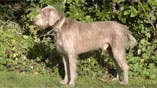 The Slovakian Rough Haired Pointer is a member of the Hunt, Point, Retrieve (HPR) type of gun dogs and is considered, in common with the other HPR breeds, a high maintenance dog to own. They are a recently introduced breed to the UK Kennel Club, the result of a deliberate breeding programme in Czechoslovakia to create a dog with great stamina which would track, point and retrieve in water or on land and be suitable for a range of prey.
They are a medium to large size generally with a harsh, wiry coat and moustache and look similar to the German Wirehaired Pointer. Their coat comes in shades of grey and their eyes are light brown to pale golden. There is however, a wide variation in coat, some are almost smooth whilst others are very hairy and there is no guarantee of the type of coat you may get.
They are stable and very trainable but can not tolerate harsh handling. They can be good natured around strangers, children and other animals with proper socialisation from a very early age but have a high prey drive. Because they were bred to have plenty of energy and stamina, they need a good deal of regular exercise and opportunities to exercise their brain too. Slovaks excel at a number of activities as well as gun dog work, for example, agility, working trials and Cani-X.
They are a loving and affectionate breed who enjoy being part of the family and are not suitable to be left alone for frequent periods of time in excess of four hours. Breed health is generally good but they can be accident prone so comprehensive pet insurance is essential.
The Slovakian Rough Haired Pointer is a member of the Hunt, Point, Retrieve (HPR) type of gun dogs and is considered, in common with the other HPR breeds, a high maintenance dog to own. They are a recently introduced breed to the UK Kennel Club, the result of a deliberate breeding programme in Czechoslovakia to create a dog with great stamina which would track, point and retrieve in water or on land and be suitable for a range of prey.
They are a medium to large size generally with a harsh, wiry coat and moustache and look similar to the German Wirehaired Pointer. Their coat comes in shades of grey and their eyes are light brown to pale golden. There is however, a wide variation in coat, some are almost smooth whilst others are very hairy and there is no guarantee of the type of coat you may get.
They are stable and very trainable but can not tolerate harsh handling. They can be good natured around strangers, children and other animals with proper socialisation from a very early age but have a high prey drive. Because they were bred to have plenty of energy and stamina, they need a good deal of regular exercise and opportunities to exercise their brain too. Slovaks excel at a number of activities as well as gun dog work, for example, agility, working trials and Cani-X.
They are a loving and affectionate breed who enjoy being part of the family and are not suitable to be left alone for frequent periods of time in excess of four hours. Breed health is generally good but they can be accident prone so comprehensive pet insurance is essential.
The Slovakian Rough Haired Pointer is a member of the Hunt, Point, Retrieve (HPR) type of gun dogs and is considered, in common with the other HPR breeds, a high maintenance dog to own. They are a recently introduced breed to the UK Kennel Club, the result of a deliberate breeding programme in Czechoslovakia to create a dog with great stamina which would track, point and retrieve in water or on land and be suitable for a range of prey.
They are a medium to large size generally with a harsh, wiry coat and moustache and look similar to the German Wirehaired Pointer. Their coat comes in shades of grey and their eyes are light brown to pale golden. There is however, a wide variation in coat, some are almost smooth whilst others are very hairy and there is no guarantee of the type of coat you may get.
They are stable and very trainable but can not tolerate harsh handling. They can be good natured around strangers, children and other animals with proper socialisation from a very early age but have a high prey drive. Because they were bred to have plenty of energy and stamina, they need a good deal of regular exercise and opportunities to exercise their brain too. Slovaks excel at a number of activities as well as gun dog work, for example, agility, working trials and Cani-X.
They are a loving and affectionate breed who enjoy being part of the family and are not suitable to be left alone for frequent periods of time in excess of four hours. Breed health is generally good but they can be accident prone so comprehensive pet insurance is essential.Small MunsterlanderThe Small Munsterlander was originally bred to flush out prey for falcons to help falconers. As the sport became less popular, the Small Munsterlander's numbers dwindled too.
They are a medium-sized, rather elegant, hunt-point-retrieve type dog, with a strong, balanced appearance. Their coat is medium-length and shiny with large patches of brown on a white or flecked background as opposed to the black and white of the Large Munsterlander.
The breed is much older than many might realise, thought to be over 500 yrs old. They come from Munster in Germany. Although at one time few in number, the breed was rescued at the end of the 19th Century by Edmund Lons.
They are lively, affectionate, very intelligent and highly trainable but they need to be given plenty of opportunity to exercise their body and brain. They are people and child friendly and normally happy around other dogs. They will normally be fine around animals they grow up with but have a strong prey drive so will be less accepting of small mammals in the wild. They need plenty of exercise and enjoy swimming.
Their coat requires regular but not excessive brushing and combing. Since the breed was reestablished, breeders have gone out of their way to ensure the breed remains healthy so instances of genetic disease are very low.
The Small Munsterlander was originally bred to flush out prey for falcons to help falconers. As the sport became less popular, the Small Munsterlander's numbers dwindled too.
They are a medium-sized, rather elegant, hunt-point-retrieve type dog, with a strong, balanced appearance. Their coat is medium-length and shiny with large patches of brown on a white or flecked background as opposed to the black and white of the Large Munsterlander.
The breed is much older than many might realise, thought to be over 500 yrs old. They come from Munster in Germany. Although at one time few in number, the breed was rescued at the end of the 19th Century by Edmund Lons.
They are lively, affectionate, very intelligent and highly trainable but they need to be given plenty of opportunity to exercise their body and brain. They are people and child friendly and normally happy around other dogs. They will normally be fine around animals they grow up with but have a strong prey drive so will be less accepting of small mammals in the wild. They need plenty of exercise and enjoy swimming.
Their coat requires regular but not excessive brushing and combing. Since the breed was reestablished, breeders have gone out of their way to ensure the breed remains healthy so instances of genetic disease are very low.Soft-Coated Wheaten Terrier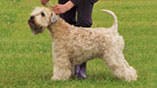 There is a playful, puppy-like quality to the Soft-Coated Wheaten Terrier that remains with them throughout their lives.
They are a medium-sized, generally square looking dog with a rectangular head. The coat is soft, quite long, wavy and obviously wheaten but comes in two coat types: American and Irish. The Irish is finer.
They are one of the oldest of the Irish terriers and worked as a general farm dog herding sheep and hunting vermin. They are very intelligent, if a little stubborn, and if trained well, will be sweet natured and calm while retaining a happy and spirited side. They are people and child friendly and will get along well with dogs if well socialised with them. They have a terrier prey-drive instinct and may be inclined to chase cats and especially small mammals. They are strong and agile and enjoy a daily walk but do not need excessive exercise and don't tolerate heat well.
Their coat should look wavy rather than fluffy so needs to be combed rather than brushed. They are prone to a protein wasting disease and flea allergies.
There is a playful, puppy-like quality to the Soft-Coated Wheaten Terrier that remains with them throughout their lives.
They are a medium-sized, generally square looking dog with a rectangular head. The coat is soft, quite long, wavy and obviously wheaten but comes in two coat types: American and Irish. The Irish is finer.
They are one of the oldest of the Irish terriers and worked as a general farm dog herding sheep and hunting vermin. They are very intelligent, if a little stubborn, and if trained well, will be sweet natured and calm while retaining a happy and spirited side. They are people and child friendly and will get along well with dogs if well socialised with them. They have a terrier prey-drive instinct and may be inclined to chase cats and especially small mammals. They are strong and agile and enjoy a daily walk but do not need excessive exercise and don't tolerate heat well.
Their coat should look wavy rather than fluffy so needs to be combed rather than brushed. They are prone to a protein wasting disease and flea allergies.
There is a playful, puppy-like quality to the Soft-Coated Wheaten Terrier that remains with them throughout their lives.
They are a medium-sized, generally square looking dog with a rectangular head. The coat is soft, quite long, wavy and obviously wheaten but comes in two coat types: American and Irish. The Irish is finer.
They are one of the oldest of the Irish terriers and worked as a general farm dog herding sheep and hunting vermin. They are very intelligent, if a little stubborn, and if trained well, will be sweet natured and calm while retaining a happy and spirited side. They are people and child friendly and will get along well with dogs if well socialised with them. They have a terrier prey-drive instinct and may be inclined to chase cats and especially small mammals. They are strong and agile and enjoy a daily walk but do not need excessive exercise and don't tolerate heat well.
Their coat should look wavy rather than fluffy so needs to be combed rather than brushed. They are prone to a protein wasting disease and flea allergies.Spaniel (American Cocker)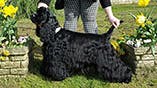 The American Cocker Spaniel was bred as a gundog for flushing and retrieving game birds. The name "Cocker" comes from the bird named the "woodcock".
They originate from the English Cocker Spaniel but were bred to be slightly smaller with rounder heads, eyes that face more to the front and shorter muzzles. Their body is shorter too and slopes slightly from front to back. Both the American and English Cocker Spaniels have a silky coat but whereas the English coat is of a similar length all over, the American coat is short on the head, longer on the body and very long on the legs and tummy. Both varieties can come in a wide range of colours. The American Kennel Club refers to American Cocker Spaniels as simply "Cocker Spaniels".
They are a happy little dog as evidenced by their ever wagging tail. They enjoy working but are equally happy as a household pet as they are essentially sweet-natured and outgoing. They are normally sociable and friendly towards other animals, strangers and children. They have a fair amount of stamina and energy so need regular exercise. They shed but still need trimming as well as regular brushing. They also have a tendency to have weepy eyes so these may need wiping too.
They are prone to quite a wide range of health problems, in particular: cataracts, glaucoma and patellar luxation. There have also been reported cases of IMHA (Immune Mediated Hemolytic Anemia) which strikes out of the blue and can prove fatal within a couple of days.
The American Cocker Spaniel was bred as a gundog for flushing and retrieving game birds. The name "Cocker" comes from the bird named the "woodcock".
They originate from the English Cocker Spaniel but were bred to be slightly smaller with rounder heads, eyes that face more to the front and shorter muzzles. Their body is shorter too and slopes slightly from front to back. Both the American and English Cocker Spaniels have a silky coat but whereas the English coat is of a similar length all over, the American coat is short on the head, longer on the body and very long on the legs and tummy. Both varieties can come in a wide range of colours. The American Kennel Club refers to American Cocker Spaniels as simply "Cocker Spaniels".
They are a happy little dog as evidenced by their ever wagging tail. They enjoy working but are equally happy as a household pet as they are essentially sweet-natured and outgoing. They are normally sociable and friendly towards other animals, strangers and children. They have a fair amount of stamina and energy so need regular exercise. They shed but still need trimming as well as regular brushing. They also have a tendency to have weepy eyes so these may need wiping too.
They are prone to quite a wide range of health problems, in particular: cataracts, glaucoma and patellar luxation. There have also been reported cases of IMHA (Immune Mediated Hemolytic Anemia) which strikes out of the blue and can prove fatal within a couple of days.
The American Cocker Spaniel was bred as a gundog for flushing and retrieving game birds. The name "Cocker" comes from the bird named the "woodcock".
They originate from the English Cocker Spaniel but were bred to be slightly smaller with rounder heads, eyes that face more to the front and shorter muzzles. Their body is shorter too and slopes slightly from front to back. Both the American and English Cocker Spaniels have a silky coat but whereas the English coat is of a similar length all over, the American coat is short on the head, longer on the body and very long on the legs and tummy. Both varieties can come in a wide range of colours. The American Kennel Club refers to American Cocker Spaniels as simply "Cocker Spaniels".
They are a happy little dog as evidenced by their ever wagging tail. They enjoy working but are equally happy as a household pet as they are essentially sweet-natured and outgoing. They are normally sociable and friendly towards other animals, strangers and children. They have a fair amount of stamina and energy so need regular exercise. They shed but still need trimming as well as regular brushing. They also have a tendency to have weepy eyes so these may need wiping too.
They are prone to quite a wide range of health problems, in particular: cataracts, glaucoma and patellar luxation. There have also been reported cases of IMHA (Immune Mediated Hemolytic Anemia) which strikes out of the blue and can prove fatal within a couple of days.Spaniel (American Water)The American Water Spaniel, not surprisingly, is an excellent swimmer, capable of swimming in even choppy water. They use their well-feathered tail as a rudder.
They are a fairly small, muscular and hardy dog with quite a long, broad head, square muzzle and long hanging ears with thick curls. Their shiny double coat is wavy or curly and comes in mainly solid colours of liver, brown and chocolate but they can have a little white on their chest and toes.
They were bred in the Great Lakes area of America, round about the 18th century as a hunt, point and retrieve dog for water birds, actually working off small boats and retrieving from the water.
They are very enthusiastic and intelligent which makes them very trainable. They make a loving, loyal and happy companion. They are normally sociable and friendly towards other animals, strangers and children. They need a lot of exercise and, ideally, opportunities to swim.
They need regular brushing but should not be bathed too often as it robs their coat of it's natural oils which they need to protect them in water. The oils also give the coat a distinctive smell. They can be prone to skin problems and are inclined to snore and drool.
The American Water Spaniel, not surprisingly, is an excellent swimmer, capable of swimming in even choppy water. They use their well-feathered tail as a rudder.
They are a fairly small, muscular and hardy dog with quite a long, broad head, square muzzle and long hanging ears with thick curls. Their shiny double coat is wavy or curly and comes in mainly solid colours of liver, brown and chocolate but they can have a little white on their chest and toes.
They were bred in the Great Lakes area of America, round about the 18th century as a hunt, point and retrieve dog for water birds, actually working off small boats and retrieving from the water.
They are very enthusiastic and intelligent which makes them very trainable. They make a loving, loyal and happy companion. They are normally sociable and friendly towards other animals, strangers and children. They need a lot of exercise and, ideally, opportunities to swim.
They need regular brushing but should not be bathed too often as it robs their coat of it's natural oils which they need to protect them in water. The oils also give the coat a distinctive smell. They can be prone to skin problems and are inclined to snore and drool.Spaniel (Clumber)Clumber Spaniels are the heaviest of the Spaniels. The name comes from home of the Duke of Newcastle, Clumber Park where the breed was perfected.
They are a medium-sized, heavy, thick-set dog, low to the ground and with a large head and deep muzzle. In fact, over the years, the breed standard has allowed them to become heavier. Their coat is soft, flat and short and mainly white with markings in orange or lemon.
The breed was set in the 18th Century in England but may have come originally from France. They are a scenting gun dog, quite slow but quiet and with good stamina. They were used to hunt birds like pheasant.
They are intelligent and trainable and possibly the most placid and steady of the Spaniels. They are affectionate, easy-going and polite and make a good family dog. They are normally sociable and friendly towards other animals, strangers and children. They need regular exercise of a decent duration. They also love to chew so need to be given something suitable to meet that need.
They need regular brushing and occasional trimming but still shed quite heavily. They can be prone to entropion, cataracts, juvenile lameness, hip dysplasia, ear infections, dry eyes and skin and flea allergies. They tend to snore, wheeze and drool and have a tendency to put on weight easily.
The breed is also prone to Exercise-induced collapse (EIC) which is a genetic syndrome where dogs show signs of muscle weakness, loss of coordination, severe marked increase in body temperature and life-threatening collapse when participating in strenuous exercise or activity. Affected dogs can cope with mild to moderate exercise, but just 5 to 20 minutes of strenuous activity, or even extreme excitement can induce weakness or collapse. New owners should also bear in mind the Inbreeding Coefficient (COI) as the breed is small in numbers so many breeders are working on introducing new bloodlines to keep the genetic pool as varied as possible.
Clumber Spaniels are the heaviest of the Spaniels. The name comes from home of the Duke of Newcastle, Clumber Park where the breed was perfected.
They are a medium-sized, heavy, thick-set dog, low to the ground and with a large head and deep muzzle. In fact, over the years, the breed standard has allowed them to become heavier. Their coat is soft, flat and short and mainly white with markings in orange or lemon.
The breed was set in the 18th Century in England but may have come originally from France. They are a scenting gun dog, quite slow but quiet and with good stamina. They were used to hunt birds like pheasant.
They are intelligent and trainable and possibly the most placid and steady of the Spaniels. They are affectionate, easy-going and polite and make a good family dog. They are normally sociable and friendly towards other animals, strangers and children. They need regular exercise of a decent duration. They also love to chew so need to be given something suitable to meet that need.
They need regular brushing and occasional trimming but still shed quite heavily. They can be prone to entropion, cataracts, juvenile lameness, hip dysplasia, ear infections, dry eyes and skin and flea allergies. They tend to snore, wheeze and drool and have a tendency to put on weight easily.
The breed is also prone to Exercise-induced collapse (EIC) which is a genetic syndrome where dogs show signs of muscle weakness, loss of coordination, severe marked increase in body temperature and life-threatening collapse when participating in strenuous exercise or activity. Affected dogs can cope with mild to moderate exercise, but just 5 to 20 minutes of strenuous activity, or even extreme excitement can induce weakness or collapse. New owners should also bear in mind the Inbreeding Coefficient (COI) as the breed is small in numbers so many breeders are working on introducing new bloodlines to keep the genetic pool as varied as possible.
Spaniel (Cocker)The English Cocker Spaniel is one of the oldest and most popular breeds of Spaniel and from whom many of the other Spaniel-types developed.
They are a medium-sized, compact dog with a muzzle the same length as the head, hanging ears and a silky coat that comes in a variety of colours. There are two types: show and field. Show types have longer coats and are sturdier and heavier.
They were bred in England as an all-terrain gun dog for game birds. The name "Cocker" comes from the woodcock, a bird the dogs were known for flushing. They are an intelligent, sociable, happy and affectionate dog that is adaptable and easy to train. They make a good family pet but also do well at competitions like agility and obedience. They are naturally friendly and sociable with other animals and strangers and excellent with children. Both types are active and enjoy regular daily exercise although the field types will need more.
They need regular brushing and combing and occasional bathing. Their long ears can pick up ticks and other foreign bodies easily so need regular checking for signs of infection.
The English Cocker Spaniel is one of the oldest and most popular breeds of Spaniel and from whom many of the other Spaniel-types developed.
They are a medium-sized, compact dog with a muzzle the same length as the head, hanging ears and a silky coat that comes in a variety of colours. There are two types: show and field. Show types have longer coats and are sturdier and heavier.
They were bred in England as an all-terrain gun dog for game birds. The name "Cocker" comes from the woodcock, a bird the dogs were known for flushing. They are an intelligent, sociable, happy and affectionate dog that is adaptable and easy to train. They make a good family pet but also do well at competitions like agility and obedience. They are naturally friendly and sociable with other animals and strangers and excellent with children. Both types are active and enjoy regular daily exercise although the field types will need more.
They need regular brushing and combing and occasional bathing. Their long ears can pick up ticks and other foreign bodies easily so need regular checking for signs of infection.Spaniel (English Springer)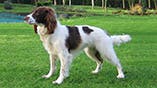 The English Springer Spaniel and English Cocker Spaniel came from the same litters hundreds of years ago. The smaller dogs were used for hunting woodcock and the larger for flushing out birds to make them "spring" up, hence the name.
English Springer Spaniels now are a medium-sized, compact dog with a muzzle the same length as the head, hanging ears and a thick, silky coat that usually comes in white with black or liver markings. They are larger and leggier than the Cocker Spaniel.
They were originally bred to hunt and retrieve game birds, both on land and in water. They are out-going, affectionate and sociable, very intelligent and eager to please. They are highly trainable and do well in competitions like agility and obedience. They are naturally friendly and sociable with other animals and strangers and excellent with children.
They have a lot of energy and need a good deal of exercise which can include retrieving and swimming. Their high energy levels make them unsuitable for anyone who can't take them for a good walk every day.
They need regular brushing and combing and occasional bathing. They can be prone to hip dysplasia, eye problems, blood problems and epilepsy.
The English Springer Spaniel and English Cocker Spaniel came from the same litters hundreds of years ago. The smaller dogs were used for hunting woodcock and the larger for flushing out birds to make them "spring" up, hence the name.
English Springer Spaniels now are a medium-sized, compact dog with a muzzle the same length as the head, hanging ears and a thick, silky coat that usually comes in white with black or liver markings. They are larger and leggier than the Cocker Spaniel.
They were originally bred to hunt and retrieve game birds, both on land and in water. They are out-going, affectionate and sociable, very intelligent and eager to please. They are highly trainable and do well in competitions like agility and obedience. They are naturally friendly and sociable with other animals and strangers and excellent with children.
They have a lot of energy and need a good deal of exercise which can include retrieving and swimming. Their high energy levels make them unsuitable for anyone who can't take them for a good walk every day.
They need regular brushing and combing and occasional bathing. They can be prone to hip dysplasia, eye problems, blood problems and epilepsy.
The English Springer Spaniel and English Cocker Spaniel came from the same litters hundreds of years ago. The smaller dogs were used for hunting woodcock and the larger for flushing out birds to make them "spring" up, hence the name.
English Springer Spaniels now are a medium-sized, compact dog with a muzzle the same length as the head, hanging ears and a thick, silky coat that usually comes in white with black or liver markings. They are larger and leggier than the Cocker Spaniel.
They were originally bred to hunt and retrieve game birds, both on land and in water. They are out-going, affectionate and sociable, very intelligent and eager to please. They are highly trainable and do well in competitions like agility and obedience. They are naturally friendly and sociable with other animals and strangers and excellent with children.
They have a lot of energy and need a good deal of exercise which can include retrieving and swimming. Their high energy levels make them unsuitable for anyone who can't take them for a good walk every day.
They need regular brushing and combing and occasional bathing. They can be prone to hip dysplasia, eye problems, blood problems and epilepsy.Spaniel (Field)Although quite similar to the Cocker Spaniel, the Field Spaniel as a breed has nearly disappeared on more than one occasion and remains very rare today.
They are a medium-sized, compact dog with a back slightly longer than their height and a distinctive long, lean muzzle. Their ears hang low and their coat is very silky. They usually come in black, liver or roan with tan markings.
They originate from England, a result of crossing different the old Sussex Springer Spaniel and Cocker Spaniel, and were bred to hunt small game and birds from water and land.
They are intelligent, steady, affectionate and playful. They can make a good family dog as long as given plenty of exercise but are happiest out on the hunt in the country. They are good with other dogs, animals and children although can be wary of strangers. They are essentially a working dog and need plenty of daily exercise. They like to roam, have a strong hunting instinct and prefer cooler climates.
They need regular brushing and combing, occasional scissoring and their ears checking. They are prone to hip dysplasia and ear infections.
Although quite similar to the Cocker Spaniel, the Field Spaniel as a breed has nearly disappeared on more than one occasion and remains very rare today.
They are a medium-sized, compact dog with a back slightly longer than their height and a distinctive long, lean muzzle. Their ears hang low and their coat is very silky. They usually come in black, liver or roan with tan markings.
They originate from England, a result of crossing different the old Sussex Springer Spaniel and Cocker Spaniel, and were bred to hunt small game and birds from water and land.
They are intelligent, steady, affectionate and playful. They can make a good family dog as long as given plenty of exercise but are happiest out on the hunt in the country. They are good with other dogs, animals and children although can be wary of strangers. They are essentially a working dog and need plenty of daily exercise. They like to roam, have a strong hunting instinct and prefer cooler climates.
They need regular brushing and combing, occasional scissoring and their ears checking. They are prone to hip dysplasia and ear infections.Spaniel (Irish Water)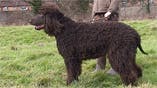 Irish Water Spaniels are the tallest of the Spaniels and have a curly rather than silky coat which is liver with a purple hue, unlike the colour of any other breed.
They are quite a large dog with a long, square muzzle and large, dangling ears. Their curly coat has a thick undercoat to protect them against cold water and their feet are webbed.
They were bred in Ireland by a Justin McCarthy for use as a land/water hunting dog and are likely to have Poodle in the mix.
Irish Water Spaniels are very intelligent and loyal, confident, affectionate and eager to please and will be a happy family pet if given enough opportunity to exercise their body and brain. They generally get on well with other animals and children but may be a little wary of strangers. The breed generally has great energy and stamina and needs a good deal of exercise, preferably in the countryside with opportunities to swim.
Their coat needs to be combed and trimmed regularly and has a tendency to matt. They are prone to hip dysplasia, hypothyroidism, eye entropion and ear infections. They may drool and slobber too.
Irish Water Spaniels are the tallest of the Spaniels and have a curly rather than silky coat which is liver with a purple hue, unlike the colour of any other breed.
They are quite a large dog with a long, square muzzle and large, dangling ears. Their curly coat has a thick undercoat to protect them against cold water and their feet are webbed.
They were bred in Ireland by a Justin McCarthy for use as a land/water hunting dog and are likely to have Poodle in the mix.
Irish Water Spaniels are very intelligent and loyal, confident, affectionate and eager to please and will be a happy family pet if given enough opportunity to exercise their body and brain. They generally get on well with other animals and children but may be a little wary of strangers. The breed generally has great energy and stamina and needs a good deal of exercise, preferably in the countryside with opportunities to swim.
Their coat needs to be combed and trimmed regularly and has a tendency to matt. They are prone to hip dysplasia, hypothyroidism, eye entropion and ear infections. They may drool and slobber too.
Irish Water Spaniels are the tallest of the Spaniels and have a curly rather than silky coat which is liver with a purple hue, unlike the colour of any other breed.
They are quite a large dog with a long, square muzzle and large, dangling ears. Their curly coat has a thick undercoat to protect them against cold water and their feet are webbed.
They were bred in Ireland by a Justin McCarthy for use as a land/water hunting dog and are likely to have Poodle in the mix.
Irish Water Spaniels are very intelligent and loyal, confident, affectionate and eager to please and will be a happy family pet if given enough opportunity to exercise their body and brain. They generally get on well with other animals and children but may be a little wary of strangers. The breed generally has great energy and stamina and needs a good deal of exercise, preferably in the countryside with opportunities to swim.
Their coat needs to be combed and trimmed regularly and has a tendency to matt. They are prone to hip dysplasia, hypothyroidism, eye entropion and ear infections. They may drool and slobber too.Spaniel (Sussex)The Sussex Spaniel is very rare and probably the result of crossing Spaniels with Hounds which is likely to be the reason they're the only Spaniel to 'bay'.
They are a heavily-built dog with a long, low body and quite a wide head and they move with a characteristic rolling gait. They have the typical Spaniel long hanging ears and silky, though flat, coat, which comes in a rich golden-liver colour.
They are slow but have good stamina and scenting ability and were bred in England in the 1800s to accompany hunters on foot, flushing and retrieving game.
They are not as out-going and playful as other Spaniels but are affectionate, gentle and loyal. With enough exercise they are stable and calm inside the home but they do have a tendency to bark. They are naturally friendly and sociable with other animals and strangers and excellent with children. They need more exercise than it might seem, especially as they have a tendency to gain weight.
They need regular brushing and combing and their ears need checking. Their main health issue is that they are prone to ear infections. There have also been some reported cases of intervertebral disc syndrome, otitis exerna, heart murmur and enlarged heart.
The Sussex Spaniel is very rare and probably the result of crossing Spaniels with Hounds which is likely to be the reason they're the only Spaniel to 'bay'.
They are a heavily-built dog with a long, low body and quite a wide head and they move with a characteristic rolling gait. They have the typical Spaniel long hanging ears and silky, though flat, coat, which comes in a rich golden-liver colour.
They are slow but have good stamina and scenting ability and were bred in England in the 1800s to accompany hunters on foot, flushing and retrieving game.
They are not as out-going and playful as other Spaniels but are affectionate, gentle and loyal. With enough exercise they are stable and calm inside the home but they do have a tendency to bark. They are naturally friendly and sociable with other animals and strangers and excellent with children. They need more exercise than it might seem, especially as they have a tendency to gain weight.
They need regular brushing and combing and their ears need checking. Their main health issue is that they are prone to ear infections. There have also been some reported cases of intervertebral disc syndrome, otitis exerna, heart murmur and enlarged heart.Spaniel (Welsh Springer)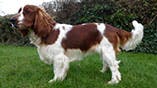 The Welsh Springer Spaniel is smaller, lighter, less racy and has a finer head than his English "cousin" the English Springer Spaniel.
They are a medium-sized, compact dog with a domed head and a muzzle the same length as the skull. The ears hang low and their coat is silky and flat or wavy. They come in red and white in any pattern.
They were developed as a more land based hunting dog. Their name comes from the action of "springing" at game.
They are loyal, loving, eager to please and enjoy human companionship. They are normally good with other animals and children but can be a little timid around strangers. Although not quite as energetic as the English Springer Spaniel, they still have a lot of energy and stamina and need a good deal of exercise.
They need regular brushing and combing and their ears need checking but they tend to stay cleaner in wet weather than their English counterpart. They are prone to ear infections, hip dysplasia, epilepsy and entropion.
The Welsh Springer Spaniel is smaller, lighter, less racy and has a finer head than his English "cousin" the English Springer Spaniel.
They are a medium-sized, compact dog with a domed head and a muzzle the same length as the skull. The ears hang low and their coat is silky and flat or wavy. They come in red and white in any pattern.
They were developed as a more land based hunting dog. Their name comes from the action of "springing" at game.
They are loyal, loving, eager to please and enjoy human companionship. They are normally good with other animals and children but can be a little timid around strangers. Although not quite as energetic as the English Springer Spaniel, they still have a lot of energy and stamina and need a good deal of exercise.
They need regular brushing and combing and their ears need checking but they tend to stay cleaner in wet weather than their English counterpart. They are prone to ear infections, hip dysplasia, epilepsy and entropion.
The Welsh Springer Spaniel is smaller, lighter, less racy and has a finer head than his English "cousin" the English Springer Spaniel.
They are a medium-sized, compact dog with a domed head and a muzzle the same length as the skull. The ears hang low and their coat is silky and flat or wavy. They come in red and white in any pattern.
They were developed as a more land based hunting dog. Their name comes from the action of "springing" at game.
They are loyal, loving, eager to please and enjoy human companionship. They are normally good with other animals and children but can be a little timid around strangers. Although not quite as energetic as the English Springer Spaniel, they still have a lot of energy and stamina and need a good deal of exercise.
They need regular brushing and combing and their ears need checking but they tend to stay cleaner in wet weather than their English counterpart. They are prone to ear infections, hip dysplasia, epilepsy and entropion.Spanish Water Dog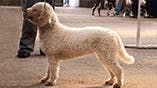 Although an ancient breed and still a working dog in remote parts of Spain, the Spanish Water Dog was not officially recognised until the 1980s due to the efforts of breeder Antonio Garcia Perez who remembered them from his youth.
They are a medium to smallish sized, balanced dog with a straight and powerful look and a strong head. Their coat is curly with a recommended show length of 3-15cms and begins to cord when long. They can come in a variety of solid and bi-colours.
Their original home is unknown, possibly Turkey or Africa, and they came to Spain a thousand years ago. They have been used for a variety of tasks including herding and guarding but also hunting.
They are very intelligent, trainable and versatile. Within the home, they can be loyal, attentive and affectionate but need plenty of opportunity to exercise their body and brain. They can be wary around strangers and need to be well socialised around other animals and children. They may a little too boisterous for small children. They have great stamina and energy and need a good deal of exercise.
Their coat should not be brushed or combed and they should only be bathed occasionally. The coat length chosen depends on whether they are a working dog, a pet, or a show dog but it is not trimmed but sheared completely. The shorter the coat required, the more regularly they should be sheared. They are prone to hip dysplasia, PRA and ear infections. In addition, some people are allergic to their saliva and urine.
Although an ancient breed and still a working dog in remote parts of Spain, the Spanish Water Dog was not officially recognised until the 1980s due to the efforts of breeder Antonio Garcia Perez who remembered them from his youth.
They are a medium to smallish sized, balanced dog with a straight and powerful look and a strong head. Their coat is curly with a recommended show length of 3-15cms and begins to cord when long. They can come in a variety of solid and bi-colours.
Their original home is unknown, possibly Turkey or Africa, and they came to Spain a thousand years ago. They have been used for a variety of tasks including herding and guarding but also hunting.
They are very intelligent, trainable and versatile. Within the home, they can be loyal, attentive and affectionate but need plenty of opportunity to exercise their body and brain. They can be wary around strangers and need to be well socialised around other animals and children. They may a little too boisterous for small children. They have great stamina and energy and need a good deal of exercise.
Their coat should not be brushed or combed and they should only be bathed occasionally. The coat length chosen depends on whether they are a working dog, a pet, or a show dog but it is not trimmed but sheared completely. The shorter the coat required, the more regularly they should be sheared. They are prone to hip dysplasia, PRA and ear infections. In addition, some people are allergic to their saliva and urine.
Although an ancient breed and still a working dog in remote parts of Spain, the Spanish Water Dog was not officially recognised until the 1980s due to the efforts of breeder Antonio Garcia Perez who remembered them from his youth.
They are a medium to smallish sized, balanced dog with a straight and powerful look and a strong head. Their coat is curly with a recommended show length of 3-15cms and begins to cord when long. They can come in a variety of solid and bi-colours.
Their original home is unknown, possibly Turkey or Africa, and they came to Spain a thousand years ago. They have been used for a variety of tasks including herding and guarding but also hunting.
They are very intelligent, trainable and versatile. Within the home, they can be loyal, attentive and affectionate but need plenty of opportunity to exercise their body and brain. They can be wary around strangers and need to be well socialised around other animals and children. They may a little too boisterous for small children. They have great stamina and energy and need a good deal of exercise.
Their coat should not be brushed or combed and they should only be bathed occasionally. The coat length chosen depends on whether they are a working dog, a pet, or a show dog but it is not trimmed but sheared completely. The shorter the coat required, the more regularly they should be sheared. They are prone to hip dysplasia, PRA and ear infections. In addition, some people are allergic to their saliva and urine.St. Bernard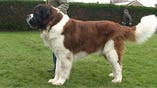 The Saint Bernard is famous as a search and rescue dog. They can detect a person under many feet of snow and have even been known to detect snow storms and avalanches. Early rescue dogs would go out in pairs so that one dog could lay next to the victim to keep them warm while the other went back for a rescue team.
They are giant, strong and muscular with a massive, powerful head. Their dense coat can be rough or smooth and comes in red with white or mahogany brindle with white. They usually have black shading on the face and ears.
They were bred by monks from the Saint Bernard Hospice to rescue travellers caught by avalanches in the Alps. Early Saint Bernards were a little smaller and had shorter hair because the long hair would fill with ice and weigh them down.
Saint Bernards are gentle, friendly and patient. They are slow moving, extremely loyal and intelligent and easy to train. They are affectionate to other animals, people and children but need to be trained to be impeccably behaved due to their great size. They have good stamina so need a long daily walk but don't tolerate hot conditions well.
They need to be brushed and combed fairly regularly and bathed only occasionally so that the coat is not stripped of its natural oils. Their eyes need to be checked, too, as they have a tendency to water. St Bernards are prone to "wobbler" syndrome, heart problems, skin problems, hip dysplasia, tumours, extropion and bloat. They also have a tendency to wheeze, snore and drool.
The Saint Bernard is famous as a search and rescue dog. They can detect a person under many feet of snow and have even been known to detect snow storms and avalanches. Early rescue dogs would go out in pairs so that one dog could lay next to the victim to keep them warm while the other went back for a rescue team.
They are giant, strong and muscular with a massive, powerful head. Their dense coat can be rough or smooth and comes in red with white or mahogany brindle with white. They usually have black shading on the face and ears.
They were bred by monks from the Saint Bernard Hospice to rescue travellers caught by avalanches in the Alps. Early Saint Bernards were a little smaller and had shorter hair because the long hair would fill with ice and weigh them down.
Saint Bernards are gentle, friendly and patient. They are slow moving, extremely loyal and intelligent and easy to train. They are affectionate to other animals, people and children but need to be trained to be impeccably behaved due to their great size. They have good stamina so need a long daily walk but don't tolerate hot conditions well.
They need to be brushed and combed fairly regularly and bathed only occasionally so that the coat is not stripped of its natural oils. Their eyes need to be checked, too, as they have a tendency to water. St Bernards are prone to "wobbler" syndrome, heart problems, skin problems, hip dysplasia, tumours, extropion and bloat. They also have a tendency to wheeze, snore and drool.
The Saint Bernard is famous as a search and rescue dog. They can detect a person under many feet of snow and have even been known to detect snow storms and avalanches. Early rescue dogs would go out in pairs so that one dog could lay next to the victim to keep them warm while the other went back for a rescue team.
They are giant, strong and muscular with a massive, powerful head. Their dense coat can be rough or smooth and comes in red with white or mahogany brindle with white. They usually have black shading on the face and ears.
They were bred by monks from the Saint Bernard Hospice to rescue travellers caught by avalanches in the Alps. Early Saint Bernards were a little smaller and had shorter hair because the long hair would fill with ice and weigh them down.
Saint Bernards are gentle, friendly and patient. They are slow moving, extremely loyal and intelligent and easy to train. They are affectionate to other animals, people and children but need to be trained to be impeccably behaved due to their great size. They have good stamina so need a long daily walk but don't tolerate hot conditions well.
They need to be brushed and combed fairly regularly and bathed only occasionally so that the coat is not stripped of its natural oils. Their eyes need to be checked, too, as they have a tendency to water. St Bernards are prone to "wobbler" syndrome, heart problems, skin problems, hip dysplasia, tumours, extropion and bloat. They also have a tendency to wheeze, snore and drool.Staffordshire Bull Terrier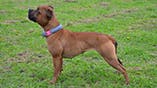 The Staffordshire Bull Terrier has come in for some bad press but a well trained Stafford can make a super companion.
They are a compact dog, very muscular and strong with a broad, deep skull. Their short, smooth coat comes in red, fawn, white, black or blue or any of these colours with white, or any shade of brindle or any shade of brindle with white. Black and tan or liver colours are highly undesirable.
They were bred in the nineteenth century in England for the then popular sport of bull baiting.
Staffords approach everything with undaunted enthusiasm. They are fearless, persistent, intelligent, love a challenge and are obedient, affectionate and love people. Some like to chew and will chew through practically everything so their chew toys need to be well chosen. Socialisation with other animals is important, but they are people-friendly and excellent with children. They have a lot of energy and stamina and enjoy their exercise.
The short coat is easy to care for. It is imperative that breeding stock should be DNA tested or hereditarily clear of HC (Hereditary Cataract) and L-2-HGA (L-2 Hydroxyglutaric Acidurea) and should be clinically tested and unaffected by PHPV (Persistent Hyperplastic Primary Vitreous). These diseases, although not common, are known in the breed and with use of the DNA tests there is no need for Staffords to suffer from the conditions in future. Some Staffords can have skin problems, including demodex mange and allergies.
The Staffordshire Bull Terrier has come in for some bad press but a well trained Stafford can make a super companion.
They are a compact dog, very muscular and strong with a broad, deep skull. Their short, smooth coat comes in red, fawn, white, black or blue or any of these colours with white, or any shade of brindle or any shade of brindle with white. Black and tan or liver colours are highly undesirable.
They were bred in the nineteenth century in England for the then popular sport of bull baiting.
Staffords approach everything with undaunted enthusiasm. They are fearless, persistent, intelligent, love a challenge and are obedient, affectionate and love people. Some like to chew and will chew through practically everything so their chew toys need to be well chosen. Socialisation with other animals is important, but they are people-friendly and excellent with children. They have a lot of energy and stamina and enjoy their exercise.
The short coat is easy to care for. It is imperative that breeding stock should be DNA tested or hereditarily clear of HC (Hereditary Cataract) and L-2-HGA (L-2 Hydroxyglutaric Acidurea) and should be clinically tested and unaffected by PHPV (Persistent Hyperplastic Primary Vitreous). These diseases, although not common, are known in the breed and with use of the DNA tests there is no need for Staffords to suffer from the conditions in future. Some Staffords can have skin problems, including demodex mange and allergies.
The Staffordshire Bull Terrier has come in for some bad press but a well trained Stafford can make a super companion.
They are a compact dog, very muscular and strong with a broad, deep skull. Their short, smooth coat comes in red, fawn, white, black or blue or any of these colours with white, or any shade of brindle or any shade of brindle with white. Black and tan or liver colours are highly undesirable.
They were bred in the nineteenth century in England for the then popular sport of bull baiting.
Staffords approach everything with undaunted enthusiasm. They are fearless, persistent, intelligent, love a challenge and are obedient, affectionate and love people. Some like to chew and will chew through practically everything so their chew toys need to be well chosen. Socialisation with other animals is important, but they are people-friendly and excellent with children. They have a lot of energy and stamina and enjoy their exercise.
The short coat is easy to care for. It is imperative that breeding stock should be DNA tested or hereditarily clear of HC (Hereditary Cataract) and L-2-HGA (L-2 Hydroxyglutaric Acidurea) and should be clinically tested and unaffected by PHPV (Persistent Hyperplastic Primary Vitreous). These diseases, although not common, are known in the breed and with use of the DNA tests there is no need for Staffords to suffer from the conditions in future. Some Staffords can have skin problems, including demodex mange and allergies.Swedish LapphundThe Swedish Lapphund is a resilient well-rounded dog that can turn their paw to anything, be it herding, guarding, hunting or family pet. They are very rare but are the national dog of Sweden.
They are a medium-sized spitz type breed with a typical spitz rectangular shape. Their weather-proof coat is thick with a soft dense undercoat and a harsher outer coat that stands out. They come in black, brown or a combination of the two with occasional small patches of white.
They have a long history which goes back to when they were a hunting and guarding dog for ancient Scandinavian tribes, to being used to herd reindeer in the mid 18th Century. They are a highly intelligent and trainable dog but one that is capable of independent thought too. They enjoy human company and are brave, loyal and friendly. They are normally good with other animals, people and children but have a tendency to bark. They need regular physical and mental exercise but they do not tolerate heat well.
Despite the thickness of their coat, they are relatively easy to brush and comb but they can shed heavily. They are prone to epilepsy and hip dysplasia.
The Swedish Lapphund is a resilient well-rounded dog that can turn their paw to anything, be it herding, guarding, hunting or family pet. They are very rare but are the national dog of Sweden.
They are a medium-sized spitz type breed with a typical spitz rectangular shape. Their weather-proof coat is thick with a soft dense undercoat and a harsher outer coat that stands out. They come in black, brown or a combination of the two with occasional small patches of white.
They have a long history which goes back to when they were a hunting and guarding dog for ancient Scandinavian tribes, to being used to herd reindeer in the mid 18th Century. They are a highly intelligent and trainable dog but one that is capable of independent thought too. They enjoy human company and are brave, loyal and friendly. They are normally good with other animals, people and children but have a tendency to bark. They need regular physical and mental exercise but they do not tolerate heat well.
Despite the thickness of their coat, they are relatively easy to brush and comb but they can shed heavily. They are prone to epilepsy and hip dysplasia.Swedish Vallhund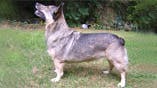 Swedish Vallhunds are busy little dogs who love human company and want to be involved with everything.
They are small and low to the ground but strong and sturdy. Their head is quite long with erect, alert ears. Their coat, can be either 'silver' or 'red', both are a combination of dark hairs and lighter hairs, the silver has a cream undercoat whereas the red's undercoat is more tan. Their double coat is thick with a dense undercoat, slightly harsh outer and a slight mane. They can have patches of white but this is not desired.
They may be distantly related to the Corgi and had a similar role as a cattle herding dog. "Vallhund" means "cattle dog" and as puppies, their natural tendency is to nip ankles but this can easily be trained out of them.
They have a cheerful, affectionate, steady temperament and are highly intelligent and trainable. They also love the sound of their own bark. They are people, children and animal friendly. Although active indoors, they enjoy a daily walk too and have good stamina.
Their coat is easy to maintain with regular brushing and combing and occasional bathing. There are no known health problems.
Swedish Vallhunds are busy little dogs who love human company and want to be involved with everything.
They are small and low to the ground but strong and sturdy. Their head is quite long with erect, alert ears. Their coat, can be either 'silver' or 'red', both are a combination of dark hairs and lighter hairs, the silver has a cream undercoat whereas the red's undercoat is more tan. Their double coat is thick with a dense undercoat, slightly harsh outer and a slight mane. They can have patches of white but this is not desired.
They may be distantly related to the Corgi and had a similar role as a cattle herding dog. "Vallhund" means "cattle dog" and as puppies, their natural tendency is to nip ankles but this can easily be trained out of them.
They have a cheerful, affectionate, steady temperament and are highly intelligent and trainable. They also love the sound of their own bark. They are people, children and animal friendly. Although active indoors, they enjoy a daily walk too and have good stamina.
Their coat is easy to maintain with regular brushing and combing and occasional bathing. There are no known health problems.
Swedish Vallhunds are busy little dogs who love human company and want to be involved with everything.
They are small and low to the ground but strong and sturdy. Their head is quite long with erect, alert ears. Their coat, can be either 'silver' or 'red', both are a combination of dark hairs and lighter hairs, the silver has a cream undercoat whereas the red's undercoat is more tan. Their double coat is thick with a dense undercoat, slightly harsh outer and a slight mane. They can have patches of white but this is not desired.
They may be distantly related to the Corgi and had a similar role as a cattle herding dog. "Vallhund" means "cattle dog" and as puppies, their natural tendency is to nip ankles but this can easily be trained out of them.
They have a cheerful, affectionate, steady temperament and are highly intelligent and trainable. They also love the sound of their own bark. They are people, children and animal friendly. Although active indoors, they enjoy a daily walk too and have good stamina.
Their coat is easy to maintain with regular brushing and combing and occasional bathing. There are no known health problems.Tibetan MastiffThis is the most ancient of all dogs, possibly going back as far as 1100BC.
They are a powerful, giant dog with a broad, strong head. Their great double coat is very thick with a mane around the neck and is usually black or black and tan. There are two types, although usually born in the same litter: the Tsang-khyi, which is taller and heavier boned with more wrinkles around the face, and the Do-khyi which is leaner with fewer wrinkles.
They were used as a guard dog either for property, which could be as much as a whole village, or for sheep. When guarding property, they were normally confined during the day and let loose at night.
Although an intelligent dog, their protective guarding instinct and wilful nature makes them more suitable for an experienced owner. They are often loving towards children and can be trained to get on well with other animals but are naturally very wary of strangers. They need a good daily walk as they are not very active indoors.
The thick coat needs regular brushing and combing, especially during times of moulting. They are prone to hip dysplasia, thyroid problems, skin conditions and ear infections. They can also suffer from a genetic problem called Canine Inherited Demyelinative Neuropathy (CIDN), which attacks puppies and is fatal.
This is the most ancient of all dogs, possibly going back as far as 1100BC.
They are a powerful, giant dog with a broad, strong head. Their great double coat is very thick with a mane around the neck and is usually black or black and tan. There are two types, although usually born in the same litter: the Tsang-khyi, which is taller and heavier boned with more wrinkles around the face, and the Do-khyi which is leaner with fewer wrinkles.
They were used as a guard dog either for property, which could be as much as a whole village, or for sheep. When guarding property, they were normally confined during the day and let loose at night.
Although an intelligent dog, their protective guarding instinct and wilful nature makes them more suitable for an experienced owner. They are often loving towards children and can be trained to get on well with other animals but are naturally very wary of strangers. They need a good daily walk as they are not very active indoors.
The thick coat needs regular brushing and combing, especially during times of moulting. They are prone to hip dysplasia, thyroid problems, skin conditions and ear infections. They can also suffer from a genetic problem called Canine Inherited Demyelinative Neuropathy (CIDN), which attacks puppies and is fatal.Tibetan SpanielTibetan Spaniels are often mistaken for Pekingese but as well having as a somewhat more relaxed outlook on life, the Spaniel does not have extra skin around the eyes, has a slightly longer face and their coat is less abundant.
They are a small, compact dog with a body slightly longer than it is tall and a domed head. They have a double, silky coat, which is medium length on the body, a mane and a feathery tail which is carried over their back. The coat can come in all colours.
They originated about two thousand years ago and were used by monks to turn a prayer wheel and as watchdogs. They are a playful and charming little dog: affectionate and curious, intelligent and trusting and although a good watchdog, they are not overly yappy. They normally get along fine with other animals and children but can be a little wary of strangers. They enjoy a daily opportunity for exercise.
Their coat needs regular brushing and combing and comes out in clumps when they moult, once a year. They are prone to breathing problems and heatstroke.
Tibetan Spaniels are often mistaken for Pekingese but as well having as a somewhat more relaxed outlook on life, the Spaniel does not have extra skin around the eyes, has a slightly longer face and their coat is less abundant.
They are a small, compact dog with a body slightly longer than it is tall and a domed head. They have a double, silky coat, which is medium length on the body, a mane and a feathery tail which is carried over their back. The coat can come in all colours.
They originated about two thousand years ago and were used by monks to turn a prayer wheel and as watchdogs. They are a playful and charming little dog: affectionate and curious, intelligent and trusting and although a good watchdog, they are not overly yappy. They normally get along fine with other animals and children but can be a little wary of strangers. They enjoy a daily opportunity for exercise.
Their coat needs regular brushing and combing and comes out in clumps when they moult, once a year. They are prone to breathing problems and heatstroke.Tibetan Terrier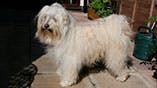 The Tibetan Terrier is not actually in the Terrier group but was given the Terrier name by the first Europeans who encountered it. There is, however, a streak of Terrier wilfulness about them.
They are a medium-sized, square looking dog with long hair on their face giving them the look of a beard, moustache and bushy eyebrows. The thick, double coat has a soft, woolly undercoat with a long, straight to wavy, top coat that comes in all colours.
They were kept by monks about two thousand years ago as good luck charms and were helpful as watchdogs and herders. The monks refused to sell them but occasionally gave them as gifts. They are a gentle and affectionate dog, intelligent and loyal. They normally get along fine with other animals but may not be suitable for small children and can be a little wary of strangers. They have a lot of stamina and energy and need plenty of exercise.
Their coat needs a good deal of brushing and combing and regular bathing. They can also be trimmed. They are prone to PRA and hip dysplasia and can also be sensitive to fleas.
The Tibetan Terrier is not actually in the Terrier group but was given the Terrier name by the first Europeans who encountered it. There is, however, a streak of Terrier wilfulness about them.
They are a medium-sized, square looking dog with long hair on their face giving them the look of a beard, moustache and bushy eyebrows. The thick, double coat has a soft, woolly undercoat with a long, straight to wavy, top coat that comes in all colours.
They were kept by monks about two thousand years ago as good luck charms and were helpful as watchdogs and herders. The monks refused to sell them but occasionally gave them as gifts. They are a gentle and affectionate dog, intelligent and loyal. They normally get along fine with other animals but may not be suitable for small children and can be a little wary of strangers. They have a lot of stamina and energy and need plenty of exercise.
Their coat needs a good deal of brushing and combing and regular bathing. They can also be trimmed. They are prone to PRA and hip dysplasia and can also be sensitive to fleas.
The Tibetan Terrier is not actually in the Terrier group but was given the Terrier name by the first Europeans who encountered it. There is, however, a streak of Terrier wilfulness about them.
They are a medium-sized, square looking dog with long hair on their face giving them the look of a beard, moustache and bushy eyebrows. The thick, double coat has a soft, woolly undercoat with a long, straight to wavy, top coat that comes in all colours.
They were kept by monks about two thousand years ago as good luck charms and were helpful as watchdogs and herders. The monks refused to sell them but occasionally gave them as gifts. They are a gentle and affectionate dog, intelligent and loyal. They normally get along fine with other animals but may not be suitable for small children and can be a little wary of strangers. They have a lot of stamina and energy and need plenty of exercise.
Their coat needs a good deal of brushing and combing and regular bathing. They can also be trimmed. They are prone to PRA and hip dysplasia and can also be sensitive to fleas.Turkish Kangal DogThe Kangal Dog is a favourite among Turks and has been declared the National Dog of Turkey. He is to be found not only guarding sheep and goats but on postage stamps and coins.
They are a large, powerful, heavy-boned dog with a broad head and a tail that curls up and over the back. Their short, thick, double coat is fawn to grey with a black muzzle and often black ears.
They are named after the Kangal district in Turkey from where they originate and have always been used as a flock guard. The Kangal Dog will bond closely with their family and be loyal and affectionate but their primary instinct is to guard. They will confront anything they perceive to be a threat but will only attack if necessary. They are a little more people-friendly than most flock guarding dogs and generally like children but they are naturally wary of strange dogs and strangers. They have great strength and speed and need a good deal of physical and mental exercise.
They do not need a lot of grooming but will shed heavily at certain times of the year. There are no known health problems.
The Kangal Dog is a favourite among Turks and has been declared the National Dog of Turkey. He is to be found not only guarding sheep and goats but on postage stamps and coins.
They are a large, powerful, heavy-boned dog with a broad head and a tail that curls up and over the back. Their short, thick, double coat is fawn to grey with a black muzzle and often black ears.
They are named after the Kangal district in Turkey from where they originate and have always been used as a flock guard. The Kangal Dog will bond closely with their family and be loyal and affectionate but their primary instinct is to guard. They will confront anything they perceive to be a threat but will only attack if necessary. They are a little more people-friendly than most flock guarding dogs and generally like children but they are naturally wary of strange dogs and strangers. They have great strength and speed and need a good deal of physical and mental exercise.
They do not need a lot of grooming but will shed heavily at certain times of the year. There are no known health problems.Weimaraner (Short and Long haired)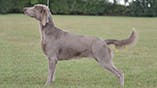 The Weimaraner is easy to recognise from his distinctive colouring. Their eyes range from amber to blue-grey and their coat is a unique grey too, occasionally with a small white patch on the chest.
They are quite a large, athletic dog. Their coat is normally short and smooth although there is a much rarer long-haired variety.
They come from Weimar in Germany where they were used as a hunting dog, originally for big game but later for hunt, point and retrieve of water birds.
With the right training they are loving and affectionate but they are a working dog that needs mental and physical challenge. They are good with children although can be boisterous, and ok with other dogs and strangers but may not be trusted around small mammals as they have a strong prey drive. They have a lot of stamina and energy and need plenty of exercise.
The typical short coat is easy to maintain. They are prone to bloat, hip dysplasia, hypertropic osteodystrophy (excessive rapid growth) and mast cell tumours.
The Weimaraner is easy to recognise from his distinctive colouring. Their eyes range from amber to blue-grey and their coat is a unique grey too, occasionally with a small white patch on the chest.
They are quite a large, athletic dog. Their coat is normally short and smooth although there is a much rarer long-haired variety.
They come from Weimar in Germany where they were used as a hunting dog, originally for big game but later for hunt, point and retrieve of water birds.
With the right training they are loving and affectionate but they are a working dog that needs mental and physical challenge. They are good with children although can be boisterous, and ok with other dogs and strangers but may not be trusted around small mammals as they have a strong prey drive. They have a lot of stamina and energy and need plenty of exercise.
The typical short coat is easy to maintain. They are prone to bloat, hip dysplasia, hypertropic osteodystrophy (excessive rapid growth) and mast cell tumours.
The Weimaraner is easy to recognise from his distinctive colouring. Their eyes range from amber to blue-grey and their coat is a unique grey too, occasionally with a small white patch on the chest.
They are quite a large, athletic dog. Their coat is normally short and smooth although there is a much rarer long-haired variety.
They come from Weimar in Germany where they were used as a hunting dog, originally for big game but later for hunt, point and retrieve of water birds.
With the right training they are loving and affectionate but they are a working dog that needs mental and physical challenge. They are good with children although can be boisterous, and ok with other dogs and strangers but may not be trusted around small mammals as they have a strong prey drive. They have a lot of stamina and energy and need plenty of exercise.
The typical short coat is easy to maintain. They are prone to bloat, hip dysplasia, hypertropic osteodystrophy (excessive rapid growth) and mast cell tumours.Welsh Corgi (Cardigan)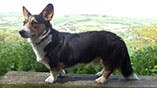 The most obvious difference between the Cardigan Welsh Corgi and the Pembroke Welsh Corgi is that the Cardigan has a long tail. Other differences are that their ears are a little larger and set wider, they have a slightly longer, heavier body, a less wedge-shaped head, round feet and less straight legs.
They are a fairly small dog with a well-proportioned head, body and tail but short legs giving them a stocky look. Their double coat, which can come in any colour with or without white markings, is thick and longer at the ruff, backs of legs and long tail.
The Cardigan Welsh Corgi is the older of the two types of Corgi. They go back as far as 1200 and were used as a cattle herding dog. They were also called a "Yard dog" because their length to the tip of their tail is the same as a Welsh yard.
They are highly intelligent, trainable, adaptable, loving and loyal. They need to be taught not to bark too much and puppies will have a natural tendency to bite ankles but this can be trained out of them. They need to be socialised well with other animals and children and may be a little wary of strangers. They are an active dog that needs a good daily walk.
The water-resistant coat is easy to maintain with regular brushing and combing and occasional bathing. They are prone to PRA and glaucoma. They are also prone to back disorders and have a tendency to put on weight easily so it is important to avoid overfeeding as the added weight makes the back problems worse.
The most obvious difference between the Cardigan Welsh Corgi and the Pembroke Welsh Corgi is that the Cardigan has a long tail. Other differences are that their ears are a little larger and set wider, they have a slightly longer, heavier body, a less wedge-shaped head, round feet and less straight legs.
They are a fairly small dog with a well-proportioned head, body and tail but short legs giving them a stocky look. Their double coat, which can come in any colour with or without white markings, is thick and longer at the ruff, backs of legs and long tail.
The Cardigan Welsh Corgi is the older of the two types of Corgi. They go back as far as 1200 and were used as a cattle herding dog. They were also called a "Yard dog" because their length to the tip of their tail is the same as a Welsh yard.
They are highly intelligent, trainable, adaptable, loving and loyal. They need to be taught not to bark too much and puppies will have a natural tendency to bite ankles but this can be trained out of them. They need to be socialised well with other animals and children and may be a little wary of strangers. They are an active dog that needs a good daily walk.
The water-resistant coat is easy to maintain with regular brushing and combing and occasional bathing. They are prone to PRA and glaucoma. They are also prone to back disorders and have a tendency to put on weight easily so it is important to avoid overfeeding as the added weight makes the back problems worse.
The most obvious difference between the Cardigan Welsh Corgi and the Pembroke Welsh Corgi is that the Cardigan has a long tail. Other differences are that their ears are a little larger and set wider, they have a slightly longer, heavier body, a less wedge-shaped head, round feet and less straight legs.
They are a fairly small dog with a well-proportioned head, body and tail but short legs giving them a stocky look. Their double coat, which can come in any colour with or without white markings, is thick and longer at the ruff, backs of legs and long tail.
The Cardigan Welsh Corgi is the older of the two types of Corgi. They go back as far as 1200 and were used as a cattle herding dog. They were also called a "Yard dog" because their length to the tip of their tail is the same as a Welsh yard.
They are highly intelligent, trainable, adaptable, loving and loyal. They need to be taught not to bark too much and puppies will have a natural tendency to bite ankles but this can be trained out of them. They need to be socialised well with other animals and children and may be a little wary of strangers. They are an active dog that needs a good daily walk.
The water-resistant coat is easy to maintain with regular brushing and combing and occasional bathing. They are prone to PRA and glaucoma. They are also prone to back disorders and have a tendency to put on weight easily so it is important to avoid overfeeding as the added weight makes the back problems worse.Welsh Corgi (Pembroke)The most obvious difference between the Pembroke Welsh Corgi and the Cardigan Welsh Corgi is that the Pembroke has very little and sometimes no tail. Other differences are that their ears are a little smaller and set closer together, they have a slightly shorter, lighter body, a more wedge-shaped head, oval feet and straighter legs.
They are a fairly small with a well-proportioned head and body but short legs giving them a stocky look. Their double coat, in shades of red (with or without black) with white patches, is thick and longer at the ruff and backs of legs.
They were bred out of the Cardigan Welsh Corgi for herding cows. The low body and lack of tail meant that they could keep out of harm from the cows' legs.
They are a busy dog, interested in everything and highly intelligent, trainable, adaptable, loving and loyal. They need to be taught not to bark too much and puppies will have a natural tendency to bite ankles but this can be trained out of them. They need to be socialised well with other animals and may be a little wary of strangers but they are usually good with children. They are an active dog that needs a good daily walk.
The water-resistant coat is easy to maintain with regular brushing and combing and occasional bathing. They are prone to PRA and glaucoma. They are also prone to back disorders and have a tendency to put on weight easily so it is important to avoid overfeeding as the added weight makes the back problems worse.
The most obvious difference between the Pembroke Welsh Corgi and the Cardigan Welsh Corgi is that the Pembroke has very little and sometimes no tail. Other differences are that their ears are a little smaller and set closer together, they have a slightly shorter, lighter body, a more wedge-shaped head, oval feet and straighter legs.
They are a fairly small with a well-proportioned head and body but short legs giving them a stocky look. Their double coat, in shades of red (with or without black) with white patches, is thick and longer at the ruff and backs of legs.
They were bred out of the Cardigan Welsh Corgi for herding cows. The low body and lack of tail meant that they could keep out of harm from the cows' legs.
They are a busy dog, interested in everything and highly intelligent, trainable, adaptable, loving and loyal. They need to be taught not to bark too much and puppies will have a natural tendency to bite ankles but this can be trained out of them. They need to be socialised well with other animals and may be a little wary of strangers but they are usually good with children. They are an active dog that needs a good daily walk.
The water-resistant coat is easy to maintain with regular brushing and combing and occasional bathing. They are prone to PRA and glaucoma. They are also prone to back disorders and have a tendency to put on weight easily so it is important to avoid overfeeding as the added weight makes the back problems worse.Welsh TerrierThroughout its history, the Welsh Terrier has been known by a number of names: the Black-and-Tan Wire Haired Terrier, the Old English Terrier and, at one point, the Old Reddish-Black Wirehaired Terrier, before the simple "Welsh Terrier" was settled on.
They look like a small version of an Airedale Terrier. They have a generally square appearance. Their head is rectangular with front-folding ears, bushy eyebrows, beard and moustache. Their double coat has a soft inner layer and a harsh outer layer and is normally black and tan or grizzle with a black jacket marking over the back.
They were bred for going out with packs of hounds and driving prey such as badger, fox and otter out of dens.
The Welsh Terrier is an intelligent, affectionate and playful dog. Like all Terriers, they have a stubborn streak but they are loving and loyal. They like to swim and dig. They are usually patient with children but need to be socialized well with strangers, dogs and other animals. Although not, perhaps, as high energy level than some of the other hunting terrier breeds, the Welsh Terrier still has plenty of energy and loves to run but care must be taken as they love to chase, too.
They shed little but need to be brushed and combed regularly and have their coat stripped about three times a year. They can be prone to eye problems and skin irritations.
Throughout its history, the Welsh Terrier has been known by a number of names: the Black-and-Tan Wire Haired Terrier, the Old English Terrier and, at one point, the Old Reddish-Black Wirehaired Terrier, before the simple "Welsh Terrier" was settled on.
They look like a small version of an Airedale Terrier. They have a generally square appearance. Their head is rectangular with front-folding ears, bushy eyebrows, beard and moustache. Their double coat has a soft inner layer and a harsh outer layer and is normally black and tan or grizzle with a black jacket marking over the back.
They were bred for going out with packs of hounds and driving prey such as badger, fox and otter out of dens.
The Welsh Terrier is an intelligent, affectionate and playful dog. Like all Terriers, they have a stubborn streak but they are loving and loyal. They like to swim and dig. They are usually patient with children but need to be socialized well with strangers, dogs and other animals. Although not, perhaps, as high energy level than some of the other hunting terrier breeds, the Welsh Terrier still has plenty of energy and loves to run but care must be taken as they love to chase, too.
They shed little but need to be brushed and combed regularly and have their coat stripped about three times a year. They can be prone to eye problems and skin irritations.West Highland White TerrierWest Highland White Terriers, or "Westies" are, essentially white Cairn Terriers. They were bred from taking the white Cairn Terriers out of litters and breeding them together.
They are a small, sturdy dog with a shaggy face and erect ears. Their coat, which is always white, is thick and double with a soft inner layer and harder outer.
They originate from Scotland and, like the Cairn Terrier, were originally bred for controlling the population of rats, fox, badger, otter and other vermin.
They are a hardy little dog that is confident, friendly, intelligent, easily trainable and game for anything. Westies love human company and the sound of their own bark. They also like to dig. They are child-friendly and usually fine towards strangers. They are ok with other dogs but won't be bossed by them and they may be inclined to chase other animals. They are an active little dog indoors but enjoy the opportunity for a daily walk outside too.
They shed little but need to be brushed and combed regularly, trimmed on occasion and have their coat stripped about twice a year. They are prone to chronic hernias, liver disease, Legg-Calve-Perthes disease, jawbone calcification, cherry eye and skin problems.
West Highland White Terriers, or "Westies" are, essentially white Cairn Terriers. They were bred from taking the white Cairn Terriers out of litters and breeding them together.
They are a small, sturdy dog with a shaggy face and erect ears. Their coat, which is always white, is thick and double with a soft inner layer and harder outer.
They originate from Scotland and, like the Cairn Terrier, were originally bred for controlling the population of rats, fox, badger, otter and other vermin.
They are a hardy little dog that is confident, friendly, intelligent, easily trainable and game for anything. Westies love human company and the sound of their own bark. They also like to dig. They are child-friendly and usually fine towards strangers. They are ok with other dogs but won't be bossed by them and they may be inclined to chase other animals. They are an active little dog indoors but enjoy the opportunity for a daily walk outside too.
They shed little but need to be brushed and combed regularly, trimmed on occasion and have their coat stripped about twice a year. They are prone to chronic hernias, liver disease, Legg-Calve-Perthes disease, jawbone calcification, cherry eye and skin problems.Whippet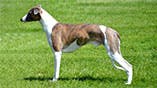 The name "Whippet" comes from the expression "whip it" meaning "move quickly" and this relatively small dog can reach speeds of up to 37 miles per hour in seconds.
They are a medium-sized sight hound that looks like a small Greyhound. Despite their power, everything about them is dainty and slender: long and lean head and muzzle, slender body and long, slim tail, often held between the back legs. Their coat is short and sleek and comes in all colours.
They originate in England and were bred in the nineteenth century as a small racing dog.
They are sweet natured but, like the Greyhound, very sensitive. They are also intelligent and, given sufficient exercise, will be quietly devoted and affectionate in the home. They may be wary of strangers but are fine with children as long as the child is not rough with them. They normally get on well with other dogs. They need opportunities to have a good run but have a natural urge to chase small mammals. They are also sensitive to cold so need a coat in winter.
Their short coat is easy to maintain with occasional brushing and combing and they have very little doggy smell. They are prone to upset stomach and skin problems.
The name "Whippet" comes from the expression "whip it" meaning "move quickly" and this relatively small dog can reach speeds of up to 37 miles per hour in seconds.
They are a medium-sized sight hound that looks like a small Greyhound. Despite their power, everything about them is dainty and slender: long and lean head and muzzle, slender body and long, slim tail, often held between the back legs. Their coat is short and sleek and comes in all colours.
They originate in England and were bred in the nineteenth century as a small racing dog.
They are sweet natured but, like the Greyhound, very sensitive. They are also intelligent and, given sufficient exercise, will be quietly devoted and affectionate in the home. They may be wary of strangers but are fine with children as long as the child is not rough with them. They normally get on well with other dogs. They need opportunities to have a good run but have a natural urge to chase small mammals. They are also sensitive to cold so need a coat in winter.
Their short coat is easy to maintain with occasional brushing and combing and they have very little doggy smell. They are prone to upset stomach and skin problems.
The name "Whippet" comes from the expression "whip it" meaning "move quickly" and this relatively small dog can reach speeds of up to 37 miles per hour in seconds.
They are a medium-sized sight hound that looks like a small Greyhound. Despite their power, everything about them is dainty and slender: long and lean head and muzzle, slender body and long, slim tail, often held between the back legs. Their coat is short and sleek and comes in all colours.
They originate in England and were bred in the nineteenth century as a small racing dog.
They are sweet natured but, like the Greyhound, very sensitive. They are also intelligent and, given sufficient exercise, will be quietly devoted and affectionate in the home. They may be wary of strangers but are fine with children as long as the child is not rough with them. They normally get on well with other dogs. They need opportunities to have a good run but have a natural urge to chase small mammals. They are also sensitive to cold so need a coat in winter.
Their short coat is easy to maintain with occasional brushing and combing and they have very little doggy smell. They are prone to upset stomach and skin problems.White Swiss Shepherd DogThe White Swiss Shepherd Dog or "Berger Blanc Suisse" has only been officially recognised by the Kennel Club in the UK since 2017.
The breed was initially a herding dog developed in Switzerland in the twentieth century.
They can be medium or long haired and (as the name suggests) they always have a white coat. They usually have a great temperament, and are loyal family pets that are friendly towards children. They are also lively and intelligent, and require plenty of exercise, stimulation and company if they are not to get bored. They can be very good at agility, obedience, flyball, tracking, herding and more.
They shed their hair throughout the year, with heavy shedding in response to temperature changes.
As with many working breeds, it's worth considering hip and elbow dysplasia tests with this breed, along with a number of other standard health tests.
The White Swiss Shepherd Dog or "Berger Blanc Suisse" has only been officially recognised by the Kennel Club in the UK since 2017.
The breed was initially a herding dog developed in Switzerland in the twentieth century.
They can be medium or long haired and (as the name suggests) they always have a white coat. They usually have a great temperament, and are loyal family pets that are friendly towards children. They are also lively and intelligent, and require plenty of exercise, stimulation and company if they are not to get bored. They can be very good at agility, obedience, flyball, tracking, herding and more.
They shed their hair throughout the year, with heavy shedding in response to temperature changes.
As with many working breeds, it's worth considering hip and elbow dysplasia tests with this breed, along with a number of other standard health tests. Yorkshire Terrier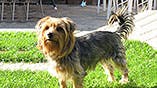 Original working Yorkshire Terriers, or "Yorkies" were much larger than the ones we see today but have been selectively bred to make a smaller dog suitable for women to carry as an attractive pet.
They are well-proportioned toy dogs. Their most noticeable feature is their coat. It is straight and silky and flows over their head (often held off the face in a top knot with a bow) and in a straight curtain to either side of their body. The coat on the body and tail is largely steel blue and the rest is tan.
They originate from the North of England where they were used to keep down the rat and mice population from mines and clothing factories.
Yorkies are intelligent and although a little wilful, are perfectly trainable. In the right hands, they are lively, courageous, loyal, playful and affectionate. They are only yappy, wary of strangers and unfriendly towards children and other animals if they are spoiled. However, they are not suitable for small children as the child may not take sufficient care to avoid hurting them. They are an active dog indoors but appreciate a daily walk outside too.
They need a good deal of brushing and combing to keep the coat looking at it's best and their teeth need to be checked regularly. Their little skeleton can be prone to a range of health issues such as problems with the spine and slipped stifle. They are also prone to bronchitis, eye infections, early tooth decay, poor tolerance of anesthetics, and digestive troubles. Dams often have trouble delivering puppies and sometimes need to have cesareans.
Original working Yorkshire Terriers, or "Yorkies" were much larger than the ones we see today but have been selectively bred to make a smaller dog suitable for women to carry as an attractive pet.
They are well-proportioned toy dogs. Their most noticeable feature is their coat. It is straight and silky and flows over their head (often held off the face in a top knot with a bow) and in a straight curtain to either side of their body. The coat on the body and tail is largely steel blue and the rest is tan.
They originate from the North of England where they were used to keep down the rat and mice population from mines and clothing factories.
Yorkies are intelligent and although a little wilful, are perfectly trainable. In the right hands, they are lively, courageous, loyal, playful and affectionate. They are only yappy, wary of strangers and unfriendly towards children and other animals if they are spoiled. However, they are not suitable for small children as the child may not take sufficient care to avoid hurting them. They are an active dog indoors but appreciate a daily walk outside too.
They need a good deal of brushing and combing to keep the coat looking at it's best and their teeth need to be checked regularly. Their little skeleton can be prone to a range of health issues such as problems with the spine and slipped stifle. They are also prone to bronchitis, eye infections, early tooth decay, poor tolerance of anesthetics, and digestive troubles. Dams often have trouble delivering puppies and sometimes need to have cesareans.
Original working Yorkshire Terriers, or "Yorkies" were much larger than the ones we see today but have been selectively bred to make a smaller dog suitable for women to carry as an attractive pet.
They are well-proportioned toy dogs. Their most noticeable feature is their coat. It is straight and silky and flows over their head (often held off the face in a top knot with a bow) and in a straight curtain to either side of their body. The coat on the body and tail is largely steel blue and the rest is tan.
They originate from the North of England where they were used to keep down the rat and mice population from mines and clothing factories.
Yorkies are intelligent and although a little wilful, are perfectly trainable. In the right hands, they are lively, courageous, loyal, playful and affectionate. They are only yappy, wary of strangers and unfriendly towards children and other animals if they are spoiled. However, they are not suitable for small children as the child may not take sufficient care to avoid hurting them. They are an active dog indoors but appreciate a daily walk outside too.
They need a good deal of brushing and combing to keep the coat looking at it's best and their teeth need to be checked regularly. Their little skeleton can be prone to a range of health issues such as problems with the spine and slipped stifle. They are also prone to bronchitis, eye infections, early tooth decay, poor tolerance of anesthetics, and digestive troubles. Dams often have trouble delivering puppies and sometimes need to have cesareans.